|
|
|
|
|
|
|
|
|
Cranston Fine Arts  Aviation Art and Artists World War Two Squadrons UK and Commonwealth No.41 Sqn to No.76 Sqn Aviation Art and Artists World War Two Squadrons UK and Commonwealth No.41 Sqn to No.76 Sqn  No.65 Sqn No.65 Sqn |
[UP] - No.41 Sqn - No.43 Sqn - No.44 Sqn - No.46 Sqn - No.49 Sqn - No.50 Sqn - No.54 Sqn - No.56 Sqn - No.57 Sqn - No.59 Sqn - No.61 Sqn - No.64 Sqn - No.65 Sqn - No.66 Sqn - No.68 Sqn - No.71 Sqn - No.73 Sqn - No.74 Sqn - No.75 Sqn RAAF - No.76 Sqn - No.76 Sqn RAAF |
Vi e tarmis - By force of arms
Flew Mustangs from December 1943.
| No.65 Sqn Aviation Art Prints, Paintings and Drawings Aviation Prints |
|
|
|
| Text for the above items : |
The Sky Warriors by Anthony Saunders. Sopwith Camel with 65 Squadron, on routine patrol, meet head-on with the unmistakable Albatross fighters of the German air force. |
Battle of Britain, Manston, 12th August 1940 by Gerald Coulson. A surprise dive bombing attack at 12.45pm as Spitfires of 65 squadron were taking off. 148 bombs were dropped on the airfield and hangars. The entire squadron got airborne with one exception, its engine was stopped by the blast from one of the bombs. |
High Pursuit by Ivan Berryman. Squadron Leader H C Sawyer is depicted here flying his 65 Sqn Spitfire Mk.1a R6799 (YT-D) in the skies above Kent on 31st July 1940 at the height of the Battle of Britain. Chasing him is Major Hans Trubenbach of 1 Gruppe, Lehrgeschwader 2 in his Messerschmitt Vf109E-3 (Red 12) . The encounter lasted eight minutes with both pilots surviving. |
| No.65 Sqn RAF Aircraft details |
DH.103 Hornet Manufacturer : de Havilland Built : 383 | DH.103 Hornet The Hornet prototype RR 915 first flew on 28 July 1944 with Geoffrey de Havilland Jr. at the controls. Powered by twin Merlin engines, it was the fastest twin piston-engined fighter in Royal Air Force service, a little slower than the fastest (single) piston-engined Supermarine Spiteful. The Hornet also has the distinction of being the second fastest wooden aircraft ever built, after the Heinkel He 162, and the second fastest operational twin propeller-driven aircraft — being slightly slower than the unconventional German Dornier Do 335 of 1945. The Hornet entered service in 1946 with 64 Squadron based at RAF Horsham St Faith. Next to convert to the Hornet was 19 Squadron at RAF Wittering, followed by 41 Squadron and 65 Squadron, both based at RAF Church Fenton. No. 65 Sqn was to participate in one of the first official overseas visits by an RAF unit when they visited Sweden in May 1948. Pilot conversion to the Hornet was provided by No. 226 Operational Conversion Unit (O.C.U.) which was based at RAF Molesworth. Operationally, the Hornet I (later F 1) was to last only a short time before being superseded by the F 3 version. The first Hornet F 3 was PX 366 which flew at the Farnborough Air Show in June 1946. New units to convert to this mark were 33 Squadron, 45 Squadron (based at RAF Tengah, Singapore where, in early 1952, the unit converted to the Hornet from the unreliable Bristol Brigand) and 80 Squadron. Along with 64 Sqn these squadrons operated in Malaysia where they replaced Beaufighters and Spitfires operating against Communist guerrillas during the Malayan Emergency. Armed with rockets and/or 1,000 lb (454 kg) bombs Hornets, with their long range and good endurance, were able to spend up to two hours loitering over the target area. They also proved to be very reliable; 45 Sqn Hornets, based in Singapore achieved 4,500 operational sorties over five years. The last operational Hornet sortie was flown on 21 May 1955. On 23 July 1954, two Hornets from RAF Kai Tak in Hong Kong were the first to arrive on the scene of a shootdown of a Cathay Pacific Skymaster off the coast of Hainan Island. All Hornets were withdrawn from operational service by mid-1956 | |
 Mustang Manufacturer : North American | Mustang The ubiquitous North American P-51 Mustang, which many consider to be the best all-around fighter of WW II, owes its origins to the British Air Ministry. Following Britains entry into WW II in 1939, the RAF was interested in purchasing additional fighter aircraft from American sources, particularly the Curtiss P-40. Curtiss, which was busy, was unable to guarantee timely delivery so the British approached North American Aviation as a possible second source for the P-40. North American chose to propose its own fighter design which would use the same Allison engine as the P-40. Utilizing new laminar flow wings, the North American fighter was expected to have performance better than the P-40. Developed in record time the new aircraft was designated as a Mustang I by the Brits, whereas the USAAF ordered two for evaluation which were designated XP-51 Apaches. Intrigued with the possibility of using this aircraft also as a dive bomber, North American proposed this to the USAAF which decided to order 500 of the P-51 aircraft to be modified for dive bombing use. Designated as the A-36 Invader, this version of the Mustang utilized dive flaps, and bomb racks under each wing. Some reinforcing of the structural members was also required because of the G-forces to be encountered in dive bombing. A-36s entered combat service with the USAAF prior to any P-51s. In early 1943 the 86th and 27th Fighter Bomber Groups of the 12th Air Force began flying A-36s out of Northern Africa. Despite some early problems with instability caused by the dive flaps, the A-36 was effective in light bombing and strafing roles. It was not, however, capable of dog fighting with German fighters, especially at higher altitudes. Despite these drawbacks one USAAF pilot, Captain Michael T. Russo, who served with the 16th Bomb Squadron of the 27th Fighter Bomber Group, was credited with five confirmed aerial victories in the A-36, thereby becoming the first mustang ace. | |
 Spitfire Manufacturer : Supermarine Built : 20351 | Spitfire Royal Air Force fighter aircraft, maximum speed for mark I Supermarine Spitfire, 362mph up to The Seafire 47 with a top speed of 452mph. maximum ceiling for Mk I 34,000feet up to 44,500 for the mark XIV. Maximum range for MK I 575 miles . up to 1475 miles for the Seafire 47. Armament for the various Marks of Spitfire. for MK I, and II . eight fixed .303 browning Machine guns, for MKs V-IX and XVI two 20mm Hispano cannons and four .303 browning machine guns. and on later Marks, six to eight Rockets under the wings or a maximum bomb load of 1,000 lbs. Designed by R J Mitchell, The proto type Spitfire first flew on the 5th March 1936. and entered service with the Royal Air Force in August 1938, with 19 squadron based and RAF Duxford. by the outbreak of World war two, there were twelve squadrons with a total of 187 spitfires, with another 83 in store. Between 1939 and 1945, a large variety of modifications and developments produced a variety of MK,s from I to XVI. The mark II came into service in late 1940, and in March 1941, the Mk,V came into service. To counter the Improvements in fighters of the Luftwaffe especially the FW190, the MK,XII was introduced with its Griffin engine. The Fleet Air Arm used the Mk,I and II and were named Seafires. By the end of production in 1948 a total of 20,351 spitfires had been made and 2408 Seafires. The most produced variant was the Spitfire Mark V, with a total of 6479 spitfires produced. The Royal Air Force kept Spitfires in front line use until April 1954. | |
| No.65 Sqn RAF Pilot and aircrew signature details |
Captain Murray Anderson DFC* Our estimated value of this signature : £20 Died : 2016 | Captain Murray Anderson DFC* Commissioned in the Royal Tank Regiment from RMA Woolwich in 1939, Murray Anderson was seconded to the Royal Air Force in 1940. He flew Spitfires with No.1 Photo Reconnaissance Unit at RAF Benson until 1943. He then joined 161 (Special Duties) Squadron flying Lysanders, and was the most successful pick up pilot for the whole of that year even though in May 1944 he was posted to 65 Squadron 2nd Tactical Air Force, flying Mustangs. After a rest period he was posted to 52 Sqn at Dum Dum in May 1945. Murray Anderson died in April 2016. | |
Flt. Lt. Arnold Cussons Our estimated value of this signature : £25 | Flt. Lt. Arnold Cussons Flt. Lt. Arnold Cussons joined the RAF in July 1940, but pilot training did not start until early 1941. After EFTS (DH82) and SFTS (Oxford) he was told he must be an Instructor. FIS at Cranwell, instructing at 14 SFTS Lyneham (then grass field!) then secondment to RNZAF at Christchurch until got back to UK September 1943. 8OTU (Dyce) then 540 Sqn, A flight, January 1944. Flew 62 operational flights including Damage Assessment of the Tirpitz just 3 hours after it was sunk by Lancasters. He returned to instructing in July 1945, first as Flt Cdr Mosquitoes at PRU's 8OTU then as CFI when Frank Dodd left. Arnold then went to the Empire Central Flying School as a Tutor. He left the RAF at end of 1949 after a time flying Hornets with 65 Sqn., Linton-on-Ouse near York. | |
Flight Lieutenant Roy Daines DFM Our estimated value of this signature : £50 | Flight Lieutenant Roy Daines DFM Roy Daines joined the RAF as soon as he was able, and after completing his hurried training as a pilot, was posted to join 247 Squadron in the autumn of 1940. Here he flew Gladiators and Hurricanes on coastal patrols, 247 being the only squadron to fly Gladiators during the Battle of Britain, before converting to nightfighting Hurricanes. Later, in 1943, he flew Typhoons with 247 before being posted to join 65 Squadron flying Spitfires and Mustangs. | |
  Sqn Ldr E D Glaser Our estimated value of this signature : £65 Died : 2001 | Sqn Ldr E D Glaser Ernest Derek Glaser, born 20th April 1921, was accepted for flight training in April 1939, following in his fathers footsteps, who had been a pilot in the Royal Flying Corps during the first world war. He joined No.65 Squadron at Hornchurch on 15th July 1940 as the Battle of Britain got underway. He became No.2 to his boyhood hero Jeffrey Quill. He was mistakenly shot down by a Royal Navy destroyer over the English Channel near Plymouth. After the Battle of Britain, Glaser joined No.53 OTU before subsequently joining No.243 Squadron. By 1943, he had been posted to Darwin in Australia, commanding No.549 Squadron. then No.548 Squadron until the end of the war. E D Glaser died aged 80 in November 2001. | |
 Flight Lieutenant Peter Hairs MBE Our estimated value of this signature : £50 Died : 2014 | Flight Lieutenant Peter Hairs MBE Peter Hairs joined the RAFVR in 1937, and was called up at the outbreak of war in September 1939 to complete his training. After being commissioned he converted to Hurricanes, joining 501 Squadron at Tangmere in January 1940. He went to France with the squadron in May, claiming a share in a Dornier Do17 a few days after arriving. 501 covered the evacuation of the BEF from Cherbourg before re-assembling in England. On the 3 June he was shot down, but fortunately not seriously hurt and two days later he rejoined the squadron at Le Mans. On the 5th of September he downed an Me109, Peter Hairs was posted to 15 FTS, Kidlington on October 13 1940 as an instructor. He went to 2 CFS, Cranwell for an instructors course on February 23 1941. after which he taught at 11 FTS, Shawbury and 10 EFTS, Weston-Super-Mare before being posted to Canada in June as a EFTS flying instructor and then assistant CFI (EFTS). In December 1943 he was posted to join 276 Squadron to 19 OTU. He finished the was in India, receiving a mention in dispatches. He died in 2014. | |
Group Captain Brian Kingcome DSO DFC Our estimated value of this signature : £65 Died : 1994 | Group Captain Brian Kingcome DSO DFC Brian Fabris Kingcome was born in Calcutta on May 31st 1917. Brian Kingcome was educated at Bedford and in 1936 entered the RAF College, Cranwell. Soon after he began his pilot course he was seriously injured in a car accident and was told by the RAF medical board that he would never fly again as he was expected to suffer permanent double vision. But after months in hospital and with Brians strength of character he proved the board wrong. In 1938 he was posted to No 65, a biplane Gladiator fighter squadron based at Hornchurch. Brian Kingcome took part in the Battles of France and Dunkirk but transferred to 92 Squadron as a flight commander and flying Spitfires in May 1940 scoring his first victories in June 1940. Brian Kingcome became acting commanding officer during the latter stages of the Battle of Britain. During this time he and his pilots achieved the highest success rate of any squadron in the entire Battle of Britain. After being shot down by Me109s and wounded, he returned to active operations. In February 1942 he was posted to command 72 Squadron, followed by promotion to Wing Leader at Kenley. In May 1943 he was posted to lead 244 Wing in the Mediterranean during the invasion of Sicily. An Ace, Brian Kingcome flew Spitfires in combat continually until the end of 1944, his tally finishing at 8 and 3 shared destroyed, plus a score of probables and damaged. One of the prewar Cranwell elite, Brian Kingcome was to become one ofthe Second World Wars great fighter leaders, alongside such immortals as Douglas Bader, Bob Stanford Tuck and Johnnie Johnson. At the outbreak of war he was serving in 65 Squadron, but in May 1940 was posted to 92 Squadron as flight commander. On 25 May he shared a Do 17 and on 2 June destroyed two He l l Is and damaged a third. He shared a Ju 88 with two others on I0 July, and again on the 24th. On 9 September he probably destroyed a Bf 110 and two days later shot down a He 111. On the 14th he damaged another. He shot down a Bf 109 on the 23rd and next day probably destroyed another and damaged a Ju 88. Three days later he shared a Ju 88 again, damaged two others, probably destroyed a Do 17, and damaged one of these also. Around this time he was awarded a DFC for six victories, and on 11 October got a Bf 109 He claimed another next day, and also damaged one. In 1941 he became commanding officer, having frequently led the squadron. It will be noted that he claimed many probables and damaged during the Battle of Britain, and this was due to his view that it was more important to hit as many as possible than to try and confirm victories. On 16 June 1941 lie probably destroyed a Bf 109, and on 24 July shot one down. He was then rested until late in the year, when he was posted to command 72 Squadron, and in February 1942 gave escort cover to the Fleet Air Arm pilot Eugene Esmonde, who won the VC trying to attack German capital ships Scharnhorst and Gneisenau and and the cruiser Prinz Eugen with Swordfish during the Channel Dash. In atrocious weather Kingcome caught a fleeting glimpse of tbe Scharnhorst - Oh what a beautiful battleboat! he exclaimed, just as a shell made a hole the size of a dustbin lid in his port wing. During 1941 he received a Bar to his DFC, having brought his score to 10. He was promoted to lead the Kenley wing, and on 15 April 1942 damaged a Fw 190. He probably destroyed a Bf 109 on 28 May, and during the year was awarded a DSO, having added another victory to his score. In 1943 he was posted to North Africa to lead 244 Wing, and lead this for 18 months, becoming a Gp. Capt. after the invasion of Italy. By the end of his stay with the wing he had brought his score to 18, and was then posted as SASO of a Liberator group, and flew an operation as a waist gunner over northern Yugoslavia after taking up this appointment. Sadly Group Captain Brian Kingcome passed away aged 76 in 1994. | |
  Jeffrey Quill, OBE, AFC, FRAeS Our estimated value of this signature : £80 Died : 1996 | Jeffrey Quill, OBE, AFC, FRAeS Jeffrey Quill was born at Littlehampton in Sussex in 1913, the youngest of five children. He was educated at Lancing College, overlooking Shoreham aerodrome (then a small grass field with old hangars and a wooden hut for the flying club). The frequent sight of aircraft at close quarters increased Quill's already burning interest in aviation, and after leaving Lancing in 1931 he was accepted into the Royal Air Force at the age of 18, as an acting Pilot Officer. He learned to fly on Avro Tutor biplanes, and went solo after only 5 hours 20 minutes - well below the usual 9 hours. In September 1932 he joined No.17 (Fighter) Squadron at Upavon, where he flew Bristol Bulldogs. He was then posted to Duxford, to the RAF Meteorological Flight, where they flew open-cockpit Siskins to heights of up to 25,000 feet to collect weather data. In November 1934 Quill became Flight Commander, and set out with his team to achieve 100 per cent regularity in the scheduled climbs (twice every day, except Sundays, at 0700 and 1300 hrs) without missing a single flight, even in 'unflyable' weather. For this outstanding achievement he was awarded the Air Force Cross. In January 1936 Jeffrey Quill became assistant to Mutt Summers, the chief test pilot at Vickers (Aviation) Ltd., and his initial task was the testing of the Wellesley bomber. On 26 March 1936 Quill made his first flight in the prototype Spitfire K5054. Much work was needed on the Spitfire before it was eventually cleared for squadron service in July 1938. Jeffrey Quill spent the entire war in charge of development and production flying, but insisted on having first-hand combat experience, and in August 1940 he was assigned to 65 (Spitfire) Squadron at RAF Hornchurch. During that month he shot down a Me109, and shared in a Heinkel He111 before being recalled to Supermarine to test the Spitfire Mk III. The Seafire, the naval version of the Spitfire used by the Fleet Air Arm, was suffering enormous losses in deck landing accidents. During 1944 Quill spent five months with the Royal Navy, and made more than 75 deck landings. By the end of the war, he had personally test-flown all 50-odd variants of Spitfire and Seafire. His personal favourite was the Spitfire Mk VIII. Jeffrey Quill continued as chief test pilot after the war, when Vickers - ever on the cutting edge of development - produced Britain's third jet aircraft, the Attacker. On 27 July 1946 Quill made the first flight from Boscombe Down, and continued to undertake the testing, until one day the following June he passed out at about 40,000 feet. Fortunately he recovered at about 10,000 ft, in time to land safely. Quill had been flying continuously for 16 years, often at high altitude and without oxygen. He had logged over 5000 hours and flown more than 95 aircraft types. Jeffrey Quill died at Andreas, Isle of Man, on 20 February 1996. | |
 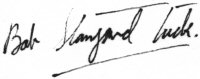 Wing Commander Bob Stanford Tuck DSO DFC** Our estimated value of this signature : £85 Died : 1987 | Wing Commander Bob Stanford Tuck DSO DFC** Bob Stanford Tuck was a flamboyant fighter pilot, his dashing good looks, courage, and success in the air coming to epitomise the young flyers who fought and won the Battle of Britain. To the British public he was a hero in the mould of the knights of old, and today his name is legend. In the early stages of the Battle of Britain Bob fought with 92 Squadron flying Spitfires, quickly becoming one of the leading aces. Promoted to command 257 Squadron, now flying Hurricanes, Bobs dashing style of leadership inspired his pilots to great success. He went on to command the Duxford and Biggin Hill Wings, taking his personal score to 29 air victories before being shot down by ground fire over Northern France in 1942. He died on 5th May 1987. | |
| Aces for : No.65 Sqn RAF | ||
| A list of all Aces from our database who are known to have flown with this squadron. A profile page is available by clicking the pilots name. | ||
| Name | Victories | Info |
| John Inglis Gilmour | 39.00 | |
| Robert Stanford-Tuck | 29.00 | The signature of Robert Stanford-Tuck features on some of our artwork - click here to see what is available. |
|
Contact Details |
Sign Up To Our Newsletter!
This website is owned by Cranston Fine Arts. Torwood House, Torwoodhill Road, Rhu, Helensburgh, Scotland, G848LE Contact: Tel: (+44) (0) 1436 820269. Email: cranstonorders -at- outlook.com
|


