|
|
|
|
|
|
|
|
|
Cranston Fine Arts  Aviation Art and Artists World War Two Squadrons UK and Commonwealth No.41 Sqn to No.76 Sqn Aviation Art and Artists World War Two Squadrons UK and Commonwealth No.41 Sqn to No.76 Sqn  No.61 Sqn No.61 Sqn |
[UP] - No.41 Sqn - No.43 Sqn - No.44 Sqn - No.46 Sqn - No.49 Sqn - No.50 Sqn - No.54 Sqn - No.56 Sqn - No.57 Sqn - No.59 Sqn - No.61 Sqn - No.64 Sqn - No.65 Sqn - No.66 Sqn - No.68 Sqn - No.71 Sqn - No.73 Sqn - No.74 Sqn - No.75 Sqn RAAF - No.76 Sqn - No.76 Sqn RAAF |
Per prurum tonantes - Thundering through the clear sky
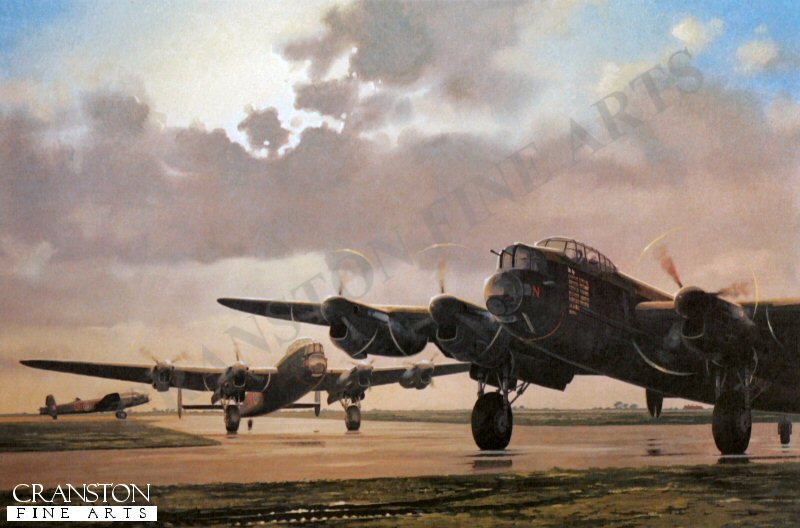
On July 1917 at RAF Rochford in Essex No.61 Squadron was formed and along with two other squadrons formed the London Air Defence Area intended to counter the daylight air raids. 61 squadron was equipped with the Sopwith Pup. The squadron first went into action on 12 thAugust, when a formation of 10 German Gotha bombers were seen over the Thames. Sixteen Sopwith Pups of No.61 Squadron took off to intercept them and succeeded in turning the enemy back, but not before two bombs had been dropped near No.61s hangars on Rochford Aerodrome. In 1918, 61 squadron was re-equipped with SE5s. When the armistice had been signed and the war was over 61 squadron was disbanded on 13th June 1919. No. 61 Squadron was re-formed on 8th March 1937 as a bomber squadron, and initially flying Hawker Audax, then the Avro Anson, followed by the Bristol Blenheim and during World War II flew with No. 5 Group, Bomer Command flying the Handley Page Hampden. The squadrons first operational mission was on 25th December 1939. The squadron then was equipped with the Avro Manchester. The slow delivery of the Manchester meant that the squadron operated both aircraft from July 1941 when the first Manchesters arrived, through to October 1941 when the use of the last of the Hampdens stopped. The squadron struggled on with the Manchester before converting to the Avro Lancaster in 1942, which 61 squadron flew for the rest of the war. Four of its Lancasters; ED860 N-Nan, EE176, JB138, and LL483, each served on more than 100 operational sorties. Records show that in the case of the first three aircraft, the long road to their centuries included participation in the raid on 3/4 November 1943, when Flt Lt William Reid of No. 61 Squadron won the Victoria Cross. After the war No. 61 Squadron re-equipped with Avro Lincolns in May 1946 and saw action in Malaya during Operation Firedog and during the Mau Mau uprising in Kenya. In 1954 at RAF Wittering, 61 Squadron was equipped with the new English Electric Canberra. The Canberras of the squadron were used during the Suez Crisis in 1956. Finally on March 31st 1958, 61 squadron wasd disbanded.
| No.61 Sqn Aviation Art Prints, Paintings and Drawings Aviation Prints |
|
|
|
|
| Text for the above items : |
Lancaster BIIIs of 61 Sqn RAF by Keith Woodcock. No text for this item |
No Turning Back by Robert Taylor. A Lancaster of No. 61 Squadron, RAF, piloted by Flt. Lt. Bill Reid, under attack from a German Fw190 en route to Dusseldorf on the night of November 3rd, 1943. Already injured in a previous attack, Bill Reid was again wounded but pressed on for another 50 minutes to bomb the target, then fly his badly damaged aircraft on the long journey home. The courage and devotion to duty that earned Bill Reid the Victoria Cross, was a hallmark of RAF bomber crews throughout their long six year campaign. |
Lancaster VC by Graeme Lothian. Lancasters of 61 Squadron head out for the enemy coast during the night of 3rd November 1943. Seen in the lead Lancaster is Flt Lt Bill Reid flying QR-O. After sustaining two heavy attacks by enemy night fighters, killing two crew members and injuring Reid in the head, shoulders and hands. He carried on to the target, dropping accurately his bomb load. Navigating back by Pole Star and Moon, he lost consciousness on occasions due to blood loss. He managed to find his way Shipdharn. Upon landing the undercarriage collapsed but luckily did not catch fire. For his exploits that night he was awarded the Victoria Cross. |
Bill Reid VC by Graeme Lothian. (P) Lancaster LM360, piloted by Bill Reid, is raked by fire from stem to stern by a Luftwaffe Fw190 fighter. Bill Reid had already sustained injuries to his head, torso and hands from a previous attack by an Me110, but, with this rest of his crew unscathed from the previous attack, he had not mentioned his injuries. In the attack depicted here, the Fw190 makes a lethal attack on the already damaged bomber, killing one crew member and fatally wounding a second. Despite this, Bill Reid flew on to his target of Dusseldorf - a further 200 miles - successfully dropped his bombs, then turned for home. With the aid of the bomb aimer and flight engineer, the Lancaster made it across the Channel and headed for an airfield, with one leg of the damaged undercarriage failing on landing. Bill Reid was awarded the Victoria Cross for this mission. |
| No.61 Sqn RAF Aircraft details |
 Blenheim Manufacturer : Bristol Built : 4422 | Blenheim The Bristol Blenheim, the most plentiful aircraft in the RAFs inventory when WWII began, was designed by Frank Barnwell, and when first flown in 1936 was unique with its all metal monoplane design incorporating a retractable undercarriage, wing flaps, metal props, and supercharged engines. A typical bomb load for a Blenheim was 1,000 pounds. In the early stages of the war Blenheims were used on many daylight bombing missions. On the day that war was declared on Germany, a Blenheim piloted by Flying Officer Andrew McPherson was the first British aircraft to cross the German coast and the following morning 15 Blenheims from three squadrons set off on one of the first bombing missions The Blenheim units operated throughout the battle, often taking heavy casualties, although they were never accorded the publicity of the fighter squadrons. The Blenheim units raided German occupied airfields throughout July to December 1940, both during daylight hours and at night. Although most of these raids were unproductive, there were some successes; on 1 August five out of 12 Blenheims sent to attack Haamstede and Evere (Brussels) were able to bomb, destroying or heavily damaging three Bf 109s of II./JG 27 and apparently killing a Staffelkapitän identified as Hauptmann Albrecht von Ankum-Frank. Two other 109s were claimed by Blenheim gunners. Another successful raid on Haamstede was made by a single Blenheim on 7 August which destroyed one 109 of 4./JG 54, heavily damaged another and caused lighter damage to four more. There were also some missions which produced an almost 100% casualty rate amongst the Blenheims. One such operation was mounted on 13 August 1940 against a Luftwaffe airfield near Aalborg in north-western Denmark by 12 aircraft of 82 Squadron. One Blenheim returned early (the pilot was later charged and due to appear before a court martial, but was killed on another operation); the other 11, which reached Denmark, were shot down, five by flak and six by Bf 109s. Blenheim-equipped units had been formed to carry out long-range strategic reconnaissance missions over Germany and German-occupied territories, as well as bombing operations. In this role, the Blenheims once again proved to be too slow and vulnerable against Luftwaffe fighters and they took constant casualties While great heroism was displayed by the air crews, tremendous losses were sustained during these missions. The Blenhiem was easy pickings at altitude for German Bf-109 fighters who quickly learned to attack from below. To protect the vulnerable bellies of the Blenheims many missions were shifted to low altitude, but this increased the aircrafts exposure to anti-aircraft fire. In the German night-bombing raid on London on 18 June 1940, Blenheims accounted for five German bombers, thus proving that they were better-suited for night fighting. In July, No. 600 Squadron, by then based at RAF Manston, had some of its Mk IFs equipped with AI Mk III radar. With this radar equipment, a Blenheim from the Fighter Interception Unit (FIU) at RAF Ford achieved the first success on the night of 2–3 July 1940, accounting for a Dornier Do 17 bomber. More successes came, and before long the Blenheim proved itself invaluable as a night fighter. One Blenheim pilot, Squadron Leader Arthur Scarf, was posthumously awarded the Victoria Cross for an attack on Singora, Thailand, on 9 December 1941. Another bomber of No. 60 Squadron RAF was credited with shooting down Lt Col Tateo Katō's Nakajima Ki-43 fighter and badly damaging two others in a single engagement on 22 May 1942, over the Bay of Bengal. Katō's death was a severe blow to the Imperial Japanese Army Air Force. |
 Hampden Manufacturer : Handley Page Built : 1500 | Hampden The Handley Page HP.52 Hampden was a twin-engine medium bomber built for the Royal Air Force and was used by Bomber Command in the early years of world war two. Along with the other medium bombers the Whitley and Wellington, the Hampden bore the brunt of the early bombing war over Europe, taking part in the first night raid on Berlin and the first 1,000-plane raid on Cologne. The newest of the three medium bombers, the Hampden was known as the Flying Suitcase because of its cramped crew conditions. A total of 226 Hampdens were in service with eight Royal Air Force squadrons by the start of the Second World War. Despite its speed and agility, in operational use the Hampden was no match for the fighters of the Luftwaffe (ME109 and FW 190) and the Hampdens role as a day bomber was brief, but Hampdens continued to operate at night on bombing raids over Germany and in mine laying (code-named gardening) in the North Sea. Almost half of the Hampdens built – 714, were lost on operations, witht he loss of 1,077 crew killed and another 739 missing. German flak accounted for 108; with one Hampden being lost due to German Barrage balloons; 263 Hampdens crashed due to a variety of causes, and 214 others were classed as missing. Luftwaffe pilots claimed 128 Hampdens, shooting down 92 at night. The Hampden soon became obsolete for its roll as a medium modern bomber, after operating mainly at night, it was retired from Bomber Command service in late 1942. but continued with Coastal Command throughout 1943 as a long-range Torpedo Bomber (the Hampden TB Mk I which carried the Mk XII torpedo in an open bomb-bay and a single 500 lb (230 kg) bomb under each wing) The Hampden was also used by the Royal Canadian Air Force and Royal New Zealand Air Force. |
 Lancaster Manufacturer : Avro Built : 7377 | Lancaster The Avro Lancaster arose from the avro Manchester and the first prototype Lancaster was a converted Manchester with four engines. The Lancaster was first flown in January 1941, and started operations in March 1942. By March 1945 The Royal Air Force had 56 squadrons of Lancasters with the first squadron equipped being No.44 Squadron. During World War Two the Avro Lancaster flew 156,000 sorties and dropped 618,378 tonnes of bombs between 1942 and 1945. Lancaster Bomberss took part in the devastating round-the-clock raids on Hamburg during Air Marshall Harris' "Operation Gomorrah" in July 1943. Just 35 Lancasters completed more than 100 successful operations each, and 3,249 were lost in action. The most successful survivor completed 139 operations, and the Lancaster was scrapped after the war in 1947. A few Lancasters were converted into tankers and the two tanker aircraft were joined by another converted Lancaster and were used in the Berlin Airlift, achieving 757 tanker sorties. A famous Lancaster bombing raid was the 1943 mission, codenamed Operation Chastise, to destroy the dams of the Ruhr Valley. The operation was carried out by 617 Squadron in modified Mk IIIs carrying special drum shaped bouncing bombs designed by Barnes Wallis. Also famous was a series of Lancaster attacks using Tallboy bombs against the German battleship Tirpitz, which first disabled and later sank the ship. The Lancaster bomber was the basis of the new Avro Lincoln bomber, initially known as the Lancaster IV and Lancaster V. (Becoming Lincoln B1 and B2 respectively.) Their Lancastrian airliner was also based on the Lancaster but was not very successful. Other developments were the Avro York and the successful Shackleton which continued in airborne early warning service up to 1992. |
Lincoln Manufacturer : Avro Built : 624 | Lincoln he first RAF Lincolns joined No. 57 Squadron at East Kirby in 1945. No. 75 (New Zealand) Squadron RAF began re-equipping with Lincolns at RAF Spilsby during August 1945. However, 75 (NZ) Sqn received just three aircraft before VJ Day. In the postwar Royal Air Force, the Lincoln equipped many bomber squadrons. Nearly 600 Lincolns were built to equip 29 RAF squadrons, mainly based in the United Kingdom. They were partially replaced by 88 Boeing Washingtons, on loan from the USAF, which had longer range and could reach targets inside the Iron Curtain. Small numbers remained in use with Nos 7, 83 and 97 Squadrons until the end of 1955, when they were replaced by the first of the V bombers. RAF Lincolns were used in combat during the 1950s, in Kenya against the Mau-Mau, operating from Eastleigh, and also served in Malaya during the Malayan Emergency, against insurgents aligned to the Malayan Communist Party. In Malaya, Lincolns operated from Changi and Tengah, More than 3,000 sorties were flown during their 7 1⁄2-year deployment, with half a million pounds of bombs dropped. This equated to 85% of the bomb tonnage dropped during the Malayan emergency. On 12 March 1953, a RAF Lincoln (RF531 "C") of Central Gunnery School was shot down 20 mi (32 km) NE of Lüneburg, Germany by several Soviet MiG-15s as it flew to Berlin on a radar reconnaissance flight, resulting in the deaths of the seven crew members. In November 1955, four Lincolns of No. 7 Squadron RAF were detached for duties in British territories in the Middle East. In Bahrain, they carried out border patrols of the then Trucial States. When 7 Sqn was disbanded in December 1955, the four detached crews and aircraft became No. 1426 Flight RAF, officially a photographic reconnaissance unit. It was later sent to Aden, carrying out patrols in the lead up to the Aden Emergency. As the RAF Lincolns became unserviceable due to wear and tear, they were replaced by jet aircraft. The Lincolns of Bomber Command were phased out from the mid-1950s and were completely replaced by jet bombers by 1963. The last Lincolns in RAF service were five operated by No. 151 Squadron, Signals Command, at RAF Watton, Norfolk, which were retired on 12 March 1963. From late 1946, Australian-built Lincolns were phased into No. 82 Wing RAAF at RAAF Amberley, replacing the Consolidated Liberators operated by 12, 21 and 23 Squadrons. In February 1948, these units were renumbered 1, 2 and 6 Squadrons respectively; a fourth RAAF Lincoln squadron, No. 10 was formed on 17 March 1949 at RAAF Townsville as a reconnaissance unit. RAAF Lincolns took part in operations in Malaya in the 1950s, operating alongside RAF examples. The RAAF based the B.Mk 30s of No.1 Squadron at Tengah, for the duration of operations in Malaya. The RAAF Lincolns were retired in 1961, with the MR.Mk 31s of No. 10 Squadron being the final variant to see service in Australia. |
 Manchester Manufacturer : Avro | Manchester No profile available |
 Spitfire Manufacturer : Supermarine Built : 20351 | Spitfire Royal Air Force fighter aircraft, maximum speed for mark I Supermarine Spitfire, 362mph up to The Seafire 47 with a top speed of 452mph. maximum ceiling for Mk I 34,000feet up to 44,500 for the mark XIV. Maximum range for MK I 575 miles . up to 1475 miles for the Seafire 47. Armament for the various Marks of Spitfire. for MK I, and II . eight fixed .303 browning Machine guns, for MKs V-IX and XVI two 20mm Hispano cannons and four .303 browning machine guns. and on later Marks, six to eight Rockets under the wings or a maximum bomb load of 1,000 lbs. Designed by R J Mitchell, The proto type Spitfire first flew on the 5th March 1936. and entered service with the Royal Air Force in August 1938, with 19 squadron based and RAF Duxford. by the outbreak of World war two, there were twelve squadrons with a total of 187 spitfires, with another 83 in store. Between 1939 and 1945, a large variety of modifications and developments produced a variety of MK,s from I to XVI. The mark II came into service in late 1940, and in March 1941, the Mk,V came into service. To counter the Improvements in fighters of the Luftwaffe especially the FW190, the MK,XII was introduced with its Griffin engine. The Fleet Air Arm used the Mk,I and II and were named Seafires. By the end of production in 1948 a total of 20,351 spitfires had been made and 2408 Seafires. The most produced variant was the Spitfire Mark V, with a total of 6479 spitfires produced. The Royal Air Force kept Spitfires in front line use until April 1954. |
| No.61 Sqn RAF Pilot and aircrew signature details |
Wing Commander Arthur Doubleday DSO DFC MID Our estimated value of this signature : £10 | Wing Commander Arthur Doubleday DSO DFC MID Flying Wellingtons then Lancasters on his 1st tour, Arthur Doubleday began his second tour on Lancasters at Waddington with 467 Sqn RAAF. From April 1944 he commanded 61 Sqn RAF Lancasters. He finished the war as Chief Instructor 75 OTU. |
 Warrant Officer Ken Johnson Our estimated value of this signature : £35 | Warrant Officer Ken Johnson As a Mid-Upper Gunner he flew on Lancasters with 9 and 61 Squadrons taking part in many raids including the final attack to sink the Tirpitz in November 1944 along with attacks on Berchtesgaden, Hitlers alpine home. |
  Flying Officer Bill North Our estimated value of this signature : £40 Died : 2011 | Flying Officer Bill North Flying Lancasters with 61 Squadron, in 1944 he was shot down over Northern France. With his aircraft badly hit, he gave the order to bale out, but as some of the crew had damaged parachutes, he elected to stay with the aircraft and crash land. Despite being badly wounded, he managed to land his Lancaster at night, and every crewmember walked away - two of them evading capture and returned to England. Bill spent the rest of the war as a POW. |
  Flight Lieutenant Bill Reid VC Our estimated value of this signature : £80 Died : 2001 | Flight Lieutenant Bill Reid VC Volunteering for RAF aircrew in 1940, Bill Reid learned to fly in California, training on the Stearman, Vultee and Harvard. After gaining his pilots wings back in England he flew Wellingtons before moving on to Lancasters in 1943. On the night of Nov 3rd 1943, his Lancaster suffered two severe attacks from Luftwaffe night fighters, badly wounding Reid, killing his navigator and radio operator, and severely damaging the aircraft. Bill flew on 200 miles to accurately bomb the target and get his aircraft home. For this act of outstanding courage and determination he was awarded the Victoria Cross. Died 28th November 2001. |
Flt Lt B S Turner DFC Our estimated value of this signature : £10 | Flt Lt B S Turner DFC Volunteered for the RAF in 1940 and trained as a Heavy Bomber pilot flying Tiger Moths, Airspeed Oxfords and Wellingtons at Hatfield, South Cerney and Pershore respectively. His first operational posting was to a grass field aerodrome at Feltwell where he flew Wellingtons with 75 NZ Sqn. After a tour of 37 trips mainly over Germany he then spent two and a half years as 'taxi driver' with various navigation training flights and some two years later was posted to 61 Sqn at Skellingforth for a second tour of ops flying Lancasters - flying N for Nan on her 100th trip. After 21 ops he went to T.R.E. Defford as an experimental pilot. At that time the Air Force was preparing Tiger Force for the invasion of Japan, but because of the atomic bomb being dropped the invasion did not take place. Flying at Defford was with radar boffins testing their various offensive and defensive radar equipment in about ten different types of aircraft. In 1946 Fly Lt Turner left the Air Force. |
Flight Lieutenant Murray Vagnolini Our estimated value of this signature : £10 | Flight Lieutenant Murray Vagnolini Completing his first tour as a Wireless Operator with 61 Sqn, he flew with 617 Sqn dropping the 12,000 lb 'Tallboy' and 22,000 lb 'Grand Slam' bombs. The war ended halfway through his second operational tour. |
Flight Lieutenant Murray Valentine Our estimated value of this signature : £10 | Flight Lieutenant Murray Valentine Completing his first tour as a Wireless Operator with 61 Sqn, he flew with 617 Sqn dropping the 12,000 lb Tallboy and 22,000 lb Grand Slam bombs. The war ended halfway through his second operational tour. |
  Wing Commander Jim Wright DFC Our estimated value of this signature : £40 Died : 2019 | Wing Commander Jim Wright DFC Upon completing his training in 1943 Jim Wright joined 61 Sqn at Syerston as a Navigator on Lancasters and served in the crew of Flight Lieutenant Ken Ames DFC and Bar. After completing 5 operations with 61 Sqn, F/L Ames and crew were posted to East Kirkby to join the newly formed 630 Squadron. After a brief spell in hospital, after a trip to Kassel on the 22 October 1943 and after completing 22 operations with 630 Squadron, Jim Wright joined 97 (Pathfinder) Squadron at Coningsby for the commencement of their 2nd tour. Jim and the crew completed 16 operations with 97 squadron with their last operation was on the 19th of September 1944. In January 1944 they completed trips to Stettin, Brunswick, Magdeburg and 4 to Berlin. Their next trip to Berlin was on 15th February 1944 followed by operations to Leipzig, Stuttgart and Augsburg. In March they went to Stuttgart, Charmand-Ferront, Stuttgart, Frankfurt and Nuremburg. In April to Toulouse, Pillau Canal (Konigsberg), Tours and Juvisy. In May, to finish their first tour, they went to Bourg. Following completion of operational duties with 97 Squadron Jim Wright was seconded to BOAC and served as an Operations Officer at Hurn and Heathrow in1945 until being demobed in October 1946. Then Jim worked for BOAC 1946 until December 1950 as an Air Traffic Control Officer (ATCO) in British West Africa (Yundum & Half Die, Gambia) and as a Flight Operations Officer at Prestwick and Heathrow before rejoining the RAF 1951 for ATCO duties until he retired in 1976. He died on 2nd June 2019. |
|
Contact Details |
Sign Up To Our Newsletter!
This website is owned by Cranston Fine Arts. Torwood House, Torwoodhill Road, Rhu, Helensburgh, Scotland, G848LE Contact: Tel: (+44) (0) 1436 820269. Email: cranstonorders -at- outlook.com
|