|
|
|
|
|
|
|
|
|
Cranston Fine Arts  Military Art and Artists Napoleonic Military Art Military Art and Artists Napoleonic Military Art  Napoleonic Print List Napoleonic Print List |
| Navigation | |
| Page 6 of 24 | Previous .. Page 6 .. Next |
|
|
|
|
|
|
|
|
|
|
|
|
|
|
|
|
|
|
|
|
|
| Navigation | |
| Page 6 of 24 | Previous .. Page 6 .. Next |
| Text for the above items : |
Napoleon Awarding the Legion of Honour by Richard Caton Woodville. No text for this item |
Retreat to Corunna by Richard Beavis General John Moore reading dispatches during the retreat from Salamanca to Corunna in January 1809. The weather was hazardous with British soldiers forced to cross over the mountains of Leon and Galicia in harsh and bitter conditions |
The Night of Victory at Belle-Alliance by Richard Knotel. Historical art print showing the Prussian Lutzows Lancers of the Prussian Army escort a Prussian Infantry Drummer who is mounted on one of Napoleons Horses of the Emperors retinue. During the evening of the battle of Waterloo. |
Capture of the French Eagle by Sgt Ewart by Sulliven. Sgt Ewart is shown taking the French standard from the 45th French Infantry Regiment. Ewart cut down two French soldiers and the standard Bearer to keep hold of the Eagle and standard, he was ordered to take it to the rear. By being ordered to the rear, this probably saved his life and also the standard for the regiment, as the rest of the regiment continued charging forward to French artillery positions, much further than they should have gone, now with very tired horses and unable to rally, the Scots Greys were attacked by Farines Brigade of Cavalry (6th and 9th Cuirassiers.) and later by the 4th Lancers, very few managed to return to the British Lines. |
La Charge (Donop's Cavalry at Waterloo) by Mark Churms. Baron de Donops Brigade at the Battle of Waterloo, 5.30pm, 18th June 1815. After four hours of fighting, the squadrons of Napoleon's 3rd Cavalry Corps finally join the massed assaults on the battered allied infantry squares. With the 42 year old marechal de camp Frederic-Guillaume de Donop at their head, the 2nd and 3rd Cuirassier Regiments break from a trot into a canter as they clear the ridge. The heavy cavalry are smashed against the steadfast bayonets of the redcoats and countercharged by light horsemen. In one of these encounters the general himself is terribly wounded and falls from his horse. His son (aide-de-camp) is also injured. Both are reported missing and presumed captured. Although the general's body is not found,it is certain that he met his death in the muddy fields of Waterloo alongside many of his brigade. In 1895 his name is inscribed on the north face of L'Arc de Triomphe in Paris in recognition of his service to France. |
Officier de Cuirassier by Jean Louis Ernest Meissonier. This is the study of the Cuirassier officer from the painting Cuirassiers Before the Charge at the Battle of Austerlitz. |
The Captive Eagle by J P Beadle. Corporal Styles of the 1st Royal Dragoons displays a captured French Eagle to the cheering Black Watch. Behind him can be seen Wellington. |
The Whole Line Will Advance by Edgar Holloway (PC) The Duke of Wellington giving the order for the final movement at the Battle of Waterloo. |
The Battle of Waterloo at 8p.m. by Sir William Allen. Showing the battle from Wellingtons position after the advance of the guards with the French troops retreating. Also shown in the image, Hougoumont farm and British Artillery. |
La Vedette Des Dragons Sous Louis XV by Jean Louis Ernest Meissonier. A scout of the French Dragoons in the uniform of the time of the Austrian Succession and Seven Years War. |
Cameron Highlanders in Square at Waterloo by Richard Simkin. No text for this item |
Sabres on the Esla Pursuit of the Imperial Guard at the Battle of Benevente by Mark Churms. Sir John Moores epic retreat to Corunna was punctuated by desperate and often heroic rear-guard actions - none more dramatic than the cavalry clash at Benevente on the 29th December 1808. Having crossed the river Esla, cold and swollen by recent rainfall, a British picquet, comprised of elements of the Kings German Legion Hussars and the 7th, 10th and 18th Hussars, covers the river and its tactically demolished Castro Gonzalos bridge from a position near the town of Benevente. Napoleon himself leads the pursuit. The Emperors elite Guard Light Cavalry, commanded by General Lefebvre-Desnouettes, is ordered at daylight to ford the river and launch a surprise attack on what appears to be the numerically inferior British units. As five-hundred and fifty French cavalry emerge in orderly fashion from the river, intent upon quickly dispatching the opposition, they are startled to find the British piquet, reinforced by a host of British cavalry, streaming from within the confines of Benevente, some on their left flank. Under the command of Lord Paget, the British become the pursuers of the surprised French, who turn and retreat with the frigid waters of the Esla blocking their escape. Unlike their crossing in echelon just minutes before, the French now in disorder plunge into the river, where many drown. Others are captured including General Lefebvre-Desnouettes who is made prisoner by Grisdale of the 10th Hussars following a dramatic pursuit. General Lefebvre-Desnouettes will eventually escape from captivity in England, to encounter Lord Paget once again on the field of Waterloo. |
La Garde Recule! by Robert Alexander Hillingford La Garde Recule! For the first time in decades of war. Napoleons elite force the Imperial Guard, retreats - but likely only the assembled prior to waterloo 3e and 4e Regiments. |
The 95th Rifle Brigade at the Battle of Fuentes De Onoro, 5th May 1811 by Chris Collingwood. The Duke of Wellington was blockading the fortress of Ciudad Rodrigo with 32,000 troops. The French sent a force of 45,000 troops under Marshal Andre Massena to relieve the fortress. Wellington took up a strong position at Fuentos DOnoro and the French attacked on May 5th with superior numbers. The British army held their ground with the cost of 1,500 casualties, the French suffered higher losses of 2,200 troops and finally withdrew. The Duke of Wellington quickly seized Almeida. |
Viva L Empereur after Edouard Detaille. Charge of the 4th Regiment of Hussars at the Battle of Friedland, June 14th 1807. |
Colonel Castex Feeds The Horses Before A Charge by Henri Dupray Colonel Castex of the 20th Chasseurs watering a horse prior to a charge made on Austrian lancers on April 30th 1809 during the War of the Fifth Coalition. Castex would go on to lead his men valiantly in the Battle of Wagram, and was promoted to General of the 3rd Brigade of Light-Cavalry. He would go on to fight in many significant battles in Russia, Germany and France, before being wounded in Saint-Trond. Taken from the original book plates published 1893. |
A Cavalry Skirmish by Theodore Gericault. Depicting French Cuirassiers capturing a Russian Standard. |
British Cavalry Passing Through A Stream, Mustered by a Trumpeter by John Augustus Atkinson A cavalryman stops to water his horse at a stream, while a trumpeter musters the British forces prior to the Battle of Waterloo. |
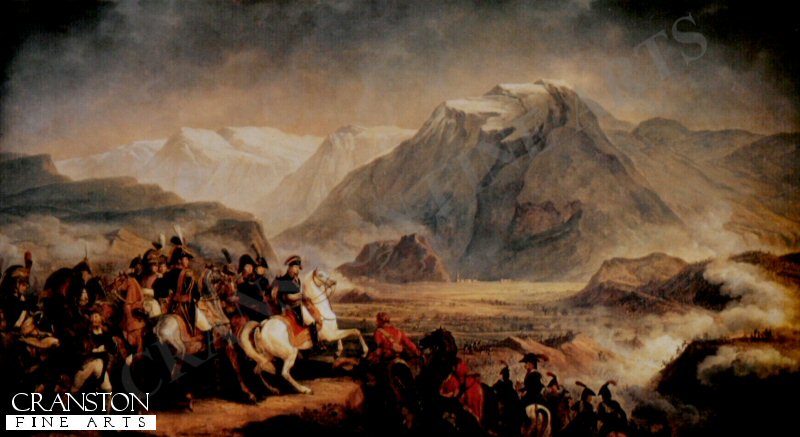
The Battle of Rivoli by Carl Vernet. This was the Austrians fourth attempt to relieve their besieged garrison of Mantua. |
Assault on the Breach of San Sebastian by Mark Churms. The Storming party, 750 volunteers, included 200 men of the Guards, one hundred each from the First and Coldstream Guards. They moved off at two in the morning on the 31st August 1813, and occupied a ruined convent where they remained till half past nine. Aware of the almost impossible task ahead of them, and subjected to a violent electric thunderstorm, the troops waited in a state of savage anticipation. Wild senseless laughter was said to have preceded the attack on the breach which could not be entered except in single file under heavy fire. The troops attacked in succession, but were struck down by hundreds. General Graham then ordered the artillery to fire over the heads of the assailants, clearing the ramparts. A shell ignited a quantity of powder, and under cover of the explosions, the storming party forced its way into the town. San Sebastian was savagely sacked and burned, and the good name of Wellingtons Army suffered as it had done at Badajoz. The civilians were raped, robbed and murdered in revenge for the heavy losses suffered by the troops. The Franco-Spanish governor retired the citadel (San Marcial) and on the 9th September, after a gallant resistance of over a week, surrendered the charge he had so faithfully defended. The casualties among the officers of the first Guards were one Officer, Ensign Burrard, First battalion (a son of Sir Henry Burrard who was responsible for the disastrous Treaty of Cintra) severely wounded, since dead, and one Officer, Ensign Orlando Bridgeman, wounded. In the Coldstream Guards, one officer ensign Thomas Chaplin, According to Lord Saltoun there were in round numbers, 150 casualties amongst 200 Guardsman. Total losses of volunteers from all regiments were 1500 men. (text by Atlanta Clifford, assistant to the Curator-The Guards Museum) In the painting. you see Ensign Chaplin lying wounded, attended by an Officer of the Coldstream Guards, Orlando Bridgeman is calling Assistant Surgeon Bacot, First Foot Guards, to go to the aid of his fellow officer, Burrard. |
Napoleons Last Grand Attack by Ernest Crofts. The fourth release of Ernest Crofts Waterloo series. Napoleon is seen with his generals as his faithfull Guard regiments (held in reserve) pass him on their way to the last French attack on the British lines during the last stages of the Battle of Waterloo. Painted in 1895 and was last sold at Sothebys London. |
|
Contact Details |
Sign Up To Our Newsletter!
This website is owned by Cranston Fine Arts. Torwood House, Torwoodhill Road, Rhu, Helensburgh, Scotland, G848LE Contact: Tel: (+44) (0) 1436 820269. Email: cranstonorders -at- outlook.com
|