|
|
|
|
|
|
|
|
|
Cranston Fine Arts  Naval Art and Artists Naval Artists Ivan Berryman Naval Art and Artists Naval Artists Ivan Berryman  Trafalgar Trafalgar |
[UP] - Royal Navy - US Navy - German Navy - French Navy - Italian Navy - Spanish Navy - Maritime Art - Trafalgar - The Nile - Copenhagen - Cape St Vincent - Original Paintings - Original Acrylic Paintings - Postcards |
|
|
|
|
|
|
|
|
|
|
|
|
|
|
|
|
|
|
|
|
| Text for the above items : |
Trafalgar by Ivan Berryman. (PC) By 2.00pm on 21st October 1805, the Battle of Trafalgar was all but won, the combined French and Spanish fleets had suffered terrible losses, but not without great cost to the British. Admiral Lord Horatio Nelson lay dying in the cockpit of his flagship, Victory, having been struck down by a single musket round fired from the fighting top of the French Redoutable's mizzen mast as Nelson walked on deck with Captain Hardy. In this scene, the battered remains of Victory can be seen beneath the figurehead of the Spanish 74 Principe de Asturias which dominates the foreground. Beside her, the hulk of the Redoutable sags in the water as Temeraire breaks free. In the centre, the British 74 Leviathan is engaging the French 80-gun Neptune, whilst the San Augustin can be seen firing at the extreme right of the picture. |
Nerves of Steel by Ivan Berryman. Just moments from her devastating opening broadside, HMS Victory prepares to pass the stern of the French flagship, Bucentaure, to break through the line of the combined French and Spanish fleets as the Battle of Trafalgar begins on 21st October 1805. Victorys guns had remained silent until this moment, Lord Nelsons flagship having already suffered severe damage during the approach, but now the gun crews awaited the moment when her double-shotted cannon, her mighty 68-pounder carronade and a shower of musket balls would smash through the French vessel, rendering it at once a useless hulk. |
The Battle of Trafalgar, 21st October 1805 by Ivan Berryman. One of the most decisive battles in the history of the Royal Navy, Nelsons defeat of the French fleet took place on 21st October 1805 off Cape Trafalgar and was conducted with not a single British ship lost, although few ships escaped severe punishment and loss of life on both sides was tragically high |
The Brave Redoutable by Ivan Berryman. Already ravaged by incoming shot from the combined French and Spanish fleets as she approached the enemy line, HMS Victory found herself under intense attack from the French 3rd Rate 74-gun Redoutable. The two ships became entangled, grappling irons went across and the most terrible artillery battle commenced. Admiral Lord Nelson was fatally wounded by a shot from the Redoutables mizzen top before it was brought crashing down. Now the British three-decker, the 98-gun Temeraire appeared outboard of the Redoutable and began pouring further shot into her, the little French ship dwarfed by two mighty British vessels. But still she fought on, refusing to strike her colours. Of all the ships at Trafalgar, Redoutable sustained the highest casualties with 478 killed and 81 wounded. Depicted from left to right are HMS Temeraire, Redoutable and HMS Victory. |
Trafalgar Aftermath by Ivan Berryman. Ravaged by the combined guns of the allied French and Spanish fleets at Trafalgar and by the great storm that followed the battle, a weary battered HMS Victory enjoys the relative calm as crew from HMS Neptune are despatched to take up the tow from the 3rd rater HMS Polyphemus for the final leg of her journey to the safety of Gibraltar, the flagship still bearing the body of Admiral Lord Horatio Nelson. |
Trafalgar- The Destruction of The Bucentaure by Ivan Berryman. With her mizzen top already gone and her sails aloft having received severe punishment, Victory breaks through the line behind the French flagship Bucentaure, delivering a shattering broadside into her stern. So severe was this opening fire that the Bucentaure was effectively put out of the rest of the battle, although Admiral Villeneuve himself was to miraculously survive the carnage. Beyong Victory can be seen the French Redoubtable, which is receiving fire from Victorys starboard guns, and the Spanish San Leandro is in the extreme distance. Most of Victorys stunsails have been cut away, but it was her stunsail booms that became entangled with the rigging of the Redoubtable when she put her helm to port and ran onto her. Admiral Nelson fell shortly afterward, having received a fatal wound from a musket ball fired by a French sharpshooter in Redoubtables mizzen fighting top. The Temeraire can be seen approaching the fray to the right. |
Prelude to Trafalgar by Ivan Berryman. 21st October 1805. As Admiral Nelsons flagship leads the British fleet towards the Franco-Spanish line, Captain Harveys Temeraire tries to pass the Victory in order to be the first to break the enemy column. Harvey was discouraged with a customry rebuke from Nelson and duly fell into line behind the flagship. The enemy can be seen spread along the horizon whilst, to the right in the distance, the leading ships of Admiral Collingwoods fleet can be seen spearheading a separate assault to the south. In the light airs preceding the battle, much sail was needed to drive the British ships towards the enemy line. HMS Victory, nearest, has royals and stunsails set and is making good way, her furniture boats strung behind in readiness for battle. On her poop deck, officers prepare to run up a signal. |
Captain Harveys HMS Temeraire tries to pass HMS Victory at the beginning of the Battle of Trafalgar by Ivan Berryman. 21st October 1805. As Admiral Nelsons flagship leads the British fleet towards the Franco-Spanish line, Captain Harveys Temeraire tries to pass the Victory in order to be the first to break the enemy column. Harvey was discouraged with a customry rebuke from Nelson and duly fell into line behind the flagship. The enemy can be seen spread along the horizon whilst, to the right in the distance, the leading ships of Admiral Collingwoods fleet can be seen spearheading a separate assault to the south. In the light airs preceding the battle, much sail was needed to drive the British ships towards the enemy line. HMS Victory, nearest, has royals and stunsails set and is making good way, her furniture boats strung behind in readiness for battle. On her poop deck, officers prepare to run up a signal. |
Trafalgar - The Destruction of the Bucentaure by Ivan Berryman. With her mizzen top already gone and her sails aloft having received severe punishment, Victory breaks through the line behind the French flagship Bucentaure, delivering a shattering broadside into her stern. So severe was this opening fire that the Bucentaure was effectively put out of the rest of the battle, although Admiral Villeneuve himself was to miraculously survive the carnage. Beyong Victory can be seen the French Redoubtable, which is receiving fire from Victorys starboard guns, and the Spanish San Leandro is in the extreme distance. Most of Victorys stunsails have been cut away, but it was her stunsail booms that became entangled with the rigging of the Redoubtable when she put her helm to port and ran onto her. Admiral Nelson fell shortly afterward, having received a fatal wound from a musket ball fired by a French sharpshooter in Redoubtables mizzen fighting top. The Temeraire can be seen approaching the fray to the right. |
Trafalgar Aftermath by Ivan Berryman. Jury rigged and battered by the relentless gunnery of the French and Spanish fleets at Trafalgar, HMS Victory lies off the coast of Gibraltar as crews from HMS Neptune (nearest) are despatched to take over the tow from the Polyphemus for the final leg of their journey to relative safety, the flagship still bearing the body of Admiral Lord Horatio Nelson. |
The Battle of Trafalgar - The First Engagement by Ivan Berryman. Midday, 21st October 1805, and Admiral Collingwoods flagship, the 100-gun HMS Royal Sovereign, breaks the allied line and delivers a shattering broadside on the Spanish flagship Santa Ana. Making great speed, Collingwoods ship had breached the Franco-Spanish line some distance ahead of the rest of his van and the Royal Sovereign suffered heavily as she quickly drew the attentions of three French and three Spanish ships. To her starboard, the French Indomitable can be seen firing into the British flagship while, astern of the Santa Ana, Belleisle and Fougueux are engaging ahead of Mars, Monarca and Pluton. |
Breaking the Line by Ivan Berryman. Just seconds from opening fire with a broadside that will devastate her opponent, HMS Victory prepares to pass the stern of the French flagship Bucentaure, closely followed by the three-deckers HMS Temeraire and HMS Neptune. With guns unable to bear on the enemy fleet during the slow approach the British ships had endured terrible punishment with Victorys sails holed, her wheel smashed and her mizzen top shot away. |
Line of Battle by Ivan Berryman. As Nelsons column of ships began their approach to the French and Spanish fleet at the start of the Battle of Trafalgar on 21st October 1805, the first four ships to break through were to be HMS Victory at the head of the line, HMS Temeraire, HMS Neptune and the 74-gun two-decker HMS Leviathan. Afraid for his admirals safety in the lead ship, Captain Harvey of the Temeraire decided to break away from the line in order to overtake Victory and be the first ship through, thus taking the worst of the gunfire from the enemy line as they approached. However, it was admiral Nelsons habit always to lead from the front and, as Temeraire manoeuvred alongside Victory, Nelson took up his speaking trumpet, went to his ships side and sternly shouted "I will thank you, Captain Harvey to maintain your proper station which is astern of the Victory". Harvey comlpied at once and the fleet continued into battle as originally planned. |
Warm Work by Ivan Berryman. The time is approximately 12.20pm on 21st October 1805. HMS Victory forces her way through the combined Spanish and French line, firing all her larboard guns into the stern of Admiral Villeneuve’s flagship. Bucentaure was utterly destroyed by the initial salvo with twenty of her guns smashed off their mounts and over 300 of her crew left dead or disabled. But Victory herself had suffered much during the perilous approach to the enemy fleet. Unable to bring any guns to bear, she received multiple hits from the Franco-Spanish ships, bringing down her mizzen top, her fore topgallant mast, her studding sails and smashing the ship’s wheel. The bowsprit, part of her figurehead and catheads were shattered, her anchors carried away and the entire bow, headrails and beakhead were peppered with shot. The title of the painting refers to a comment made by Admiral Horatio Nelson as HMS Victory began to receive fire from the enemy. A piece of hot shrapnel tore the buckle off Nelson’s shoe as he paced the deck with Captain Hardy, to which he responded, “It is warm work today!” Sadly, just one hour later, Nelson was fatally wounded by a sharpshooter stationed on the mizzen top of the French Redoutable which can be seen to the left of the painting. The towering spectre of HMS Temeraire looms in the gunsmoke as she follows HMS Victory into the fray. |
Mid Atlantic Dawn by Ivan Berryman. Upon hearing the news that Admiral Villeneuve and his squadron had headed across the Atlantic to the West Indies, Nelson, in HMS Victory, set off in pursuit early in June, 1805, in the hope of engaging the French there, thus preventing them from combining with the Spanish fleet that were blockaded in Cadiz. Nelsons squadron comprised the 74-gun Amazon, Swiftsure, Belleisle, Canopus, Conqueror, Donegal, Leviathan, Superb, Spencer and Tigre, plus the smaller Amphion (32) and Decade (36). The chase to Barbados and back was HMS Victorys only crossing of the Atlantic and proved fruitless, as Villeneuve had already escaped, but this action laid the ground for the Battle of Trafalgar in October of the same year. |
Battle of Trafalgar by Ivan Berryman. One of the most decisive battles in the history of the Royal Navy, Nelsons defeat of the French fleet took place on 21st October 1805 off Cape Trafalgar and was conducted with not a single British ship lost, although few ships escaped severe punishment and loss of life on both sides was tragically high |
The Fighting Temeraire by Ivan Berryman. Few ships availed themselves better at the Battle of Trafalgar on 21st October 1805 than HMS Temeraire. Here, she is depicted engaging the French Fougeuex, the two ships inflicting the most terrible damage upon one another in the early stages of the battle. Some crew members can be seen on Temeraire’s foredeck, trying to cut away the fallen fore yard and sail while her fore topsail flaps helplessly above after being set on fire. The acrid gun smoke soon became so bad that Captain Harvey ordered the Temeraire’s larboard guns to stop firing briefly so that he could check that he was not firing on his own ships. Temeraire would eventually take both the Fougeuex and The Redoutable as prizes, at one point having one enemy ship lashed to each side of her hull. As an aside, Temeraire was most likely the only ship at Trafalgar to have no figurehead. Having been built during a more austere period, she lacked much of the decoration of her contemporaries. It is believed, however, that her crew funded a figurehead after the battle from their own prize money, as a ship with no figurehead was considered a ship with no eyes and no soul. A modest crowned head featured at her bow until she was broken up at Beatson’s Yard in Rotherhithe between 1838 and 1839. |
Tugging the Tiger's Tail by Ivan Berryman. It is the Battle of Trafalgar, 21st October 1805 and the British 2nd rater Temeraire with 98 guns, having followed HMS Victory through the Franco-Spanish line, finds herself alongside the Spanish flagship, La Santisima Trinidad. This giant was by some measure the largest warship in the World, boasting four full gun decks and 130 guns. Undaunted, Captain Eliab Harvey took on the Santisima Trinidad, delivering a number of blows into the enemy’s massive red and black hull. However, Temeraire was largely out of control by this time, having taken much punishment as she had approached the enemy fleet. Her main topgallant mast had been shot away, as well as the mizzen topgallant. Her fore yard had crashed down onto her deck and her fore topsail had caught fire and been extinguished. Taking fire from both sides, the Temeraire lumbered on, eventually colliding with Le Redoutable, which was engaged with Victory. Between them, the two British three-deckers poured fire into the French ship until it struck its colours. |
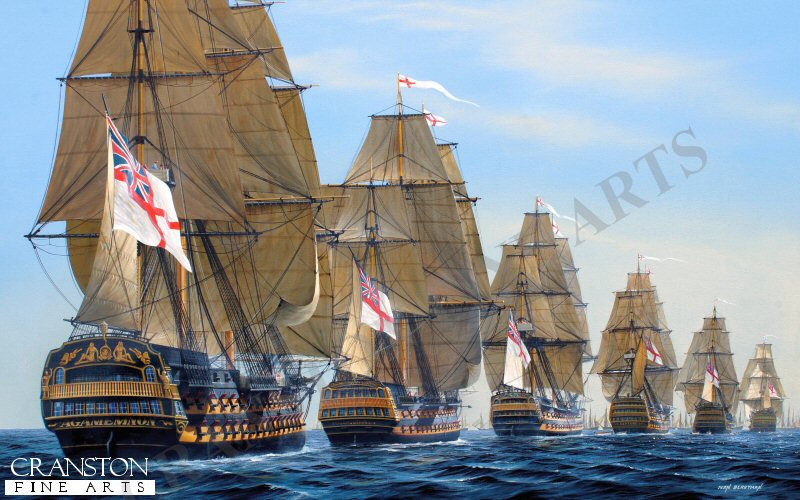
In Destinys Hands, Trafalgar, 12:15 PM by Ivan Berryman It is approximately 12,15 pm on 21st October 1805. With the combined Franco-Spanish enemy line in the far distance, HMS Victory is just beginning to manouevre, having chosen the French flagship Bucentaure as her target. Behind Victory lies Temeraire, then Neptune, followed by the two-deckers, Leviathan and Conqueror and Agamemnon in the foreground. Victory is flying the signal Engage the Enemy Closely from her main mast. Most ships have their studding sails set on the larboard (port) side only trying to harness as much wind as possible to hasten their approach 1n such light airs. At this stage, the stoves will have been extinguished, the guns run out and all decks cleared for action, their floors strewn with sawdust to avoid slipping and to soak up the blood. The Marines will be in position the officers at their posts and gun crews may likely have been singing hearty songs to raise their spirits. Fate alone knew what awaited them, once the firing started. |
|
Contact Details |
Sign Up To Our Newsletter!
This website is owned by Cranston Fine Arts. Torwood House, Torwoodhill Road, Rhu, Helensburgh, Scotland, G848LE Contact: Tel: (+44) (0) 1436 820269. Email: cranstonorders -at- outlook.com
|