|
|
|
|
|
|
|
|
|
Cranston Fine Arts  Landscape Art and Artists Countries  England |
[UP] - England - Scotland - Italy - France - Wales - Ireland - Netherlands - Austria - Denmark - Germany - New Zealand - Spain - Isle of Man - USA - Channel Islands - Belgium - Greece - Switzerland - Australia - Northern Ireland - Malta - Norway - Gibraltar - South Africa - Canada - Brazil - Iraq - Russia - Falkland Islands - Afghanistan - Japan - Hong Kong - Uruguay - Yemen - Croatia - Bosnia and Herzegovina - Egypt - Kuwait - Slovenia - Sudan - Portugal - Ascension Island |
| More Pages : Cities - Counties - Rivers - Lakes and Waters - Other Places - Buildings and Landmarks (Outside London) - English Coast - Lake District - Isle of Wight - St Michaels Mount |
| Navigation | |
| Page 3 of 20 | Previous .. Page 3 .. Next |
| England Landscape Art Prints, Paintings and Drawings |
|
|
|
|
|
|
|
|
|
|
|
|
|
|
|
|
|
|
|
|
|
| Navigation | |
| Page 3 of 20 | Previous .. Page 3 .. Next |
| Text for the above items : |
PS Ryde by Ivan Berryman. The venerable old paddle steamer Ryde has just backed away from Ryde pier, Isle of Wight, and is about to begin her journey across the Solent to Portsmouth in the summer of 1968. Just one year later the Ryde was withdrawn from service and, having spent a brief period as a floating nightclub, now languishes in the mud at Binfield, near Newport - a rusting hulk, though still recognisable as the proud war veteran she once was. |
Cheviot Shepherd by Michael Kitchen Hurle No text for this item |
Battle of Britain by Stan Stokes. The Battle of Britain in 1940 was the biggest air battle ever fought in the history of armed conflict. After the fall of France Hitler hoped to sign a peace treaty with Britain allowing the Germans to dominate Europe, and ultimately attack Russia in the East. Being rebuffed by the British, Hitler and his senior military advisors formulated Operation Sea Lion. This was to involve an invasion of Britain after the Luftwaffe had attained total domination over the RAF. As plans evolved for knocking out the RAF, the Germans began assembling a large number of airfields in Holland, France, and Belgium to be used for the attack. In their arsenal the Germans had more than 800 medium range bombers including the Heinkel He-111, the Junker Ju-88, and the Dornier Do-17. They also had more than 200 Ju-87 Stuka dive bombers, and more than 900 Bf-109 and Bf-110 fighters to escort their attacking forces. The British had far less than 1000 defensive aircraft at their disposal with Hawker Hurricanes outnumbering Supermarine Spitfires about 2-to-1. Despite the Germans numerical superiority the British had at least five advantages in this epic Battle. First, radar allowed the Brits to determine where to target its fighter defenses. Second, when British aircraft were downed many of the pilots were recovered and returned to flight duty. When German aircraft were downed the pilots became British POWs. Third, the BF-109, Germanys best fighter, had limited range, and generally could spend only about twenty minutes over British soil before having to return to Europe. Fourth, the British dispersed their defensive forces widely into many small groups, eliminating the ability of the Luftwaffe to deliver a knockout punch on the ground. Fifth, the RAF pilots were surprisingly well trained, and while few in number were supplemented with volunteers from Canada, Australia, New Zealand, Poland, South Africa, and the United States. Also important was the tenacity of the RAF support staff that kept an amazing amount of the aircraft in the air. The man most responsible for the British victory was Air Marshal Sir Hugh Dowding, head of Fighter Command. In the first phase of the Battle the Luftwaffe focused its efforts on knocking out RAF airfields. The RAF lost 50 fighters in the first 10-days. This resulted in modified tactics permitting looser formation flying similar to that employed by the Germans. The Germans suffered too with the Bf-110 and Ju-87 proving particularly vulnerable. In August Hitler authorized a massive attack called Eagle Day that was designed to obliterate the RAF by attacking coastal radar stations. Again the German effort fell far short and later in August the Germans had one of their worst days losing 75 aircraft on Black Thursday. In late August the German tactics changed again with the focus now on destroying RAF fighters in the air. In a two-week period ending on September 6, the RAF lost 466 fighter aircraft, taking the Germans to their closest point of victory during the Battle. The turning point in the Battle is generally acknowledged to be September 7 when the Germans shifted focus to general attacks on London. This gave the RAF a breather, and on September 15 they took down 60 Luftwaffe aircraft. The losses on the 15th convinced the Germans that their strategy had failed and they slowly retrenched their attacks. September 15 is celebrated in Britain as Battle of Britain Day. |
Now and Then by Peter Westacott. A tribute to Sir Thomas Sopwith and British Aerospace. BAe Harrier GR.5 ZD346 and Sopwith Pup N5195 at the Biggin Hill air fair June 1988. |
Combat Over Beachy Head by Nicolas Trudgian. Mickey Mount, flying his 602 Squadron MkII Spitfire, successfully attacks a Messerschmitt Me109 low over the cliffs of Beachy Head on the south coast during the Battle of Britain in the summer of 1940. Spitfires and Me109s were so evenly matched at this early point in the war that the outcome of such contests were usually decided by the skill of the competing pilots. |
A4s at York by Barry Price. No.60009 Union of South Africa stands at the platform as sister engine No.60022 Mallard passes with the southbound Elizabethan from Edinburgh for London c.1960. |
Weald of Kent by Graeme Lothian. No text for this item |
Trafalgar Square by Graeme Lothian. (GS) No text for this item |
White-out at Breighton - Tribute to No.78 Squadron by Ivan Berryman. With the departure of No 1 Group in May 1943, No 4 Group's 78 Sqn Halifaxes arrived at Breighton in Yorkshire from where they would continue to operate until the end of the war. Halifax III LW291 (EY-M) is depicted snowbound in the Winter of 1944, not long before it was lost over Grossmutz whilst taking part on a raid on Berlin on 20th January 1944. Crew of EY-M : Pilot : Flight Sergeant F Moffat RCAF (killed), Navigator : Flying Officer W McGreggor RCAF (killed), Bomb Aimer : Flying Officer R Selman RCAF (killed), Wireless Operator : Flight Sergeant H H Bennett (taken prisoner), Flight Engineer : Sergeant N Legg (killed), Rear Gunner : Sergeant W Ruelhoff (killed, Mid-Upper Gunner : Sergeant J Stewart (killed). |
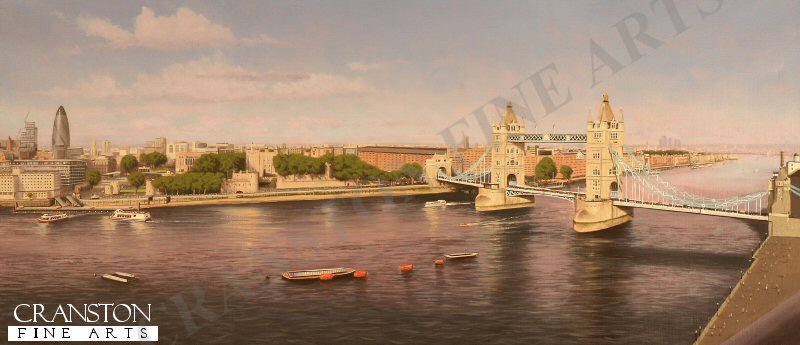
View from City Hall by Graeme Lothian. (GS) No text for this item |
Queen Elizabeth at Southampton by Ivan Berryman. No text for this item |
City Hall - London Marathon 2003 by Graeme Lothian. One of the major sporting events held in the UK is the London Marathon, an event which attracts a host of world class athletes. This painting by Graeme Lothian brings together the sight and feel of this great London event. |
Dawn Descent by David Pentland. A C130 Hercules MK1 from RAF Lynham Transport Wing, delivers a low level Brigade drop of Airbourne forces over Salisbury Plain. The C130 Hercules is the workhorse of the Royal Air Force Air Transport (AT) fleet and is based at RAF Lyneham in Wiltshire, where it is operated by Nos 24, 30, 47 and 70 Squadrons. The fleet totals 50 aircraft and is a mixture of C1/C3 aircraft and the new C-130J aircraft, designated C4/C5. |
Ops On Hold by Richard Taylor. March 1944 and heavy snow has settled firmly over the frozen Lincolnshire countryside around RAF Fiskerton. For once the Lancasters of 49 Squadron stand quietly idle at their dispersal points around the perimeter of the airfield. It is a scene recreated at many other heavy bomber airfields across the east of England and the young airmen who crew these mighty machines now wait patiently for the inevitable thaw that will soon see them in combat again. For some, however, the future is uncertain. Just a few weeks later, on 30 March 1944, during a raid on Nuremberg, more than 100 bombers would be shot down. In the space of a single night Bomber Command would suffer more men lost than Fighter Command during the entire Battle of Britain. Bomber Command flew more than 389,000 sorties from 101 operational bases across the east of England during WWII and the aircrew that undertook these missions came from Britain, Canada, Australia, New Zealand, South Africa, Rhodesia and many countries under Nazi occupation. Every airman was a volunteer and with an average age of just 22 they were forced to grow up quickly, enduring frightening odds and suffering terrible losses - only the Nazi U-Boat force experienced a higher casualty rate. Of the 125,000 men who served, 55,573 were killed. For every 100 airmen who joined Bomber Command, 45 would lose their lives, 6 would be seriously wounded and 8 made prisoners of war. Yet they resolutely overcame the overwhelming forces stacked against them, including some of the worst flying conditions imaginable and, never flinching from their task, flew until victory was finally achieved. |
Concorde - The Final Touchdown by Ivan Berryman. Shortly after 2.00pm on Friday 24th October 2003, supersonic commercial aviation was brought to a close as three British Airways Concordes touched down within minutes of each other at London's Heathrow Airport for the last time. Here, BA Captain Mike Bannister brings G-BOAG home for the final touchdown. |
Pheasant Shooting by Samuel John Egbert Jones No text for this item |
HMS Bristol departing Portsmouth by Ivan Berryman. The only Type 82 destroyer to be built for the Royal Navy, HMS Bristol (D23) was designed for a role that never materialised, the rest of her class being cancelled when the intended CVA-01 class of aircraft carriers that she was intended to escort and defend were themselves cancelled in the late 1960s. Bristol enjoyed a long and varied career however, her size making her a suitable flagship for Operation Ocean Safari 81 before going in for a refit and joining the Royal Navy Task Force in the South Atlantic during the Falklands Campaign. Paid off in 1991, she is now moored permanently at Whale Island, Portsmouth, as a training ship. HMS Bristol is depicted here slipping quietly out of Portsmouth Harbour in the 1970s. |
Return of the Heroes by Ivan Berryman. Spitfire of 610 Squadron which has been damaged during combat during the height of the Battle of Britain is shown over the white cliffs of Dover. No. 610 (County of Chester) Squadron of the Royal Auxiliary Air Force's first major combat with the Luftwaffe was on 27th May when a Heinkel bomber protected by about 40 Me110s, was engaged. The combat which followed saw the Heinkel and three Me110 fighters being shot down. Throughout August 610 Squadron was involved in bitter fighting over the Channel and Home Counties of England. During the Battle of Britain No.610 Squadron operated from Biggin Hill, Hawkinge, and, on one occasion, from Croydon. The Squadron put up a terrific show and 40 enemy aircraft were confirmed as having been destroyed by 610 Squadron during August. The loss to the Squadron was eleven pilots killed during the battle. |
Tonight We Make History by Keith Aspinall. Guy Gibson, Micky Martin and John Hopgood outward bound from Scampton on the evening of 16th May 1943. |
Windsor by Graeme Lothian. (GS) No text for this item |
Into the Fray by Richard Taylor. Squadron Leader Douglas Bader leads the Hurricanes of 242 Squadron in an aggressive diving attack upon a large force of Heinkel 111s approaching the Kent coast, whilst Spitfires from 66 Squadron tangle with the escorting Bf109s of JG52. It is September 1940, and the climax of the Battle of Britain. Throughout those critical months in 1940, the RAF engaged opposing pilots of the Luftwaffe time and time again and this atmospheric new painting depicts one such frantic engagement as one of the most legendary fighter Aces of the war, Douglas Bader leads his unit into battle. |
|
Contact Details |
Sign Up To Our Newsletter!
This website is owned by Cranston Fine Arts. Torwood House, Torwoodhill Road, Rhu, Helensburgh, Scotland, G848LE Contact: Tel: (+44) (0) 1436 820269. Email: cranstonorders -at- outlook.com
|