|
|
|
|
|
|
|
|
|
Cranston Fine Arts  Landscape Art and Artists Countries England Landscape Art and Artists Countries England  English Coast English Coast |
[UP] - Cities - Counties - Rivers - Lakes and Waters - Other Places - Buildings and Landmarks (Outside London) - English Coast - Lake District - Isle of Wight - St Michaels Mount |
| Navigation | |
| Page 1 of 2 | Page 1 .. Next |
|
|
|
|
|
|
|
|
|
|
|
|
|
|
|
|
|
|
|
|
|
| Navigation | |
| Page 1 of 2 | Page 1 .. Next |
| Text for the above items : |
Poole Quay by Gaslight by Rodney Charman. The near empty harbour-front of Poole during the 19th century, the large masted sailing ships stand quiet as a coalman loads his cart for the morning deliveries. |
F/Lt J R Baldwin by Ivan Berryman. F/Lt (later Wing Commander) Baldwin was to become the highest-scoring Typhoon pilot of all with 15 confirmed victories, one shared, one probable and four damaged. He is depicted here downing a Bf.109 in Typhoon 1B, DN360 (PR-A) of 609 Sqn over Beachy Head. |
Sunrise over Bristol Docks by Rodney Charman. No text for this item |
Whitby Harbour by Moonlight by Rodney Charman. No text for this item |
Appledore by Moonlight by Roger Desoutter. No text for this item |
Quayside Evening by Rodney Charman. A quiet evening in the harbour area of Poole, Dorset, England, during the 19th century. Men stand outside the Kings Arms Inn as the sail rigged sailing ships are shown in the distance. |
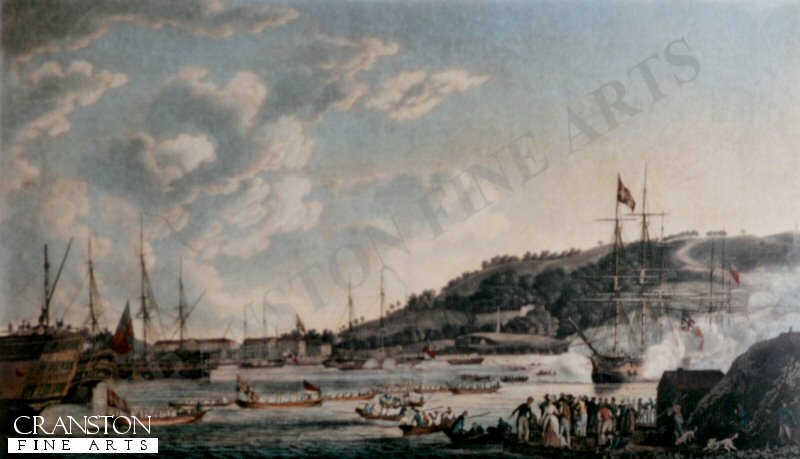
Royal Dockyard Plymouth. Plymouth Royal Naval dockyard during the Napoleonic Era with royal naval Men of War and Frigates in Plymouth Harbour |
Into the Fray by Richard Taylor. Squadron Leader Douglas Bader leads the Hurricanes of 242 Squadron in an aggressive diving attack upon a large force of Heinkel 111s approaching the Kent coast, whilst Spitfires from 66 Squadron tangle with the escorting Bf109s of JG52. It is September 1940, and the climax of the Battle of Britain. Throughout those critical months in 1940, the RAF engaged opposing pilots of the Luftwaffe time and time again and this atmospheric new painting depicts one such frantic engagement as one of the most legendary fighter Aces of the war, Douglas Bader leads his unit into battle. |
The Chain by Ivan Berryman. (PC) Spitfire Mk.1 over a trio of Chain radar masts on the south coast of England. This Spitfire is from No.603 Sqn based at RAF Hornchurch from 27th August 1940, the height of the Battle of Britain. |
Channel Sweep by Richard Taylor. On 14th June 1940, the first German jackboots were heard on the streets of Paris. Within days France signed an armistice and Hitler could now turn his avaricious eyes north and across the grey waters of the Channel. The island of Britain stood alone and, faced with the threat of imminent invasion, few gave her much chance of survival. Before the all-conquering Panzers could invade, Germany needed to gain air superiority and Goering boasted that his Luftwaffe 'would quickly sweep the RAF from the skies' - how wrong he would be. The Battle of Britain began on 10th July 1940 and for the next eight weeks most front-line squadrons were often flying four missions a day. Totally outnumbered by the Luftwaffe the RAF was close to breaking point by early September, with some units reduced to a handful of pilots and aircraft. Then on 7th September, an over-confident Goering made a fatal error. Believing the RAF destroyed, he changed tactics and the Luftwaffe began bombing civilian targets in London. It was the respite that Fighter Command needed and the tide of battle was turned. Against overwhelming and seemingly impossible odds, a replenished RAF repelled the Luftwaffe and by the end of October it was over. Richard Taylor's stunning painting depicts Mk1 Spitfires from 92 Squadron undertaking a defensive sweep along the Kent coastline against a dramatic backdrop of the white cliffs of Dover, at the height of the battle in September 1940. |
Whitby by Chris Collingwood. No text for this item |
Cornish Riviera Express by Barry Price. No.6000 King George V with the Cornish Riviera Express between Dawlish and Teignmouth, Devon in the late 1950s. |
Royal Dockyard Portsmouth. Portsmouth Royal Naval dockyard during the Napoleonic Era with royal naval Men of War and Frigates in Portsmouth Harbour |
Coming In Over the Estuary by Robert Taylor. In Robert Taylors panoramic painting, P-38J Lightnings of the 364th Fighter Group return from a strafing mission over France in the summer of 1944. Making their land-fall at just 100 feet, they skim across an estuary on Englands south coast, near the old village of Bosham. With his unmistakable skill and vivid imagination Robert cleverly contrasts the exhilaration of the low-level combat flying, with the peaceful atmosphere of a quiet coastal setting, emphasising that curious blend of war and peace that was the daily lifestyle of the World War II flyer. This classic aviation painting provides collectors with a wonderful study of a memorable warbird. |
Merlin Chorus by Anthony Saunders. The Battle of Britan - 13th August 1940. Fresh from a successful action over a marauding group of Me110s and Me109s attempting to raid port facilities at Portland during the Battle of Britain, Spitfires of 152 Squadron return to their base at Warmwell to refuel and rearm. As the distinctive sound of their Merlin engines echoes around Lulworth Cove, one of the Spitfires - hit during the engagement - is starting to smoke. Thankfully all will land safely, ready to continue the bitter struggle while Goerings Luftwaffe begin to intensify their attacks as they try to gain air superiority during one of the most decisive battles ever fought. |
Straggler's End by Ivan Berryman. Byron Duckenfield is recorded as having shot down a Stuka near Dover, but the exact circumstances are not clear. 501 Sqn did encounter Stukas in this area on a number of occasions - depicted here is a 501 Sqn Hurricane on the tail of a Ju.87. |
A Time for Heroes by Robert Taylor Royal Air Force and Royal Navy fighter aircrews flew combat throughout the six long years of World War Two. At the outbreak of war in 1939 four RAF Hurricane squadrons and two equipped with Gladiators went immediately to France where in short time New Zealander Cobber Kain became the first Allied Ace of the war. In April 1940 Hurricanes and Gladiators saw in action in Norway, when Rhodesian Caesar Hull of 263 Squadron became the second air Ace. By the fall of France the new Spitfire joined in the great air battles over the Channel as the British Expeditionary Force evacuated Dunkirk. Bob Stanford -Tuck, Douglas Bader, Peter Townsend, Sailor Malan, and many other great Aces gained their first victories, but with German forces massing on the French coast, the invasion of Britain looked imminent. Only RAF Fighter Command stood in Hitlers way. By July, the most famous of all air battles had begun. The next three months, under glorious summer skies, saw the most decisive and continual aerial fighting in history. The British victory in the Battle of Britain was to fundamentally change the course of the war and, ultimately, the course of history. But there were four and a half more years of air battles still to be fought and won -from the English Channel Front to the North African desert, from the Mediterranean to Far East Asia. It fell to Fleet Air Arm pilots to see the last air fighting for British and Commonwealth pilots, by then equipped with Seafires and American Corsairs and Hellcats, as they took part in the final assaults on the Japanese mainland. As the last embers of hostilities faded into history the centuries old doctrine of maritime supremacy had gone. Now the aircraft ruled. In his masterful painting A Time For Heroes Robert Taylor pays tribute to the World War II fighter aircrews of the RAF and Fleet Air Arm. A panoramic scene from the era of the Battle of Britain shows Mk I Spitfires of 234 Squadron, 10 Groups top scoring squadron, returning to St. Eval after intercepting heavy raids on south coast ports during the heaviest fighting, in September 1940. St. Michaels Mount, the castle built on the site of a 14th Century monastery to defend Britains shores from earlier enemies, provides a symbolic backdrop as once again a band of brothers is called upon to defend their Sceptred Isle. Sadly, since the passing of Mahinder Pujji in September 2010, all of the great pilots who signed any of the editions of this print have now passed away. |
Coastal Scene with Fishermen on Broadstairs Pier, Kent by Henry C Gritten. (GS) No text for this item |
A View Over the Sussex Coast by Alfred Augustus Glendening (GL) No text for this item |
A View of Cromer, Norfolk, From the East by John Moore. (GL) No text for this item |
A View of Cromer, Norfolk, from the West by John Moore. (GL) No text for this item |
|
Contact Details |
Sign Up To Our Newsletter!
This website is owned by Cranston Fine Arts. Torwood House, Torwoodhill Road, Rhu, Helensburgh, Scotland, G848LE Contact: Tel: (+44) (0) 1436 820269. Email: cranstonorders -at- outlook.com
|