|
|
|
|
|
|
|
|
|
Cranston Fine Arts  Aviation Art and Artists World War Two Veteran Signatures UK and Commonwealth H Aviation Art and Artists World War Two Veteran Signatures UK and Commonwealth H  Hodges, Jack Hodges, Jack |
Warrant Officer Jack Hodges DFC
Jack Hodges joined the RAF in late 1940, and after completing his pilot training in Canada he returned to England and was then briefly sent to a Photo Reconnaissance Unit flying Spitfires. He moved to a OTU in Annan, Scotland on Hurricanes before finally moving to a holding unit in Redhill, flying Typhoons. In 1944 he was posted to join 175 Squadron. Shortly after this he moved to 174 Squadron at Westhampnett. He served on operations throughout occupied Europe until the end of the war, being awarded the DFC in 1945 for successfully leading a group of Typhoons against a German Armoured Division.
 |
| Distinguished Flying Cross |
| Navigation | |
| Page 1 of 2 | Page 1 .. Next |
| Warrant Officer Jack Hodges DFC - Signed Aviation Art |
|
|
|
|
|
|
|
|
|
|
|
|
|
|
|
|
|
|
|
|
|
| Navigation | |
| Page 1 of 2 | Page 1 .. Next |
| Text for the above items : |
F/Lt J R Baldwin by Ivan Berryman. F/Lt (later Wing Commander) Baldwin was to become the highest-scoring Typhoon pilot of all with 15 confirmed victories, one shared, one probable and four damaged. He is depicted here downing a Bf.109 in Typhoon 1B, DN360 (PR-A) of 609 Sqn over Beachy Head. |
Foob Fairbanks - The Terror of the Rhine by Ivan Berryman. Flying his last mission with his old mount, Hawker Tempest EJ762, fresh from repair after being damaged by flak, David Fairbanks found himself embroiled in a fierce battle with Messerschmitt Bf109s on 17th December 1944. In the course of the combat, Fairbanks shot down two of the enemy aircraft and damaged another before returning safely. |
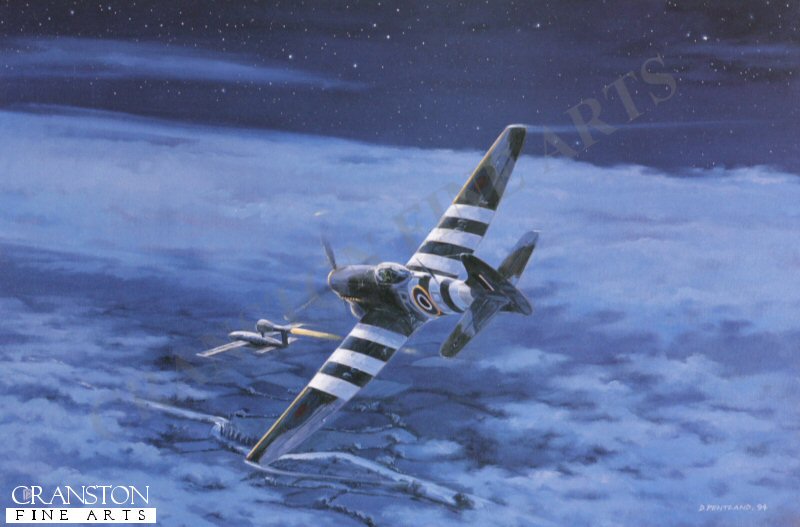
A Buzz for Beamont by David Pentland. Wing Commander Roland Beamont in his personal Tempest V, intercepted and downed his first V1 Buzzbomb on the night of June 22nd, 1944, over south east England. As Commander of 150 wing and others he went on to shoot down a total of 30 V1 flying bombs, 8 enemy aircraft and 35 locomotives destroyed plus one minesweeper sunk. |
A Busy Day at the Office by Ivan Berryman. The leadership qualities and grim determination of Squadron Leader J R Baldwin was seldom better demonstrated that when he led a small flight of Hawker Typhoons against a force of some thirty Focke-Wulf Fw.190s in January 1944. Nine of the German aircraft were shot down that day, Baldwin himself being responsible for two of them. He is shown here in Typhoon PR-A of No.609 Squadron. |
Tempest Moon by Ivan Berryman. Three 501 Sqn Hawker Tempests roar low across the North Sea outbound from Bradwell Bay, Essex, on their way to attack a German airfield at Bad Zwischehhan and nearby rail yards on the night of 2nd October 1944. The trio comprised of Sqn Ldr Joseph Berry, flying EJ600 (SD-F), Flt Lt E L 'Willy' Williams (SD-L) and Flt Lt C A 'Horry' Hansen. Berry was to lose his life on this mission, his aircraft being hit by ground fire from soldiers manning a radar station east of Veendam. |
Taming the Tiger by Geoff Lea. It is August 1944, barely two months since the Allies landed their first troops on the beaches of Normandy. After the failed Operation Luttich (codename given to a German counterattack during the Battle of Normandy, which took place around the American positions near Mortain from 7 August to 13 August, 1944 ) The German Panzer Divisions were in full retreat, The British and American Generals believed it to be critical to halt them before they cauld regroup. Caught in the Gap at Falaise, the battle was to be decisive. Flying throughout a continuous onslaught, rocket-firing Typhoons kept up their attacks on the trapped armoured divisions from dawn to dusk. The effect was devastating: at the end of the ten day battle the 100,000 strong German force was decimated. The battle of the Falaise Pocket marked the closing phase of the Battle of Normandy with a decisive German defeat. It is believed that between 80,000 to 100,000 German troops were caught in the encirclement of which 10,000 to 15,000 were killed, 45,000 to 50,000 taken prisoner, and around 20,000 escaped . Shown here are German Tiger I tanks under continues attack by Royal Aoir Force Typhoons. |
Sledgehammer by Ivan Berryman. Regarded by some in the Air Ministry as a failed fighter, the mighty Hawker Typhoon was unrivalled as a ground attack aircraft, especially in the crucial months immediately prior to - and after - D-Day when squadrons of Typhoons operated in 'cab ranks' to smash the German infrastructure and smooth the passage of the invading allied force. This aircraft is Mk.1B (MN570) of Wing Commander R E P Brooker of 123 Wing based at Thorney Island. |
Bug Killer by Ivan Berryman. Equipped with the experimental Monica IIIE detection device, Hawker Tempest EJ535 was deployed to the Fighter Interception Unit at Newchurch for evaluation in July 1944. Originally developed as the AN/APS 13, Monica had been intended as a rear-looking device to warn crews of attacks from behind. Now modified to face forward, it became a valuable aid in the battle against Hitler's terror weapons, notably the V-1 Flying Bomb. In the hands of the Fighter Interception Unit's then Commanding Officer Joseph Berry, this became a winning combination with no fewer than 52 Doodlebugs falling to Berry's guns - on one occasion, seven V1s being shot down by Berry in a single night. |
Clipped Signature - Douglas Oram. Douglas Oram joined the RAF in 1942, training in the USA before being posted to No.174 Sqn flying Typhoons where he completed a year on operations. He left after the war but rejoined in 1947 until retiring in 1967. Clipped alongside the signatures of Jack Hodges and Frank Wheeler - Jack Hodges joined the RAF in 1940, serving in a number of roles before flying Typhoons with No.175 Sqn then No.174 Sqn from 1944. He flew in the ground attack role until the end of the war, gaining a Distinguished Flying Cross leading an attack against a German armoured division. Frank Wheeler trained as a pilot and served as an instructor from 1941 until he joined No.174 Sqn flying Typhoons in 1944. After his tour of operations he was awarded the Distinguished Flying Cross. He died in 2013. |
Tribute to Sqn Ldr David Fairbanks by Ivan Berryman. Whilst flying with other Hawker Tempests of 274 Sqn on 11th February 1945, Sqn Ldr David Fairbanks spotted a lone Arado Ar234 of the Kommando Sperling 1 (F) / 123 flown by Hauptmann Hans Felde returning to its base at Rheine. A desperate chase commenced through the cloudbase until the German jet prepared to land, whereupon Fairbanks sent 4U+DH down in flames after a single short burst of his four 20mm cannon. |
In the Playground of the Gods by Ivan Berryman. A lone Royal Air Force Spitfire is shown high amongst the clouds over the southern counties of England during the hieght of the Battle of Britain. |
JBII - Hawker Typhoon of Wing Commander J R Baldwin by Ivan Berryman. Squadron Leader J R Baldwin passes above a section of Mulberry Harbour near Arromanches, late in June 1944, his personalised Hawker Typhoon bearing the codes JBII. |
Normandy Sunrise by Gerald Coulson. Here, in the brightening morning sky, Typhoons are prepared for the first sortie of the day. One has already fired up its big, powerful engine, blowing up whirlwinds of Normandy dust, ground crew hover, ready to remove chocks prior to taxi and take-off. A second is readied, while the remainder of the squadron, widely dispersed around the temporary field, are about to set about their deadly missions of the day. |
Airborne in JB1 by Ivan Berryman. Squadron Leader J R Baldwin gets airborne from a makeshift airfield in northern France flying one of his personalised Hawker Typhoons, JB-1. |
Closing the Gap by Robert Taylor. As Typhoon Mk1b fighter-bombers of 247 Squadron exit the target area near Falaise at full throttle, the havoc wreaked in their wake bears witness to the devastation of their powerful rockets. Fuel and ammunition from the retreating German column explode with shattering detonations, the savagery of the attack demoralising the enemy into stunned oblivion. The Typhoons will hurtle back to base to re-arm and hastily re-fuel, ready for yet another withering strike on the encircled Wehrmacht columns. This stunning rendition from the the worlds premier aviation artist pays tribute to the brave young RAF fighter pilots of the twenty squadrons of rocket-firing Hawker Typhoons who flew those perilous ground attacks during the Battle of Normandy. |
Bombs Away by Ivan Berryman. On 20th June 1944, Hawker Typhoons of 146 Wing, 84 Group, were detailed to attack a railway tunnel that was being used by the Germans as a supplies store. Leading the raid in MN934 (ZH-Z), Wing Commander J R Baldwin and his men successfully sealed the tunnel at both ends, thus depriving the retreating German infantry of essential provisions and ammunition. |
Typhoon Season by Ivan Berryman. Typhoon IBs of No.181 Squadron attack a German supply vessel off the coast of northern France during the run up to D-Day in 1944 using cannon and 60lb rockets. This unique aircraft's amazing speed at low level and awesome fire-power proved formidable and, after a shaky start to its service career, proved itself beyond all doubt to be an essential tool in the softening-up operations against German defences prior to allied invasion in June 1944. |
Return of the Heroes by Ivan Berryman. Spitfire of 610 Squadron which has been damaged during combat during the height of the Battle of Britain is shown over the white cliffs of Dover. No. 610 (County of Chester) Squadron of the Royal Auxiliary Air Force's first major combat with the Luftwaffe was on 27th May when a Heinkel bomber protected by about 40 Me110s, was engaged. The combat which followed saw the Heinkel and three Me110 fighters being shot down. Throughout August 610 Squadron was involved in bitter fighting over the Channel and Home Counties of England. During the Battle of Britain No.610 Squadron operated from Biggin Hill, Hawkinge, and, on one occasion, from Croydon. The Squadron put up a terrific show and 40 enemy aircraft were confirmed as having been destroyed by 610 Squadron during August. The loss to the Squadron was eleven pilots killed during the battle. |
Typhoon! by Ivan Berryman. So often overshadowed by its own achievements as a ground attack aircraft, Hawkers mighty Typhoon also proved itself a formidable adversary in air to air combat as demonstrated by the successes of F/Lt (later Wing Commander) J R Baldwin who claimed no fewer than three Bf.109G4s in the skies above Kent on 20th January 1943 in a single sortie. Baldwin finished the war as the highest-scoring Typhoon pilot of all with 15 confirmed victories, one shared, one probable and four damaged. He was tragically lost over Korea in 1952 whilst on an exchange posting with the USAF, but is depicted here at the peak of his powers, flying Typhoon 1B DN360 (PR-A) of 609 Sqn. |
Clipped Signature - Jack Hodges. Jack Hodges joined the RAF in 1940, serving in a number of roles before flying Typhoons with No.175 Sqn then No.174 Sqn from 1944. He flew in the ground attack role until the end of the war, gaining a Distinguished Flying Cross leading an attack against a German armoured division. Clipped alongside the signatures of Frank Wheeler and Douglas Oram - Frank Wheeler trained as a pilot and served as an instructor from 1941 until he joined No.174 Sqn flying Typhoons in 1944. After his tour of operations he was awarded the Distinguished Flying Cross. He died in 2013. Douglas Oram joined the RAF in 1942, training in the USA before being posted to No.174 Sqn flying Typhoons where he completed a year on operations. He left after the war but rejoined in 1947 until retiring in 1967. |
Hard Hitter by Ivan Berryman. Whilst in command of 609 Sqn in January 1944, F/Lt (later Wing Commander) J R Baldwin, leading a small formation of Hawker Typhoon 1Bs, encountered thirty Focke-Wulf Fw190s and engaged them in a furious battle. Nine enemy aircraft were shot down in the action, Baldwin accounting for two of them himself. He went on to finish the war as the highest-scoring Typhoon pilot of all with 15 confirmed victories, one shared, one probable and four damaged. He is depicted here, flying DN360 with the codes PR-A. |
| Warrant Officer Jack Hodges DFC Aircraft details |
 Hurricane Manufacturer : Hawker Built : 14533 | Hurricane Royal Air Force Fighter, the Hawker Hurricane had a top speed of 320mph, at 18,200 feet and 340mph at 17,500, ceiling of 34,200 and a range of 935 miles. The Hurricane was armed with eight fixed wing mounted .303 browning machine guns in the Mark I and twelve .303 browning's in the MKIIB in the Hurricane MKIIC it had four 20mm cannon. All time classic fighter the Hurricane was designed in 1933-1934, the first prototype flew in June 1936 and a contract for 600 for the Royal Air Force was placed. The first production model flew ion the 12th October 1937 and 111 squadron of the Royal Air Force received the first Hurricanes in January 1938. By the outbreak of World war two the Royal Air Force had 18 operational squadrons of Hurricanes. During the Battle of Britain a total of 1715 Hurricanes took part, (which was more than the rest of the aircraft of the Royal air force put together) and almost 75% of the Victories during the Battle of Britain went to hurricane pilots. The Hawker Hurricane was used in all theatres during World war two, and in many roles. in total 14,533 Hurricanes were built. |
 Spitfire Manufacturer : Supermarine Built : 20351 | Spitfire Royal Air Force fighter aircraft, maximum speed for mark I Supermarine Spitfire, 362mph up to The Seafire 47 with a top speed of 452mph. maximum ceiling for Mk I 34,000feet up to 44,500 for the mark XIV. Maximum range for MK I 575 miles . up to 1475 miles for the Seafire 47. Armament for the various Marks of Spitfire. for MK I, and II . eight fixed .303 browning Machine guns, for MKs V-IX and XVI two 20mm Hispano cannons and four .303 browning machine guns. and on later Marks, six to eight Rockets under the wings or a maximum bomb load of 1,000 lbs. Designed by R J Mitchell, The proto type Spitfire first flew on the 5th March 1936. and entered service with the Royal Air Force in August 1938, with 19 squadron based and RAF Duxford. by the outbreak of World war two, there were twelve squadrons with a total of 187 spitfires, with another 83 in store. Between 1939 and 1945, a large variety of modifications and developments produced a variety of MK,s from I to XVI. The mark II came into service in late 1940, and in March 1941, the Mk,V came into service. To counter the Improvements in fighters of the Luftwaffe especially the FW190, the MK,XII was introduced with its Griffin engine. The Fleet Air Arm used the Mk,I and II and were named Seafires. By the end of production in 1948 a total of 20,351 spitfires had been made and 2408 Seafires. The most produced variant was the Spitfire Mark V, with a total of 6479 spitfires produced. The Royal Air Force kept Spitfires in front line use until April 1954. |
 Typhoon Manufacturer : Hawker Built : 3330 | Typhoon Single engine fighter with a maximum speed of 412 mph at 19,000 feet and a ceiling of 35,200 feet. range 510 miles. The Typhoon was armed with twelve browning .303inch machine guns in the wings (MK1A) Four 20mm Hispano cannon in wings (MK!B) Two 1000ilb bombs or eight 3-inch rockets under wings. The first proto type flew in February 1940, but due to production problems the first production model flew in May 1941. with The Royal Air Force receiving their first aircraft in September 1941. Due to accidents due to engine problems (Sabre engine) The Hawker Typhoon started front line service in December 1941.The Hawker Typhoon started life in the role of interceptor around the cost of England but soon found its real role as a ground attack aircraft. especially with its 20mm cannon and rockets. This role was proved during the Normandy landings and the period after. The total number of Hawker typhoons built was 3,330. |
| Warrant Officer Jack Hodges DFC Squadron details |
No.174 Sqn RAF Country : UK Disbanded 20th April 1946 Known Codes : , XP, | No.174 Sqn RAF Mauritius Attack |
No.175 Sqn RAF Country : UK Disbanded 30th September 1945 Known Codes : , HH, | No.175 Sqn RAF Stop at nothing |
|
Contact Details |
Sign Up To Our Newsletter!
This website is owned by Cranston Fine Arts. Torwood House, Torwoodhill Road, Rhu, Helensburgh, Scotland, G848LE Contact: Tel: (+44) (0) 1436 820269. Email: cranstonorders -at- outlook.com
|