|
|
|
|
|
|
|
|
|
Cranston Fine Arts  Military Art and Artists World War Two Military Art and Artists World War Two  WW2 Military Postcards WW2 Military Postcards |
[UP] - Battles - Tanks - Campaigns - Countries - Veteran Signatures - WW2 Military Postcards - WW2 Military Print List - World War Two Regiments |
| Navigation | |
| Page 2 of 8 | Previous .. Page 2 .. Next |
|
|
|
|
|
|
|
|
|
|
|
|
|
|
|
|
|
|
|
|
|
| Navigation | |
| Page 2 of 8 | Previous .. Page 2 .. Next |
| Text for the above items : |
Typhoon's End by David Pentland. (PC) Volokolamsk, Moscow, December 1941. Panzer III's and Panzergrenadiers of the 11th Panzer Division press on towards Moscow in the final stages of Operation Typhoon. Ultimately doomed to failure by the freezing weather and tenacious Soviet defence, this proved to be the high water mark of the Axis advance on the Soviet capital. |
Objective Cairo by David Pentland. (PC) Egypt, North Africa, 13th - 20th September 1940. Carro Veloce L3 /33 tankettes and MVSN Blackshirts advance into Egypt from Libya as part of the long awaited offensive by the Italian 5th and 10th Armies in North Africa. |
Heavy Artillery by David Pentland. (PC) Falaise, 12th - 21st August 1944. British 5.5 inch guns of the Royal Artillery in action during the final Normandy battles to close the Falaise Pocket. |
Fish n Chips by David Pentland. (PC) Normandy, France, 1944. US M5 Stuart 'Fish n Chips' of 113th Cavalry Regiment, 83rd Reconnaissance Battalion, 3rd Armoured Division engage targets from a Normandy field. |
The Steelhorse by David Pentland (PC) Polish Armoured train No.11, "Danuta", Poznan Army, September 1939. The Polish armoured trains such as "Danuta" were powerful weapons. They where considered state of the art having been upgraded in the 1930’s and made up of 2 twin artillery wagons an assault wagon and 5 TKS tankettes used foe scouting. |
Valour of the Guards by David Pentland (PC) Soviet guards launch a Human Wave attack on beleaguered German defenders at Stalingrad, Autumn 1942. |
The Magician, Balkans, 11th April 1941 by David Pentland. (PC) Hauptsturm fuhrer Fritz Klingenberg, and the men of 2nd SS Divisions Motorcycle Reconnaissance battalion stop at the swollen banks of the River Danube. The following day he and six men, a broken down radio, and totally unsupported were to capture the Yugoslavian capital of Belgrade. |
Piper Bill, Pegasus Bridge, Normandy, 13.00hrs, 6th June 1944 by David Pentland. (PC) Commandos of 1st Special Service Brigade, led by Lord Lovat, are piped past the defenders of the Caen canal (Pegasus) bridge by piper Bill Millin. The bridge was originally taken in a coup de main attack by the gliders of 6th Airborne Divisions D Company, 2nd battalion Oxfordshire and Buckinghamshire Light Infantry, led by Major John Howard earlier that morning. Shortly afterwards the glider troops were reinforced by 7 Parachute Battalion, and together they held the area against German attacks until the main British forces landing at Sword beach could fight through to join them. |
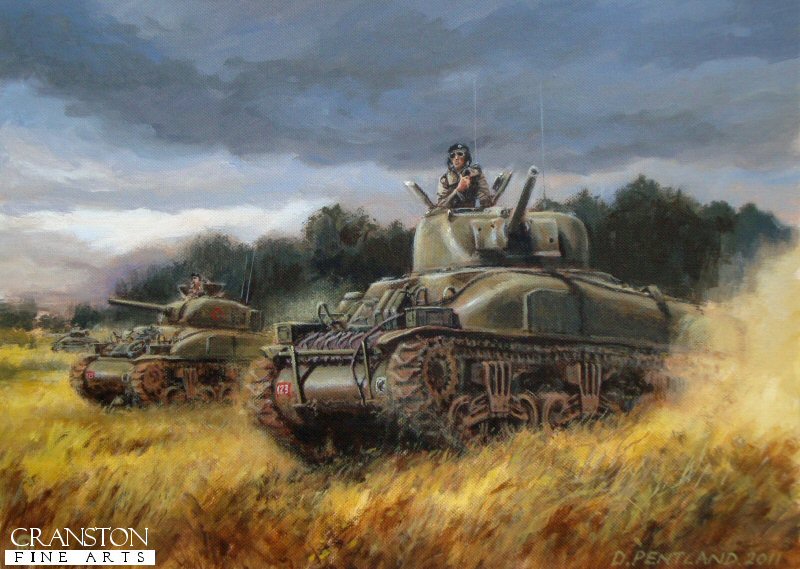
The Greys by David Pentland. (PC) Normandy, Odon, France, 1944. M4 Sherman II's of the Royal Scots Greys, 4th Armoured Brigade, during Operation Epsom. |
D-Day, Sword Beach, Normandy 1944 by David Pentland. (PC) After suppressing the initial German defences, a Sherman Crab flail tank of the 22nd Dragoons, 79th Armoured Division, clears a path through a minefield to allow tanks of 27th Armoured Brigade, and men of 3rd Infantry Division to breakout from the beaches. Fire support from surviving Sherman DD (amphibious) tanks of 13th /18th Hussars (QMO), proved invaluable in the initial push towards Caen. |
Debut at Caumont, 30th July 1944 by David Pentland (PC) Jagdpanthers of 654 heavy Tank Battalion engage 6th Guards Tank Brigade Churchills. |
Defence of the Reichstag, Berlin, 1st May 1945 by David Pentland (PC) On the 30th April, Untersharfuhrer Georg Diers and his crew of tank 314, were ordered to take up a defensive position at the Reichstag buildings. This was one of only two remaining King Tigers belonging to Heavy SS Tank Battalion 503 in Berlin. By that evening they had knocked out about 30 T34s, and the following day led a successful counterattack against the Kroll Opera House directly opposite the Reichstag. Their efforts though, merely postponed the inevitable and by the end of the day the order was given to abandon the position and prepare to break out of Berlin. |
Coup de Main, Pegasus Bridge, Normandy, 6th June 1944 by David Pentland. (PC) As a prelude to the invasion of Europe, certain important targets were attacked by airborne forces. Among them the bridge over the Caen canal which would protect the allies left flank. Major John Howard (D Company Ox and Bucks Light Infantry) gliders achieved complete surprise and the bridge was taken in a matter of minutes. Ever after it has been known as Pegasus Bridge in honour of the airborne forces emblem. |
The Barricade by David Pentland (PC) Nationalist anti tank gun position, Shanghai, 16th August 1937. A 37mm anti-tank gun of the elite German trained 88th Division, guarding a road junction in downtown Shanghai, against Japanese counterattacks to take the city. |
Mussolini's Boys by David Pentland. (PC) Bir El Gubi , North Africa, 4th December 1941. Young soldiers of the 'Giovani Fascisti' Division man a 47mm Breda Anti Tank gun during bitter fighting against the 4th Indian Division. Comprised of volunteers aged from 17 to 21, the GGFF, earned a reputation for bravery, and the nickname Mussolini's Boys. |
SS Panzer Grenadiers by Chris Collingwood. (PC) The term Panzergrenadier was applied equally to both the infantry section of the German Panzer Divisons and was also used for the new Panzergrenadier Divisions. The German army Panzergrenadier Divisions initially came from existing infantry divisions but were the first Divisons to be motorised. These included the 3rd, 10th, 14th, 15th, 16th, 18th, 20th, 25th, and 29th divisions. During the war special elite regiments such as the Grosdeutchland Division were created. The Waffen SS also produced a number of panzergrenadier regiments. Many army and Waffen SS regiments were upgraded to Panzer divisions during the later stages of the war. The Panzergrenadier division usually consisted of six battalions of truck-mounted infantry organized into either two or three regiments, also a battalion of tanks and artillery were included along with sections of anti-tank, anti-aircraft and combat engineers. Panzer grenadier divisions were often equipped with assault guns - Stugs. Panzergrenadier divisions had one tank battalion less than a Panzer division but strengthened with two more infantry battalions. Of 226 panzergrenadier battalions in the whole of the German Army, Waffen SS (and some in the Luftwaffe ) in September 1943, only 26 were equipped with armoured half tracks, the remaining Panzergrenadier divisions were equipped with trucks. |
Red Beach Two, Tarawa Atoll, 20th November 1943 by David Pentland (PC) US Marines of the 2nd Battalion, 2nd RCT, 2nd Marine Division, supported by LVTs and tanks, take part in the successful but bloody assault on Betio Island, part of the Tarawa Atoll. Operation Galvanic as it was known became the first step on the island road to Japan itself. |
Operation Winter Tempest by David Pentland (PC) Panzer IVF2 tanks of 6th Panzer Division, Panzer Armee Hoth, attempt to fight their way through to the beleaguered Sixth Army at Stalingrad, 12th December 1942. On the 21st the operation was abandoned when the expected breakout from Stalingrad failed to materialise, the relief column was only 25 miles from the city. |
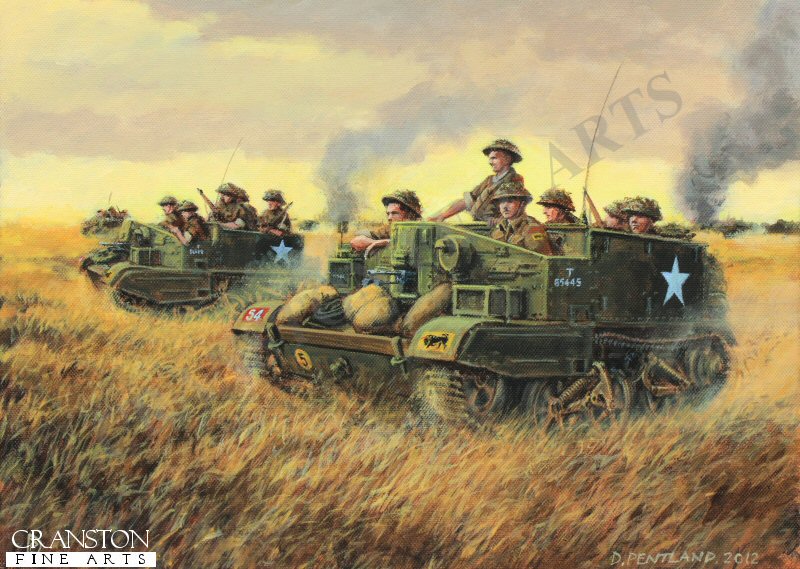
Carriers by David Pentland. (PC) Normandy, France, July 1944. Universal Carriers MkII of the Rifle Brigade, 11th Armoured Division, race forward at speed towards enemy positions. |
Anzio, Italy, February 1944 by David Pentland (PC) Replacements from 1st Battalion Irish Guards and Sherman tanks of the 46th Royal Tank Regiment move through the debris of Anzio town towards their jump-off positions for the Battle of Campoleone Station. |
General Erwin Rommel with the Africa Korps before the Battle for Tobruk by Chris Collingwood. (PC) No text for this item |
|
Contact Details |
Sign Up To Our Newsletter!
This website is owned by Cranston Fine Arts. Torwood House, Torwoodhill Road, Rhu, Helensburgh, Scotland, G848LE Contact: Tel: (+44) (0) 1436 820269. Email: cranstonorders -at- outlook.com
|