Order Enquiries (UK) : 01436 820269

You currently have no items in your basket


Buy with confidence and security!
Publishing historical art since 1985

Don't Miss Any Special Deals - Sign Up To Our Newsletter!
Product Search         
ALWAYS GREAT OFFERS :
20% FURTHER PRICE REDUCTIONS ON HUNDREDS OF LIMITED EDITION ART PRINTS
BUY ONE GET ONE HALF PRICE ON THOUSANDS OF PAINTINGS AND PRINTS
FOR MORE OFFERS SIGN UP TO OUR FREE NEWSLETTER

No.74 Sqn RAF

Founded : 1st July 1917
Country : UK
Fate :
Known Aircraft Codes : GM, JH, 4D, ZP

Trinidad

I fear no man

Hurricane of 56 Squadron was shot down by mistake by No. 74 Squadron and Pilot Officer M L Halton-Harrop of 56 sqd was killed on the 6th September 1939

No.74 Sqn RAF

Latest No.74 Sqn RAF Artwork Releases !
 Grid Caldwell, the top New Zealand Ace with 25 victories in his SE5A of 74 Squadron, is shown taking off from his home airfield during the Great War. Keith Logan (Grid Caldwell) was born 16th October 1895.  At the outbreak of World War One, Caldwell joined the territorial army.  He attempted to enlist with the New Zealand expeditionary force destined for Gallipoli but was refused.  In October 1915 he paid the sum of £100 to join the first class of the New Zealand Flying School.  In January 1916 Grid Caldwell arrived in England and was commissioned into the Royal Flying Corps in April that year.  In July 1916 he was posted to No.8 Squadron, flying BE2Cs and Ds on observation duty.  It was on 18th September 1916 his first aerial victory was scored, shooting down a Roland CII.  He transferred to 60 Squadron in November and flew Nieuport 17 fighters and was promoted to Captain in February 1917.  During this period he scored further victories, shooting down Albatros Scouts, and on 17th September was awarded the Military Cross.  In October 1917 he was posted back to England as an instructor.  In March 1918, promoted to Major, he was given command of 74 Squadron RAF flying SE5As.  The squadron under his command was credited with 140 aircraft destroyed and 85 out of control.  This tally was scored in the last eight months of the war with the loss of only 15 pilots killed or taken prisoner.  During his wartime flying, he had fought dogfights with German aces Werner Voss and Herman Becker, and he once survived a mid-air collision, bringing his badly damaged aircraft to ground level, jumping out before it crashed.  He was credited with 11 aircraft destroyed, 3 shared destroyed or captured and 10 out of control, and 1 further shared out of control.  During World War Two he was station commander at Woodbourne and later Wigram and posted to India in 1944.  After the war he was made commander of the British Empire.  He retired from the RNZAF in 1956, and sadly died of cancer in Auckland on 28th November 1980.

Grid Caldwell by Graeme Lothian. (PC)
 New Zealand's highest scoring ace, with 25 victories to his credit, proved himself to be an extraordinary and resourceful leader.  Whilst on a routine patrol in September 1918, Keith Logan 'Grid' Caldwell's 74 Sqn SE5a was involved in a mid-air collision with another SE5a, the impact breaking one of Caldwell's struts and destroying the aerodynamics of his aircraft, which promptly dropped 1,000 ft and went into a flat spin.  Incredibly, Caldwell climbed from the cockpit of his stricken machine and held the broken strut together with his left hand whilst keeping his right hand on the joystick, somehow steering his wayward fighter out of danger and over friendly territory.  With no hope of a safe landing, the Kiwi jumped clear of the SE5a just a second or so before it impacted with the ground. Astounded British soldiers in a nearby trench saw Caldwell stand, dust himself off and walk casually toward them.  He returned to his unit and continued flying until the end of the war.

The Tenacious Grid Caldwell by Ivan Berryman. (PC)
For nearly a thousand years the white cliffs of southern England had taunted many a foreign army.  These fortress walls of chalk, however, were defended by the moat-like waters of the Channel, and together they had shielded the British from her enemies.  Alongside Drake they had defied the armies of Spain and her great Armada and, in 1805, had halted the march of Napoleon's <i>Grand Armée</i>.  No enemy force since that of William the Conqueror in 1066 had successfully managed to cross the Channel in anger but, in May 1940, one of the most powerful armies the world had ever seen arrived at Calais.  An invasion by Hitler's all-conquering Wehrmacht was imminent - or so it seemed.  To cross the Channel and breach the English defences, the Luftwaffe simply had to gain control of the skies, and with massively superior numbers the outcom seemed inevitable.  The fate of Britain lay in the hands of less than 3,000 young airmen from Fighter Command - Churhill's 'Few'.  By July the most famous air battle in history was underway and, over the next three months under tranquil summer skies, the 'Few' battled to defend their Scpetred Isle.  Impossibly outnumbered and flying daily to the point of exhaustion, by October these courageous young men had snatched victory from the jaws of defeat, emerging defiantly victorious.  The threat of invasion might be over but a terrible price had been paid - during that long battle for the survival of Britain 544 had been killed and 422 wounded; and of those who survived a further 814 would be killed before the end of the war.  This painting pays tribute to the valiant 'Few', portraying a fleeting moment of calm for the pilots of 74 (Tiger) Squadron during the height of the Battle of Britain.  With his commanding officer Sailor Malan (ZP-A) to his right, Acting Flight Lieutenant John Freeborn (ZP-C) takes time to reflect on another day of intense combat while passing over the white cliffs and the familiar lighthouse at Beachy Head, as the squadron cross the English coast to head for home.

This Sceptred Isle by Robert Taylor.
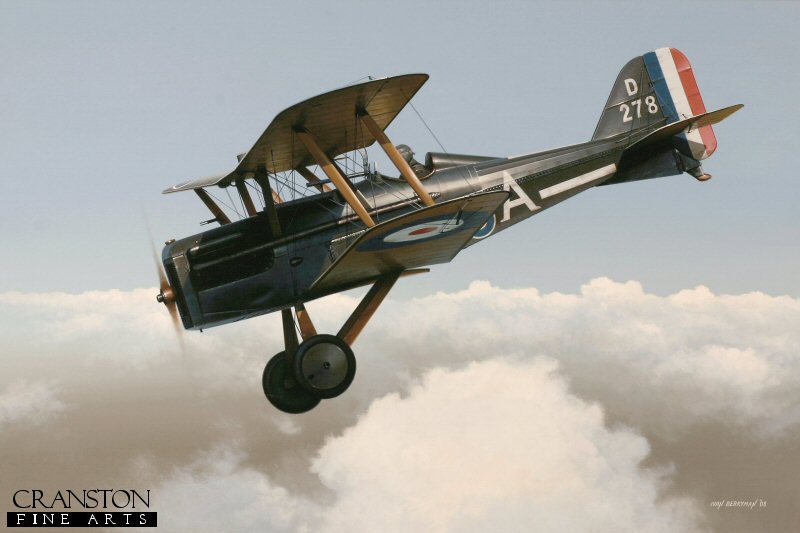
 Despite having sight in just one eye, Major Edward Mick Mannock was to become one of the most decorated and celebrated aces of World War 1, bringing down an official 61 enemy aircraft in just eighteen months before himself being brought down in flames by enemy ground fire. He was reluctant to add shared kills to his tally, so his actual total of victories is recorded at 73. His decorations include the VC, DSO and 2 Bars, MC and Bar and he is depicted here diving on enemy aircraft in SE5a D278 of 74 Sqn in April, 1918.

Major Edward Mannock by Ivan Berryman. (PC)

No.74 Sqn RAF Artwork Collection
Click the images below to view the fantastic artwork we have available to purchase!


The Tenacious Grid Caldwell by Ivan Berryman.


The Right of the Line by Graeme Lothian.


Dawn Dog Fight, Mick Mannock VC by Graeme Lothian.


Grid Caldwell by Graeme Lothian.


Major Edward Mannock by Ivan Berryman.


First Flap of the Day by Nicolas Trudgian.

Tigers Roar by Robert Tomlin.


Height of the Battle by Robert Taylor. (GS)


This Sceptred Isle by Robert Taylor.

Aces for : No.74 Sqn RAF
A list of all Aces from our database who are known to have flown with this squadron. A profile page is available by clicking the pilots name.
NameVictoriesInfo
Adolf Gysbert Malam35.00
John Connell Freeborn13.50The signature of John Connell Freeborn features on some of our artwork - click here to see what is available.