|
|
|
|
|
|
|
|
|
Cranston Fine Arts  Aviation Art and Artists World War Two Squadrons UK and Commonwealth No.225 Sqn to No.269 Sqn Aviation Art and Artists World War Two Squadrons UK and Commonwealth No.225 Sqn to No.269 Sqn  No.253 Sqn No.253 Sqn |
[UP] - No.225 Sqn - No.228 Sqn - No.229 Sqn - No.234 Sqn - No.235 Sqn - No.236 Sqn - No.238 Sqn - No.240 Sqn - No.242 Sqn - No.243 Sqn - No.244 Sqn - No.245 Sqn - No.247 Sqn - No.248 Sqn - No.249 Sqn - No.253 Sqn - No.254 Sqn - No.257 Sqn - No.261 Sqn - No.262 Sqn - No.263 Sqn - No.264 Sqn - No.266 Sqn - No.269 Sqn |
Come one, come all
253 Squadron was formed at Bembridge, on the Isle of Wight, on 7 June 1918,
During the squadrons stay at Bembridge it parented No. 412 (Seaplane) Flight RAF and No. 413 (Seaplane) Flight RAF, as well as No. 511 (Special Duty) Flight RAF, No. 512 (Special Duty) Flight RAF and No. 513 (Special Duty) Flight RAF for coastal reconnaissance and anti-submarine patrols, flying Short Type 184 and Airco DH.6 aircraft. DH.6s of 511 and 512 Flights flew their aircraft from the aerodrome at Foreland 253 sqd was disbanded on 31 May 1919.
On 30 October 1939, No 253 Squadron reformed at Manston and was originally intended as a shipping protection unit with Blenheims. None were delivered, however, and the squadron began to receive Hurricanes in February 1940, becoming operational on 3 April. In May 1940 one flight was sent to France to reinforce the hard-pressed Hurricane squadrons while the second flight flew daily to French airfields from 17 to 23 May. After re-equipping in Lincolnshire, No 253 took part in the Battle of Britain from the end of August and remained in southern England until January 1941. In February the squadron moved to the Orkneys for air defence duties, returning to England in September for convoy patrols off the East Coast. After taking part in the Dieppe raid, No.253 became non-operational in preparation for the invasion of North Africa and arrived in Algeria a few days after the landings. It provided air cover for the Army and its supply lines during the Tunisian campaign and its aftermath, moving to Italy in October 1943. In February 1944, the squadron arrived in Corsica to undertake escort and anti-shipping missions, returning to Italy in April for similar duties over Yugoslvia.
In April 1945 the squadron actually moved to a base at Zadar that had been captured by the Yugoslav partisans during the German retreat from the country. After the end of the war the squadron quickly returned to Italy, spending the next year at Treviso. the squadron acquired a flight of Spitfire XIs from No.225 Squadron and disbanded on 16 May 1947. It moved to Austria during the winter of 1946-47 before returning to Treviso, where it was disbanded on 16 May 1947.
On 18 April 1955, No 253 reformed at Waterbeach as a night fighter squadron with Venoms which it flew until disbanded on 1 September 1957.
The Squadron operated the following aircraft December 1939-May 1940: Fairey Battle I
February 1940-August 1941: Hawker Hurricane I, July 1941-September 1942: Hawker Hurricane IIA and IIB ' January 1942-September 1943: Hawker Hurricane IIC, March 1943: Supermarine Spitfire VC , August 1943-November 1944: Supermarine Spitfire VC , September 1943-June 1944: Supermarine Spitfire IX , November 1944-May 1947: Supermarine Spitfire VIII and IX
March-May 1947: Supermarine Spitfire XI April 1955 Venom Jet Fighters
| No.253 Sqn Aviation Art Prints, Paintings and Drawings Aviation Prints |
|
|
|
| Text for the above items : |
Hurricane Mk.IIC by Ivan Berryman. Hurricane Mk.IIC Z3971 of 253 Sqn, closing on a Heinkel 111. |
We All Stand Together by Robert Taylor. Spitfires of 616 Squadron scramble from RAF Kenley during the heavy fighting of the Battle of Britain, late August 1940. Below them a Hurricane of 253 Squadron, sharing the same base, is being prepared for its next vital mission at a distant dispersal. All through the long summer of 1940, as Britain stood alone, a small band of fighter pilots took part in the greatest aerial battle in history. Day after day the men of Fighter Command valiantly took to the air to defend their country from the Luftwaffe and the threat of German invasion and Nazi tyranny. Outnumbered, but never out-fought, they fought to the point of exhaustion and, in doing so, paid a heavy price. But they won. |
Hurricanes from Kenley by Michael Turner A flight of 253 Squadron Hurricanes taking off from Kenley in August 1940, led by Sqn.Ldr. Tom Gleave. |
| No.253 Sqn RAF Aircraft details |
 Havoc Manufacturer : Douglas | Havoc A-20 | |
 Hurricane Manufacturer : Hawker Built : 14533 | Hurricane Royal Air Force Fighter, the Hawker Hurricane had a top speed of 320mph, at 18,200 feet and 340mph at 17,500, ceiling of 34,200 and a range of 935 miles. The Hurricane was armed with eight fixed wing mounted .303 browning machine guns in the Mark I and twelve .303 browning's in the MKIIB in the Hurricane MKIIC it had four 20mm cannon. All time classic fighter the Hurricane was designed in 1933-1934, the first prototype flew in June 1936 and a contract for 600 for the Royal Air Force was placed. The first production model flew ion the 12th October 1937 and 111 squadron of the Royal Air Force received the first Hurricanes in January 1938. By the outbreak of World war two the Royal Air Force had 18 operational squadrons of Hurricanes. During the Battle of Britain a total of 1715 Hurricanes took part, (which was more than the rest of the aircraft of the Royal air force put together) and almost 75% of the Victories during the Battle of Britain went to hurricane pilots. The Hawker Hurricane was used in all theatres during World war two, and in many roles. in total 14,533 Hurricanes were built. | |
 Spitfire Manufacturer : Supermarine Built : 20351 | Spitfire Royal Air Force fighter aircraft, maximum speed for mark I Supermarine Spitfire, 362mph up to The Seafire 47 with a top speed of 452mph. maximum ceiling for Mk I 34,000feet up to 44,500 for the mark XIV. Maximum range for MK I 575 miles . up to 1475 miles for the Seafire 47. Armament for the various Marks of Spitfire. for MK I, and II . eight fixed .303 browning Machine guns, for MKs V-IX and XVI two 20mm Hispano cannons and four .303 browning machine guns. and on later Marks, six to eight Rockets under the wings or a maximum bomb load of 1,000 lbs. Designed by R J Mitchell, The proto type Spitfire first flew on the 5th March 1936. and entered service with the Royal Air Force in August 1938, with 19 squadron based and RAF Duxford. by the outbreak of World war two, there were twelve squadrons with a total of 187 spitfires, with another 83 in store. Between 1939 and 1945, a large variety of modifications and developments produced a variety of MK,s from I to XVI. The mark II came into service in late 1940, and in March 1941, the Mk,V came into service. To counter the Improvements in fighters of the Luftwaffe especially the FW190, the MK,XII was introduced with its Griffin engine. The Fleet Air Arm used the Mk,I and II and were named Seafires. By the end of production in 1948 a total of 20,351 spitfires had been made and 2408 Seafires. The most produced variant was the Spitfire Mark V, with a total of 6479 spitfires produced. The Royal Air Force kept Spitfires in front line use until April 1954. | |
 Venom | Venom No profile available | |
| No.253 Sqn RAF Pilot and aircrew signature details |
Flight Lieutenant Alan Davies Our estimated value of this signature : £45 | Flight Lieutenant Alan Davies Joining the RAF in 1943, Alan Davies did his pilot training in America. Returning to the UK he flew Spitfire MkXIVs with an OTU, before joining 225 Tactical Reconnaissance Squadron flying Spitfire Mk IXs. At the end of the war, he remained with the squadron, first at Klagenfurt in Austria, then Udine in Italy, and served briefly with 253 Squadron. | |
  Air Commodore John Ellacombe CB DFC* Our estimated value of this signature : £50 Died : 2014 | Air Commodore John Ellacombe CB DFC* John Ellacombe joined the RAF in 1939 and was posted to 151 Squadron in July 1940, immediately converting to Hurricanes. On 24th August he shot down a He111, but a week later his Hurricane was blown up in combat and he baled out, with burns. Rejoining his squadron a few months later, in February 1941 was posted to 253 Squadron where he took part in the Dieppe operations. On 28th July, flying a Turbinlite Havoc, he probably destroyed a Do217. Converting to Mosquitos, John was posted to 487 Squadron RNZAF, and during the build up to the Normandy Invasion and after, was involved in many ground attacks on enemy held airfields, railways, and other targets of opportunity. He completed a total of 37 sorties on Mosquitos. Flying a de Havilland Mosquito XIII with a devastating set of four 20mm cannon in the nose, John Ellacombe flew deep into occupied France on the night before D-Day searching out and destroying German convoys and railway targets. As the Normandy campaign raged on, 151 Squadron intensified its interdiction sorties - including night attacks on Falaise and the Seine bridges. On August 1st Ellacombe took part in the famous attack by 23 Mosquitoes on the German bar-racks in Poitiers, led by Group Captain Wykeham Barnes. Ellacombe had first joined 151 Squadron during the Battle of Britain, direct from Flying Training School. Within weeks he had scored his first victory but also force landed in a field, having shot down a He 111, and baled out of a blazing Hurricane. He baled out a second time during the Dieppe Raid in 1942 but was picked up safely. Postwar he had a long and successful career in the RAE. Air Commodore John Ellacombe, who has died aged 94, survived being shot down three times during the Second World War - twice during the Battle of Britain. On August 15th 1940 the Luftwaffe launched Adler Tag (Eagle Day), with the object of destroying Fighter Command by attacking the ground organisation and drawing the RAF's fighters into the air. Nine Hurricanes of No 151 Squadron were scrambled during the afternoon and met enemy fighters near Dover at 18,000ft. Ellacombe attacked a Messerschmitt Bf 109 and fired three bursts. The enemy fighter rolled on to its back and dived into the sea. There was heavy fighting over the next few days, and on August 24 Ellacombe engaged a Heinkel III bomber. His fire hit its engines and the bomber crash-landed in Essex . During intense fighting on August 30 he attacked a formation of Heinkels head on. He hit one, which crashed, but return fire damaged the engine of his Hurricane and he was forced to land in a field, where a farmer accosted him with a pitchfork. On the following day Ellacombe damaged two Bf 109s before attacking a Junkers 88 bomber. When the Junkers returned fire, setting his Hurricane's fuel tank ablaze, he bailed out. As he drifted to the ground, a member of the Home Guard fired on him. He was then marched to a police station where he was assaulted by a constable who thought he was German. Later in life Ellacombe remarked: In two days, a farmer had attempted to kill me, the Home Guard had shot at me and a policeman had tried to kill me - quite apart from the Germans. I wondered whose side I was on. He received hospital treatment for his burns, and his fighting days during the Battle of Britain were over. After several months convalescing Ellacombe returned to No 151, which had been reassigned to night fighting. Equipped with the Hurricane and the Defiant, the squadron had little contact with the enemy; but Ellacombe developed a reputation for flying at night in the worst weather, and in April 1942 he was awarded a DFC for his service in the Battle of Britain and for showing the greatest keenness to engage the enemy. Posted to No 253 Squadron as a flight commander, he found night fighting dull, and volunteered for daylight operations. He flew in support of the ill-fated raid on Dieppe, and as he attacked a gun battery his aircraft was hit by flak. Ellacombe managed to get over the sea before bailing out and being picked up by a Canadian landing craft. After a rest tour, Ellacombe converted to the Mosquito before joining No 487 (NZ) Squadron, flying low-level intruder missions over France and the Low Countries. He attacked V-1 sites in the Pas de Calais and bombed roads and railways in support of the Normandy landings. He saw constant action attacking targets in support of the Allied armies and during the breakout from the Falaise pocket. After 37 intruder bombing patrols Ellacombe was rested and awarded a Bar to his DFC. He spent the remainder of the war on training duties, but still managed occasionally to take a Mosquito on an operational sortie. The son of an English doctor who had served during the Boer War, John Lawrence Wemyss Ellacombe was born at Livingstone, Northern Rhodesia, on February 28 1920 and educated at Diocesan College (Bishops) in Cape Town. In May 1939 he went to Britain to join the RAF, trained as a pilot and in July 1940 was posted to No 151 Squadron; he had never flown a Hurricane. Post-war he remained in the RAF, most of his flying appointments being in Fighter Command. After service in Aden he led No 1 Squadron, flying Meteor jets, and he commanded the Fighter Development Unit at the Central Fighter Establishment, developing tactics for the Hunter and Lightning . He served in Washington as a liaison officer with the USAF on fighter operations before commanding the RAF flying training base at Linton-on-Ouse, near York. Ellacombe was the senior serving representative at the Defence Operational Analysis Establishment, and on promotion to air commodore in 1968 was appointed Air Commander of Air Forces, Gulf, with headquarters at Muharraq, Bahrain. The withdrawal of British forces from Aden was scheduled for the end of that year, and Muharraq became a key staging post and support airfield . Ellacombe's calm handling of affairs in Bahrain was recognised by his appointment as CB. His final appointment was in the MoD, and he retired in 1973. Ellacombe then became Director of Scientific Services at St Thomas's Hospital in London, and later administrator to the hospital's trustees. A good cricketer and rugby player in his younger days, he played golf three times a week until he was 88, and he was a keen follower of Middlesex CCC. He particularly enjoyed watching his grandchildren play cricket (some of them at county junior level, including a granddaughter who turned out for Essex Ladies). John Ellacombe's wife, Mary, whom he married in 1951 when she was serving in the WRAF, had served on Winston Churchill's staff and been appointed OBE. She died in 2007, and he is survived by their son and two daughters. Air Commodore John Ellacombe, born February 28 1920, died May 11 2014. | |
Group Captain Peter Gilpin CBE DFC Our estimated value of this signature : £25 | Group Captain Peter Gilpin CBE DFC Peter originally joined 253 Sqn flying Hurricanes, converting to Spitfire Mark 5s he took part in the invasions of North Africa and Sicily, providing fighter cover. Later based in Italy he was on a low level fighter sweep over Yugoslavia on the 2nd June 1944 when he was hit by ground fire and had to bale out. Captured by the Germans he was initially a PoW in Yugoslavia, before being transferred to Stalag Luft 7a, Moosberg, Germany. | |
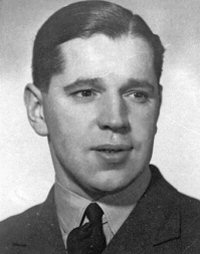 Group Captain Tom Gleave Our estimated value of this signature : £40 Died : 1993 | Group Captain Tom Gleave Gleave joined the RAF in 1930 after returning to Britain, qualifying as an exceptional pilot before serving with No. 1 Squadron and later as a flying instructor. At the outbreak of the Second World War he held staff appointments before taking command of No. 253 Squadron during the Battle of Britain. In August 1940 he was shot down and severely burned, undergoing extensive reconstructive surgery under Sir Archibald McIndoe at Queen Victoria Hospital, where he became a founding member and later Vice-President of the Guinea Pig Club. Returning to flying within a year, he commanded RAF Manston during the Channel Dash and the Dieppe operation, championing improvements that led to the construction of a long concrete runway to aid damaged returning aircraft. Promoted to Group Captain, Gleave played a pivotal role in Allied air planning, co-authoring the air strategy for Operation Overlord and later serving as Head of Air Plans at Supreme Headquarters Allied Expeditionary Force. His wartime service earned him numerous British and international honours, including the CBE, the French Légion d'Honneur and the US Bronze Star. After retiring from the RAF in 1953, he became an official historian with the Cabinet Office and remained a leading figure in the Guinea Pig Club and the Battle of Britain Fighter Association until his death in 1993. | |
Squadron Leader Robert Innes Our estimated value of this signature : £50 Died : 2005 | Squadron Leader Robert Innes Born on June 15th 1918, Innes joined the RAFVR about August 1938 as an Airman under training Pilot. Called up on September 1st 1939 he completed his training at No 10 FTS Fern Hill from November 5th 1939 to early May 1940. Bob Innes was then posted to 253 (F) Squadron on Hurricanes at Kenley on May 6th 1940. He claimed a Bf110 destroyed on August 30th and on September 15th shot down a Dornier Do17 of 8/KG2. Bob Innes crashed in Hurricane V6736 on September 20th 1940 following an attack by Bf109s over Maidstone. He crashed again during an interception patrol on October 11th at Staplehurst in Kent, whilst flying Hurricane L1666 (force landing). He probably destroyed a Bf109 off the coast of Essex on November 11th 1940. Commissioned in March 1941 - Bob Innes served in Malta and retired from the RAF on August 31st 1961 as a Squadron Leader. Bob sadly passed away on April 6th 2005. | |
 General Joseph Risso Our estimated value of this signature : £45 Died : 2005 | General Joseph Risso Born in Cardolive on the 23rd January 1920, Joseph Risso was first engaged in aviation in 1938, he entered the Caudron d'Ambérieu pilot school the same year. In 1939-1940, he finished his education at the school of Istres. After the armistice of 1940, he escaped from Nouvion (today El Ghomri, Algeria) aboard a Simoun to join Gibraltar. After a forced landing at La Línea , he succeeded in rallying the FFL in Gibraltar and then in England. Joseph Risso joined the RAF in 1940. Flying Hurricanes with 253 squadron, he later took part in Turbin-light night fighter operations over the North Sea. In March 1943 Joseph Risso was one of the first batch of 14 pilots to take part in air operations over the Russian front with the first Normandie-Niemen Squadron. Joseph Risso was one of the very first elements of the hunting group 3 Normandy. He arrived in the USSR at Ivanovo in October 1942 and remained in that unit until 1948. Only three of these first pilots survived the war. Joseph Risso flew over 600 missions and scored 11 victories. He was decorated by France and the Soviet Union. He then held numerous positions in the Air Force; He was assigned to the General Staff of the 5th RA in Algiers, the {11th} Fighter Squadron (2nd in command), to the 13th All-Weather Fighter Squadron (Commander). He was also an auditor at the NATO Defense College and subsequently assigned to the Directorate of Military Security . After a visit to the Center for Advanced Military Studies and the Institute of Higher Studies of National Defense, he headed the Air Defense Operations Center at Taverny as a brigadier general. Sadly Joseph died 24th November 2005 at the age of 85. | |
| Aces for : No.253 Sqn RAF | ||
| A list of all Aces from our database who are known to have flown with this squadron. A profile page is available by clicking the pilots name. | ||
| Name | Victories | Info |
| Joseph Risso | 11.00 | The signature of Joseph Risso features on some of our artwork - click here to see what is available. |
|
Contact Details |
Sign Up To Our Newsletter!
This website is owned by Cranston Fine Arts. Torwood House, Torwoodhill Road, Rhu, Helensburgh, Scotland, G848LE Contact: Tel: (+44) (0) 1436 820269. Email: cranstonorders -at- outlook.com
|


