|
|
|
|
|
|
|
|
|
Cranston Fine Arts  Aviation Art and Artists World War Two Squadrons Germany JG1 to JG54 Aviation Art and Artists World War Two Squadrons Germany JG1 to JG54  JG53 JG53 |
[UP] - JG1 - JG2 - JG3 - JG4 - JG5 - JG7 - JG11 - JG21 - JG26 - JG27 - JG50 - JG51 - JG52 - JG53 - JG54 |
| JG53 Aviation Art Prints, Paintings and Drawings Aviation Prints |
|
|
|
|
|
|
|
|
| Text for the above items : |
Tribute to Franz Schieß by Ivan Berryman. Scoring his first victories on the Eastern Front with JG53, Franz Schieß was posted with his squadron to the Mediterranean from December 1941. He shot down aircraft consistently through 1942, operating from Sicily then Tunisia. He achieved his 50th victory in May 1943, claiming one of his eventual unsurpassed tally of 17 P-38 Lightnings. Awarded the Knight's Cross in June 1943, he was sent on leave for two months but returned in August, claiming 12 victories in 11 days. On 2nd September 1943, he was killed when his Me109 crashed into the sea during combat with P-38 Lightnings. He was credited with 67 victories in more than 650 missions. |
Angels Three Zero by Robert Taylor Bobby Oxspring in his 66 Squadron Spitfire destroys an ME109 of JF/53 Ace of Spades Group, in a high level attack at 30,000 feet above Dover, 18th September 1940. |
The Blond Knight by Robert Taylor. It is a record likely to stand for all time, Erich Hartmann's tally of 352 victories is more than any other pilot in history. Posted to JG52 over Russia in August 1942 his new Kommodore, Dieter Hrabak, placed the novice pilot under the guidance of Paule Rossman, one of the unit's most experienced and respected Aces. However, during his very first combat Hartmann became so disorientated that he got lost in cloud and ran out of fuel. His undoubted skill as a pilot enabled him to survive the inevitable crash-landing, but a few days later and just minutes after scoring his first ever victory, he was shot down - again crash-landing. This time he only just escaped from his burning aircraft before it exploded. Any other new pilot might have succumbed but Hartmann was made of sterner stuff and , with Rossman's help and guidance, it was not long before everyone in JG52 realised that he possessed exceptional skill. By the summer of 1943 the Blond Knight and his colleagues were flying up to six missions a day and having now perfected his technique, it was unusual for him to finish a day without a victory. Never claiming to be an expert marksman, his approach, which took nerves of steel and great flying skills, was to get as close to his enemy as possible before opening fire at the last minute. Often flying head on, the risks of collision and damage were great - of the sixteen times Hartmann was brought down, eight were as a result of flying into the debris of his victim! Hartmann's 352 victories were achieved with JG52 - all except one. It happened during a brief two week spell at the beginning of February 1945 when the top Ace was placed in temporary command of I./JG53. His new unit were based in Hungary where German Army Group South was in bitter retreat and the fighting was as tough and relentless as ever. The Blond Knightportrays Erich Hartmann climbing out of his Bf109 G-6 at Weszperem's snow-covered airfield after returning from another arduous mission leading Stab I./JG53 with whom, on 4th February he downed a Yak-9. It was his 337th victory. |
Bf109 K-4 by Randall Wilson. (GL) Messerschmitts from Stabb 111/JG53 patrolling over Germany in the last days of WW2, piloted by Lt. Bernard Ernst Dieter April 1945. |
Tribute to Alfred Grislawski by Ivan Berryman. Credited with more than 130 victories in World War Two, Alfred Grislawksi scored 24 of these on the Western Front. He is depicted here flying his Me109 with JG53 in what would be his last combat on 26th September 1944. Having shot down a P-38 Lightning earlier in the day, he was shot down in the combat shown by the P-51 Mustang of American Ace Hub Zemke and bailed out. Opening his parachute very low for fear of being shot at, he landed hard and damaged vertebrae, and did not recover before the end of the war. Awarded the Knight's Cross with Oak Leaves, he died in 2003 aged 83. |
Malta - George Cross by Robert Taylor. Pilot Officer John Bisley of 126 Squadron in combat with Me 109s from JG-53 during one of the intense aerial air battles over Valetta in April 1942. Between the summer of 1940 and the end of 1942, Malta became one of the most bombed places on earth. The RAFs desperate fight to retain control of the diminutive Mediterranean island, and the defiant courage of the people of Malta, is one of the epic stories of World War Two. |
Special Duties by Robert Taylor. A Junkers Ju52 of Luftflotte 2, escorted by Me109s of JG-53, transports important military personnel over the Dolomites in 1942. With the setting sun illuminating the mountain tops in a brilliant light, the panoramic vista is both chilling and spectacular. As the aircraft lumbers across the impressive mountain scenery, members of the High Command can be seen in conference in the cabin, while crew in the cockpit concentrate on their special duties flight plan. Behind them, unprotected from the elements, a lone gunner keeps a watchful eye. The Ju52 became the Luftwaffes primary wartime transport aircraft, taking part in every German army land operation during World War II. |
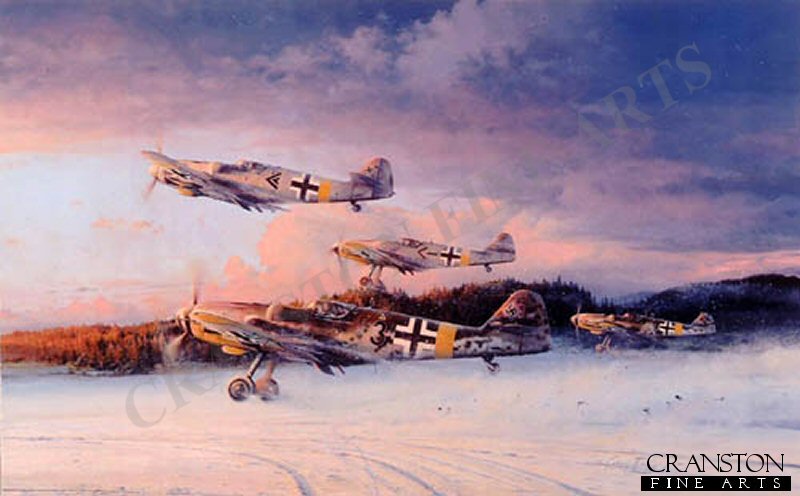
Eagles at Dawn by Robert Taylor. On Thursday, August 24, 1944 a 22-year old Oberleutnant Erich Hartmann powered his Mel09G fighter in a spectacular low pass over his squadrons airstrip in north-eastern Rumania, wagging his wings to the cheering Luftwaffe personnel on the ground below. The young flaxen-haired pilot had just become the first fighter Ace in history to bring down 300 enemy aircraft in combat. As World War II drew to its close, after three and a half years of continual aerial combat, this gifted young fighter pilot brought his final tally of aerial victories to 352, bringing down a Yak-7 during the last of his 1400 missions on May 8, 1945. He was the most successful fighter pilot of all time. In this dramatic rendition, we see captured a brilliantly colourful midwinter scene during the final phase of the war on the Eastern Front. Glinting in the sub-zero early morning sunlight as fresh snow begins to fall, and led by their Gruppenkommandeur Erich Hartmann, the Mel09G fighters of I./JG-53 scramble off the snow-covered airstrip at Veszprem in Hungary, February 1945. They will intercept waves of Russian fighters and bombers in the skies above Czechoslovakia in a last ditch attempt to repel the impending invasion of Germany. |
| JG53 Aircraft details |
 Me109 Manufacturer : Messerschmitt Built : 33984 | Me109 Willy Messerschmitt designed the BF109 during the early 1930s. The Bf109 was one of the first all metal monocoque construction fighters with a closed canopy and retractable undercarriage. The engine of the Me109 was a V12 aero engine which was liquid-cooled. The Bf109 first saw operational service during the Spanish Civil War and flew to the end of World War II, during which time it was the backbone of the Luftwaffe fighter squadrons. During the Battle of Britian the Bf109 was used in the role of an escort fighter, a role for which it was not designed for, and it was also used as a fighter bomber. During the last days of May 1940 Robert Stanford-Tuck, the RAF ace, got the chance to fly an Me109 which they had rebuilt after it had crash landed. Stanford-Tuck found out that the Me109 was a wonderful little plane, it was slightly faster than the Spitfire, but lacked the Spitfire manoeuvrability. By testing the Me109, Tuck could put himself inside the Me109 when fighting them, knowing its weak and strong points. With the introduction of the improved Bf109F in the spring of 1941, the type again proved to be an effective fighter during the invasion of Yugoslavia and during the Battle of Crete and the invasion of Russia and it was used during the Siege of the Mediteranean island of Malta. The Bf109 was the main fighter for the Luftwaffe until 1942 when the Fw190 entered service and shared this position, and was partially replaced in Western Europe, but the Me109 continued to serve on the Eastern Front and during the defence of the Reich against the allied bombers. It was also used to good effect in the Mediterranean and North Africa in support of The Africa Korps. The Me109 was also supplied to several German allies, including Finland, Hungary, Romania, Bulgaria, Croatia, and Slovakia. The Bf109 scored more kills than any other fighter of any country during the war and was built in greater numbers with a total of over 31,000 aircraft being built. The Bf109 was flown by the three top German aces of the war war. Erich Hartmann with 352 victories, Gerhard Barkhorn with 301 victories and Gunther Rall with 275 kills. Bf109 pilots were credited with the destruction of 100 or more enemy aircraft. Thirteen Luftwaffe Aces scored more than 200 kills. Altogether this group of pilots were credited with a total of nearly 15,000 kills, of which the Messerschmitt Bf109 was credited with over 10,000 of these victories. The Bf109 was the most produced warplane during World War II, with 30,573 examples built during the war, and the most produced fighter aircraft in history, with a total of 33,984 units produced up to April 1945. Bf109s remained in foreign service for many years after World War II. The Swiss used their Bf109Gs well into the 1950s. The Finnish Air Force did not retire their Bf109Gs until March 1954. Romania used its Bf109s until 1955. The Spanish Hispanos flew even longer. Some were still in service in the late 1960s. |
| JG53 Pilot and aircrew signature details |
  Leutnant Helmut Ballewski Our estimated value of this signature : £55 Died : 2015 | Leutnant Helmut Ballewski Helmut Ballewski was one of the 'younger' generation flyers, not joining the Luftwaffe until November 1942. Posted to JG53 PIK AS he flew all of his 47 missions in the west. With IV./JG53 from January 1945, Helmut Ballewski was Helmut Bennemann's wingman on Operation Bodenplatte. He also flew fighter bomber operations on the Bridge at Remagen operation. He was awarded the Iron Cross. He died on 27th June 2015. |
  Oberstleutnant Helmut Bennemann Our estimated value of this signature : £65 Died : 2007 | Oberstleutnant Helmut Bennemann Helmut Bennemann was born 16th March 1915. During the Battle of Britain Helmut Bennemann was Gruppenadjutant with I./JG52 on the Channel Front. In April 1942 he was Staffelkapitan of 3./JG52 in the east and was appointed Kommandeur of I./JG52 from June 1942 until October 1943. Posted to Italy in November 1943, he was promoted to Kommodore of JG53 (Ace of Spades) in this theatre and in the defence of Germany. He commanded JG53 on Operation Bodenplatte. Helmut Bennemann flew over 400 missions, scoring 92 victories and was awarded the Knight's Cross. He died 17th November 2007. |
  Hauptmann Alfred Grislawski Our estimated value of this signature : £60 Died : 2003 | Hauptmann Alfred Grislawski Alfred Grislawski joined 9./JG52 in 1940, quickly becoming an Ace. An outstanding fighter pilot, his air victories were 133 in over 800 combat missions until he was severely wounded. he was awarded the Knight's Cross with Oak Leaves. Died 19th September 2003. |
  Major Julius Meimberg Our estimated value of this signature : £80 Died : 2012 | Major Julius Meimberg Julius Meimberg joined JG2 Richthofen in December 1939 and during the Battle of France flew as wingman to Assi Hahn. An Ace during the Battle of Britain, Meimberg flew with Wick on the day that he was fatally shot down over the Isle of Wight. In 1944 Meimburg was appointed Gruppenkommandeur II./JG53. He was awarded the Knight's Cross and achieved 53 victories in 600 combat missions. Memories from Julius Meimberg of the day that Helmut Wick was shot down : Late in the afternoon of 28th November 1940, we took off for southern England from Beaumont le Roger for our second mission of the day. Climbing towards the Isle of Wight in bright sunshine, I was leading the 4th Staffel and directly ahead of us was the Staff Schwarm of JG2 Richthofen led by Kommodore Major Helmut Wick, at that time the leading fighter pilot in the Luftwaffe. With him were his wingman Oberleutnant Rudi Pflanz, Oberleutnant Leie and Oberfeldwebel Rudorffer. At about 23,000 ft, we were almost above the Isle of Wight when we spotted vapour trails caused by Spitfires above us at a much greater height. Major Wick led his Staff Schwarm towards them at full throttle, with the result that the Schwarm aircraft pulled apart from each other. Climbing with my Staffel to one side, we were soon drawn into the main battle and the Staffel separated. A single Spitfire turned in front of me and disappeared behing my engine cowling as I fired off my weapons. Apparently undamaged, the aircraft went into a spin and I followed it down, expecting the aircraft to pull out at any time, but it never did. The red glow in the cockpit indicated a possible oxygen tank hit. When we landed, Rudi Pflanz reported that Major Wick had shot down a Spitfire, was then in turn shot down by a second Spitfire, which in turn had been shot down by Pflanz. We were all told that no-one had seen what had happened to Wicks aircraft, which left us hoping for the safety of our Kommodore. We returned later next day, and again the following day, but there was no sign of him. What we had not been told was that Rudorffer had witnessed him go down, a large bullet hole passing through the starboard wing trailing edge, straight through the cockpit and engine block. He felt that Wick was already dead as his aircraft corkscrewed downwards, finally plunging into the sea. After the war, I learned that his conqueror had been Flight Lieutenant John Dundas DFC, himself only seconds later shot down by Pflanz and killed. Julius Meimberg passed away on 17th January 2012. |
 Stabsgefreiter Hubert-Ludwig Pflaum Our estimated value of this signature : £25 | Stabsgefreiter Hubert-Ludwig Pflaum After joining the Luftwaffe and completing his flight training, he originally flew Heinkel 111 bombers with IV./KG 27 Boelcke. Towards the end of the war, however, he transferred to train as a fighter pilot, and after qualifying joined II./JG53 PikAs where he flew Bf109s with 6 Staffel in the Defence of the Reich. |
  Oberleutnant Gunther Seeger Our estimated value of this signature : £50 Died : 2013 | Oberleutnant Gunther Seeger In February 1940, Gunther Seeger was an Unteroffizier with 3./JG2, scoring his first victory in the early days of the Battle of Britain. he served on the Channel Front until December 1942, including several months with the Geschwaderstabsschwarm. He transferred to the Mediterranean theatre with II./JG2 before joining 6./JG53. In February 1943 he joined 7./JG53 becoming Staffelkapitan in September 1944. Awarded the Knight's Cross, Gunther Seeger scored 56 victories. |