|
|
|
|
|
|
|
|
|
Cranston Fine Arts  Military Art and Artists 17th - 18th Century History 17th to 18th Century Regiments Military Art and Artists 17th - 18th Century History 17th to 18th Century Regiments  Coldstream Regiment of Foot Guards Coldstream Regiment of Foot Guards |
|
|
|
|
|
|
|
|
|
|
|
|
| Text for the above items : |
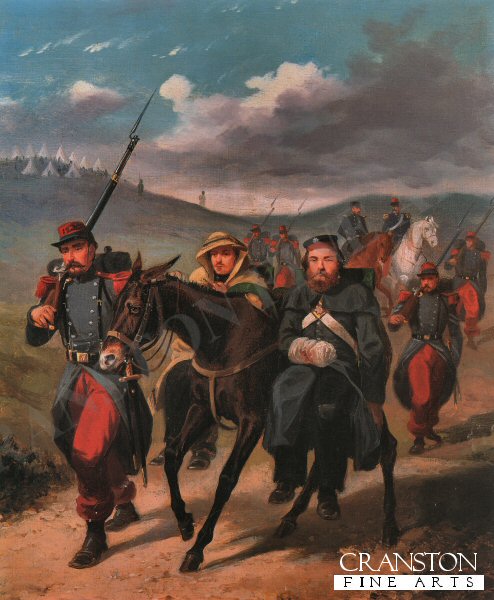
Return from Inkerman by Lady Elizabeth Butler. A column of exhausted and wounded men of the Coldstream Guards and the 20th East Devonshire regiment returning from the heights of Inkerman, 5th November 1854, during the Crimean War. |
Assault on the Breach of San Sebastian by Mark Churms. The Storming party, 750 volunteers, included 200 men of the Guards, one hundred each from the First and Coldstream Guards. They moved off at two in the morning on the 31st August 1813, and occupied a ruined convent where they remained till half past nine. Aware of the almost impossible task ahead of them, and subjected to a violent electric thunderstorm, the troops waited in a state of savage anticipation. Wild senseless laughter was said to have preceded the attack on the breach which could not be entered except in single file under heavy fire. The troops attacked in succession, but were struck down by hundreds. General Graham then ordered the artillery to fire over the heads of the assailants, clearing the ramparts. A shell ignited a quantity of powder, and under cover of the explosions, the storming party forced its way into the town. San Sebastian was savagely sacked and burned, and the good name of Wellingtons Army suffered as it had done at Badajoz. The civilians were raped, robbed and murdered in revenge for the heavy losses suffered by the troops. The Franco-Spanish governor retired the citadel (San Marcial) and on the 9th September, after a gallant resistance of over a week, surrendered the charge he had so faithfully defended. The casualties among the officers of the first Guards were one Officer, Ensign Burrard, First battalion (a son of Sir Henry Burrard who was responsible for the disastrous Treaty of Cintra) severely wounded, since dead, and one Officer, Ensign Orlando Bridgeman, wounded. In the Coldstream Guards, one officer ensign Thomas Chaplin, According to Lord Saltoun there were in round numbers, 150 casualties amongst 200 Guardsman. Total losses of volunteers from all regiments were 1500 men. (text by Atlanta Clifford, assistant to the Curator-The Guards Museum) In the painting. you see Ensign Chaplin lying wounded, attended by an Officer of the Coldstream Guards, Orlando Bridgeman is calling Assistant Surgeon Bacot, First Foot Guards, to go to the aid of his fellow officer, Burrard. |
The Battle of Alma by Felix Philippoteaux. The Black Watch is shown with the Coldstream Guards and Scots Guards in the distance advancing up from the river Alma to attack the Russian forces at the top of the surrounding hills. |
Defence of Hougoumont Farm at the Battle of Waterloo by Jason Askew. The British 1st Foot Guards and Coldstream Guards rush to defend the gate of Hougoumont Farm against a fierce French attack during the battle of Waterloo. During the battle, the Coldstream Guards lost 97 killed, 446 wounded and 4 missing, while the 1st Foot Guards lost 125 killed and 352 wounded. |
Officer of the Coldstream Guards (Winter Dress) by L Mansion & L Eschauzier (P) No text for this item |
Hougoumont by Robert Gibb. Showing the 1st Foot Guards and The Coldstream Guards struggling to close the gates at Hougoumont Farm against the Heavy French forces at the Height of the the battle of waterloo. During the Battle of waterloo the 1st Foot Guards and the Coldstream Guards losses were as follows. 1st Foot Guards, 125 Killed, 352 Wounded, and the Coldstream Guards losses, were 97 killed and 446 wounded and four missing. |
The Wounded Coldstream Guardsman by Alfred D Prades. No text for this item |
Defence of Hougoumont Farm by Robert Hillingford. 1st Foot Guards and The Coldstream Guards are shown manning the walls of Hougoumont Farm against the heavy French forces at the height of the the Battle of Waterloo. Also shown are some captured French soldiers. During the Battle of Waterloo the 1st Foot Guards and the Coldstream Guards losses were as follows: 1st Foot Guards - 125 Killed, 352 Wounded, and the Coldstream Guards - 97 killed and 446 wounded and four missing. |
Coldstream Guards 1810 by Douglas Anderson No text for this item |
Return from Inkerman by Lady Elizabeth Butler. A column of exhausted and wounded men of the Coldstream Guards and the 20th East Devonshire regiment returning from the heights of Inkerman, 5th November 1854, during the Crimean War. |
Officer, Coldstream Guards 1680 by P H Smitherman The dress shown here is an undress uniform, similar in use, perhaps, to the blue frock coat commonly worn by officers before 1914 and still worn by officers of the Brigade of Guards. The details are taken from a picture showing a guard mounted by the regiment in the Horse Guards, Whitehall, in which the officers are shown, rather to ones surprise, in this order of dress rather than in ceremonial full dress. the brown coat, in fact, is very little different from the simple brown coats - shown in the same picture - being worn by King Charles II and the members of his court.. Indeed the whole picture is one of delightful informality, with the King and his friends walking along a path, the guard turned out in his honour, cows grazing peacefully on the grass, and the country people going about their business within a few yards of the Monarch. In a setting of this sort a brown undress coat was probably more appropriate than the full dress coat worn today. The crimson sash, which has been worn by the British infantry officer on duty from about this time, is here shown almost in the form in which it is worn today.. The main weapon carried by the officers, only part of which is shown, is the sixteen foot pike, the same as that carried by the pikemen of the regiment. It was more usual for officers to carry the half pike, or spontoon, but evidently, for guard duties, the full pike was ordered. The regiment was raised by Cromwell during the Commonwealth, and their first colonel was Monck, who led them from Coldstream, where they were stationed at the time, to join King Charles II at his Restoration. They acquired the name Coldstream Guards then, and have retained it ever since. They were thus the first infantry regiment to join the establishment of the regular army, although they were made junior in precedence to the First guards, who had been with Charles in exile as Wentworths Regiment. |
Grenadier, Coldstream Guards 1775 by P H Smitherman This image, based on the Clothing Warrant of 1768 and on actual items of clothing still in existence, shows a typical grenadier of this period. The most striking change in dress is the replacement of the grenadiers mitre by a fur cap. The grenadier cap began originally as a fur-trimmed cap, and the fur trimming was replaced by the stiff front, which we have seen in several prints, but in the 1768 warrant the fur cap was brought back. In fact it must have made its return before that date. Indeed, some regiments had never worn the mitre. The grenadiers of the Black Watch, for instance, always wore a fur cap closely resembling the one shown here. It was this fur cap that gradually developed into the bearskin that is worn by the Foot Guards today. It is often said that the bearskin cap was introduced into the army by the Prince Regent in imitation of the bearskin caps of Napoleons Guard. This is not so. The fur cap had its own respectable ancestry on this side of the Channel, as we can see from this image, but it was, of course, worn by grenadiers in many other armies at that time. Another notable feature of the uniform here is the arrangement of buttons in pairs. The arrangement was adopted by many regiments when the 1768 warrant was introduced, but all gave it up in 1857 when the tunic replaced the coatee, except the Coldstream Guards, who retain it to this day. The white spatterdashes in the army had been generally changed for black, in fact the Clothing Warrant specified black. However, the Foot Guards retained their white ones and used them until some date after 1821for ceremonial dress, long after both white and black spatterdashes had vanished from the rest of the army. With the war in America at this time and the formation of light companies, the use of grenadier companies as such ceased, and the Grenadiers became more ornamental than anything else. Their fur caps were rarely worn on service, and were kept for ceremonial occasions. It will be seen that this grenadier has his hair tied up in a plait at the back and not in a queue. This was generally a distinction of the grenadiers. |
|
Contact Details |
Sign Up To Our Newsletter!
This website is owned by Cranston Fine Arts. Torwood House, Torwoodhill Road, Rhu, Helensburgh, Scotland, G848LE Contact: Tel: (+44) (0) 1436 820269. Email: cranstonorders -at- outlook.com
|