|
|
|
|
|
|
|
|
|
Cranston Fine Arts  Military Art and Artists 17th - 18th Century History 17th to 18th Century Regiments  Corps of Royal Engineers |
| Navigation | |
| Page 2 of 3 | Previous .. Page 2 .. Next |
|
|
|
|
|
|
|
|
|
|
|
|
|
|
|
|
|
|
|
|
|
| Navigation | |
| Page 2 of 3 | Previous .. Page 2 .. Next |
| Text for the above items : |
Musa Qaleh, Helmand Province, Afghanistan by Graeme Lothian. Located in Helmund Province Musa Qaleh - district centre occupies a central base surrounded by forward observation bases (FOB's) From one of the rooftops looking down below, can be seen various units which occupy the base. The Infantry, the dog handlers, REME, Royal Engineers, Police mentoring teams, Postal Services, medics, ANA (Afghan National Army) and ANP (Afghan National Police) |
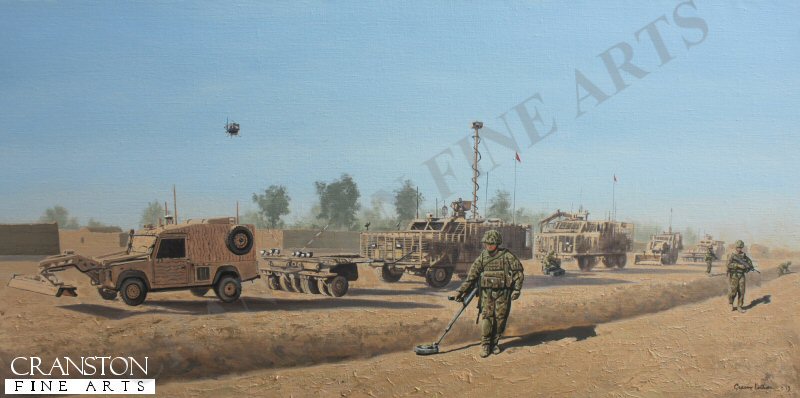
Talisman by Graeme Lothian. Talisman is a suite of vehicles operated by the Royal Engineers that clears routes of IED's and mines. Each Talisman consists of 2x Mastiffs, a Buffalo mine protected vehicle, a JCB high mobility engineer excavator, a T-HAWK micro air vehicle and TALON tracked remote control vehicle. |
Royal Engineer by Richard Caton Woodville. No text for this item |
Hit the Beach by David Pentland. 50th Division, Gold Beach, D-Day, 6th June 1944. British Infantry, Royal Engineers and Medics of the 50th Division scramble ashore during the initial wave onto Gold Beach under the guns of Hitler's Atlantic Wall. The first wave of the 50th Division was made up of the 6th Green Howards landing on King Beach and the 1st Dorsets and the 1st Royal Hampshires landing on Jig Beach, two of the three sectors of Gold Beach. |
The Bank Job by David Rowlands. Operation Magpie, Mostar, Bosnia, 18th April 2001. 2nd Battalion the Princess of Waless Royal Regiment and C Squadron, 1st The Queens Dragoon Guards, with Royal Engineers in support, gained entry to the Hercegovacka Bank during the night. They seized funds and evidence proving links between politicians and illegal activities that threatened peace and stability in the region. |
Operation Deadstick by Michael Turner At 0016hrs on 6th June 1944 three Airspeed Horsa gliders, flown with outstanding skill by pilots from the Glider Pilot Regiment, and carrying airborne troops from the Oxfordshire and Buckinghamshire Light Infantry and Royal Engineers, landed within yards of the bridge over the Caen Canal at Benouville, Normandy. The audacious attack achieved complete surprise, and some fifteen minutes later the bridge had been secured, an objective of vital importance to enable the advance of the Allied Liberation Forces on D-Day. |
Clearing the Way - Royal Engineer Regiment by David Rowlands. Royal Engineers Clearing one of the Convoy Routes (Route TRIANGLE) in the mountains of Central Bosnia. |
The Hidden Enemy by David Pentland. Helmand Province, Afghanistan, July 2008. A specialist search team of Royal Engineers, 2 PARA, and Army Dog Unit clear the route of Improvised Explosive Devices during a routine patrol in the Sangin area. |
Pontoons of the Royal Engineers on the March 1890 by Harry Payne (P) No text for this item |
Sergeant Boulger Taking His Heavy Cable Cart Across Half A Mile Of Fire Swept Ground. On the 30th October 1914, the Allied forces, which were advancing northeast and east of Ypres, were vigorously attacked by a large German force, but not only were all the attacks repulsed, but progress was made. It was during these operations that Sergeant H. W. R. Bougler, Signal Service, R.E., won the D.C.M. under circumstances of great danger. Although a certain portion of the ground, over half a mile in extent, was so heavily fire swept, he took his heavy cable cart across it, accompanied by a few men, and succeeded in establishing communications with our forward lines. |
Lieutenant Martin, D.S.O., R.E., And A Small Bombing Party Holding Back The Germans At Spanbroek Molen. Lieutenant Martin (56th Field Company Royal Engineers) gained his first distinction, the D.S.O., in the retreat from Mons, when he was wounded. Though wounded again during the battle of Neuve Chapelle he refused to retire, but heading a party of six volunteer bombers, he led them with such resolute bravery that they drove the enemy from a section of their trenches at Spanbroek Molen. Then after securing themselves by transposing the parapet and piling up sandbags, they awaited a counter attack. When the attack cam they held overwhelming numbers of the enemy at bay for two and a half hours. They were ultimately forced to retire, but their gallant defence was of great value in preventing German reinforcements passing through this section of the trenches. Lieutenant Martins splendid courage and energy had gained for him the V.C. |
How Lance Corporal C. A. Jarvis Blew Up The Bridge At Jemappes. The duties of the Engineers are more manifold than those of any other part of the forces, and include making roads, bridges and railways, working telegraphs telephones, balloons, preparing camps, water supply, field work for attacking or defence, and for the demolition of those of the enemy. In the present war the Royal Engineers have nobly lived (and died) up to their great traditions, and several of their number have already won the V.C. by daring deeds, one of which is here illustrated. Lance Corporal Jarvis, of the 57th Field Company, royal Engineers, won his V.C. for great gallantry at Jemappes, which is three miles west of Mons, on the 23rd of August 1914. He worked for three and a half hours under a most deadly fire in full view of the enemy, and eventually was successful in laying a fire charge for the demolition of a bridge. |
Sergeant Taylor Clearing Fallen Horses From a Pontoon Bridge at Valley. The passage of the Aisne was begun on Sunday, September 13th 1914, when the 8th British Brigade made the crossing at Vailly. On the following day the enemy made a counter attack at this point, and for a time the communications of the 3rd Division appeared to be in danger of being cut. No reserves were available except cavalry, but this proved sufficient in repelling the attack after hard fighting. As the 5th Cavalry Brigade was retiring across the river at Vailly, shells burn in quick succession over the pontoon bridge, and falling horses began to cause confusion. Sergeant Taylor, of the 57th Company Royal Engineers, however, rushed forward and did most gallant and effective work in clearing them away. He was awarded the D.C.M. |
Lieutenant Withington Bringing a Field Gun into Action in the British Trenches Against the Enemys Sap. No text for this item |
Lieutenant Morland Making Prisoners of Eighteen Germans in a Mine at Givenchy. In the last days of the Battle of Festubert, on May 24th and 25th 1915, the 47th Division (2nd London Territorial) succeeded in capturing some of the enemys trenches. At Givenchy on the latter day, Lieutenant Denys Max Thomson Morland, of the 3rd London Field Company Royal Engineers Territorial Force, accompanied a London battalion in an assault on the German trenches. On finding his way into a mine, he explored it alone, and made prisoners of eighteen Germans who were hiding in it. He displayed great energy and bravery throughout the night and was rewarded with the M.C. |
Acting Lance-Corporal Barker Assisting a Party Collected by him to Open out a Communication Trench Under Heavy Shell and Machine Gun Fire. In the assault on September 25th 1915, of the salient of Sanctuary Wood, near Hooge, Acting Lance Corporal Barker, 1st Cheshire Field Company Royal Engineers (T.F.) was separated from his party. He however, at once assisted and superintended a party of the Royal Scots Fusiliers to dig himself in, and, afterwards on his own initiative, collected a party of infantry. With them he opened up under heavy shell and machine gun fire a communication trench from the British line to the captured position. He was the last man to leave the work when it became impossible to continue. For his conspicuous gallantry and initiative, Lance-Corporal Barker was awarded the D.C.M. |
Captain Johnstone Guiding A Couple Of Rafts Filled With Wounded Across The Aisne At Missy Under Heavy fire. All through the thick of the fighting on September 14th 1914, Captain William Henry Johnstone, of the Royal Engineers, guided a couple of rafts to and fro across the Aisne under heavy fire. Returning from one side with the wounded he carried back to the other supplies of ammunition. It was of the utmost importance to maintain communications between either bank of the river, and for his gallant work, carried out a great personal risk, Captain Johnstone was awarded the V.C. |
Second Corporal Daniell clearing a fallen tree from a road under heavy shellfire. For his conspicuous devotion to duty throughout the campaign, Second Corporal T. A. Daniell of the First Field Squadron Royal Engineers has been awarded the D.C.M. On one occasion a tree fell across a road in the way of some armoured cars, and he at once went out under heavy shellfire to clear it away. |
Acting Second Corporal OBrien Descending a shaft with an officer to search for the enemy. Close to their front line of trenches, and not far from the Hulluch quarries the British discovered a shaft. On October 16th 1915, a sentry at the shaft reported that he had seen two of the enemy moving along a gallery leading out of it. In company with an officer, Corporal OBrien of the 170th Tunnelling Company Engineers, at once descended the shafts by means of a rope ladder, expecting to find the enemy there. No gallery was however found but for the courage that he had shown Acting Second Corporal OBrien was awarded the D.C.M. |
Sergeant Davies and Second Corporal Perry repairing a barrel pier under heavy shellfire. In circumstances demanding the greatest courage and coolness, sergeant O Davies and Second Corporal F. G. Perry, of the 1st Wiltshire Army Troops Company, Royal Engineers (T.F.) set to work under heavy shellfire to repair a barrel pier across a canal. They succeeded in repairing it for the passage of the wounded, and were both awarded the D.C.M. for conspicuous gallantry and devotion to duty. |
Sapper Wells working a searchlight under heavy and continuous rifle fire. The battle which began at Shaibs, turkey in Asia 12th 1915m, had as its ibject the capture of Basra. Though his searchlight was exposed to heavy and continuous rifle fire on the night of April 13th-14th Sapper C. A. Wells of the Searchlight Section royal Engineers (formerly of the Electrical engineer Company, Bombay Volunteer Artillery) continued to work it until it was put our of action. By acting in the same way on the previous night he brought to timely notice many unexpected rushes by the enemy. For his gallant conduct and devotion to duty he was awarded the D.C.M. |
|
Contact Details |
Sign Up To Our Newsletter!
This website is owned by Cranston Fine Arts. Torwood House, Torwoodhill Road, Rhu, Helensburgh, Scotland, G848LE Contact: Tel: (+44) (0) 1436 820269. Email: cranstonorders -at- outlook.com
|