| Text for the above items : |
|
Retaking Tirtsu by David Pentland.
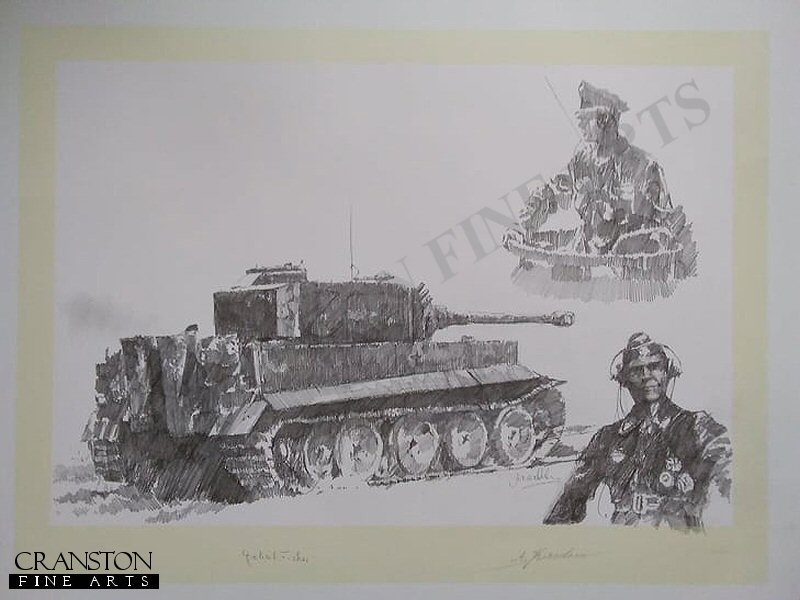
Albert Kerscher and Otto Carius. Narva Bridgehead, 18th March 1944 - 2nd Company, 502 Heavy Tank Battalion and Nordland Infantry.
|
|
Holding the Line by Richard Taylor.
Skillfully led by their mercurial commander, SS-Hauptsturmfuhrer Michael Wittmann, the Tiger Tanks of s.SS-Pz. Abt. 101 blaze through a shattered French village in the days following D-Day, June, 1944. Their destination - Normandy!
|
|
Strike For Gela, Sicily, 11th June 1943 by David Pentland.
Tiger I tanks of 2 Kompanie/ Schwere Panzer Abteilung 504, attached to Panzer Division Herman Goring, launch their attack on the main US 7th Army landing beach at Gela, on the first day of Operation Husky. Despite the fact that the Herman Goring troops were untried in battle it was only the devastating effect of allied naval gunfire that stopped them reaching and probably destroying the beach head.
|
|
Tiger on the Russian Front by Jason Askew. (P)
No text for this item
|
|
Wittmann at Villers Bocage, Normandy, 0900 hrs, June 13th 1944 by David Pentland.
While other Tigers of his command struck northwest and decimated the tanks and half tracks of the Sharpshooters and Rifle Brigade parked along the road towards point 213 and Caen, Haupsturmfuhrer Michel Wittmann attacked on his own to the south east. Driving his panzer into the village of Villers Bocage. he proceeded to destroy the Stuart and Cromwell tanks of Viscount Arthur Cranleys 4th County of London Yeomanry the Sharpshooters RHQ. Although subsequently immobilized in the village center, the battle between the British 7th Armoured Division Desert Rats and Wittmanns 101st Heavy Tank Battalion continued for a full day, and blunted the British threat to the German line.
|
|
The Russian Front by Jason Askew. (P)
A German machine gun team and a Tiger tank on the Russian Front in 1943.
|
|
The Shepherd by David Pentland.
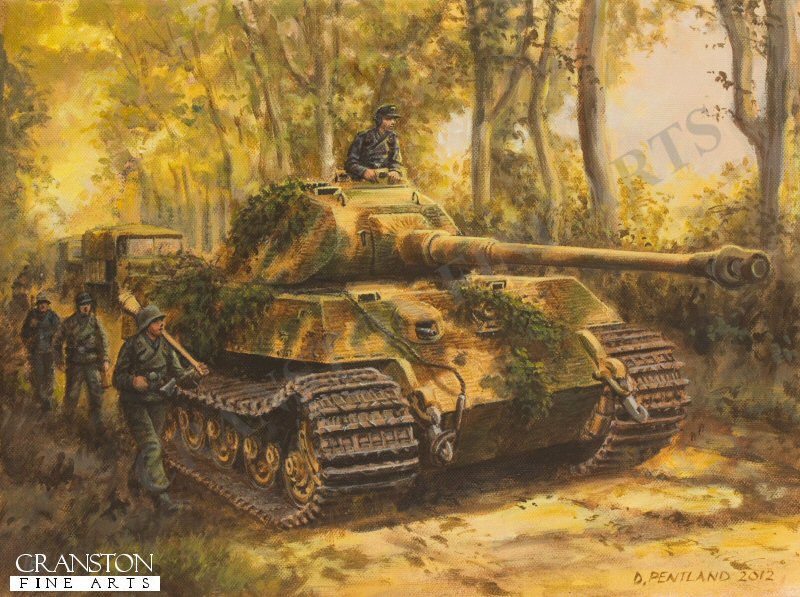
Orville, Normandy, 20th August 1944. Within days of the death of his friend and commander Obfw. Fendesack, Feldwebel Kurt Knipsel climbed into the last remaining Tiger II of 1st Company 503rd Heavy Tank Battalion as a tank commander. While leading the unit's retreat to the Seine he more than once saved it by knocking out allied tanks at extreme visual range. On the 28th the column reached Pontiose, and safety.
|
|
Rearm and Resupply by David Pentland.
Albert Kerscher and Otto Carius. Kinderheim, Narva Bridgehead 17th March 1944, 2nd Kompany, 502 Heavy Tank Battalion. Tiger I tanks of Albert Kersher and Otto Carius, of 2nd Company. Heavy tank Battalion 502, pull back to their headquarters at The Kinderheim to reload ammunition and refuel for the next engagement.
|
|
Pather Tank - Fight for Kowel, Poland, March / April 1944 by Jason Askew. (P)
Although in the process of regrouping after their escape from the Cherkassy Pocket, Panthers and Panzer Grenadiers of the crack 5th SS Panzer Division Wiking are part of the relief force hastily assembled and thrown in to free the strategically important city of Kowel in the Pripet Marshes. By April 10th the Soviet encirclement of the city was broken and Wiking were pulled out of the line to continue refitting.
|
|
Kerscher's Defence of Neuhauser Forest by David Pentland.
Oberfeldwebel Albert Kerscher, commander of 2nd company 511 Heavy Tank Battalion aided by a Panzer IV, two Hetzers, a Kingtiger and a Pak gun, successfully defended against concerted Soviet air and armoured attacks, his action buying valuable time for the evacuation of German wounded from Pilau and scoring his 100th victory in the process.
|
|
Pather Tanks at Kursk by Jason Askew. (P)
No text for this item
|
|
Clash of Steel, Prokhorovka, Kursk, 12th July 1943 by David Pentland.
The battle for Prokhorovka marked the high water mark of the German southern drive for Kursk. At the apex of the thrust were the 14 tiger tanks of the 13 Heavy Tank Company, 1st SS Panzer Division Liebstandarte, led by Michael Wittman. Their advance was eventually thwarted, however, by the epic charge of the Soviet 29th Guards Tank Corps, as part of 5th Guards Tank Armys furious counter attack against the SS Tank Corps.
|
|
Pather Tank at the Danube Bridgehead by Jason Askew. (P)
Floridsdorf, Vienna, 3th April 1945. By mid April the Soviet assault had almost cleared German resistance from the south bank of the Danube. Only one small bridgehead remained open to allow troops a chance to escape, and this exit was defended by only 2 tanks and a few anti-tank guns. Defending the eastern approaches to the bridge was the Panther tank of SS Obersturmfurher Arnold Friesen, 2nd SS Panzer Division. Despite being only 19 he was a veteran of Kursk, Normandy, the Ardennes and Hungary with a tally of 97 tank kills to his credit. By the end of the day Friesen and his crew accounted for a further 14 soviet tanks, (the last two with panzerfausts), before covering the final withdrawal of the last German units across the bridge under cover of darkness.
|
|
Kampfgruppe Carius by David Pentland.
Near Lake Ricu, 12th - 16th July 1944.
|
|
Tiger I by Jason Askew. (P)
The Tiger tank was one of the most fearsome tanks in the German WW2 armoury. With firepower that could destroy most enemies at long range and armour that could withstand all but the closest of attacks, the Tiger is rightfully regarded as one of the most effective fighting machines of the war.
|
|
Panzergrenadiers by Jason Askew. (P)
Elite German Panzergrenadiers accompany a Tiger tank on the Russian Front in 1943.
|
|
Taming the Tiger by Geoff Lea.
It is August 1944, barely two months since the Allies landed their first troops on the beaches of Normandy. After the failed Operation Luttich (codename given to a German counterattack during the Battle of Normandy, which took place around the American positions near Mortain from 7 August to 13 August, 1944 ) The German Panzer Divisions were in full retreat, The British and American Generals believed it to be critical to halt them before they cauld regroup. Caught in the Gap at Falaise, the battle was to be decisive. Flying throughout a continuous onslaught, rocket-firing Typhoons kept up their attacks on the trapped armoured divisions from dawn to dusk. The effect was devastating: at the end of the ten day battle the 100,000 strong German force was decimated. The battle of the Falaise Pocket marked the closing phase of the Battle of Normandy with a decisive German defeat. It is believed that between 80,000 to 100,000 German troops were caught in the encirclement of which 10,000 to 15,000 were killed, 45,000 to 50,000 taken prisoner, and around 20,000 escaped . Shown here are German Tiger I tanks under continues attack by Royal Aoir Force Typhoons.
|
|
Typhoon's End by David Pentland.
Volokolamsk, Moscow, December 1941. Panzer III's and Panzergrenadiers of the 11th Panzer Division press on towards Moscow in the final stages of Operation Typhoon. Ultimately doomed to failure by the freezing weather and tenacious Soviet defence, this proved to be the high water mark of the Axis advance on the Soviet capital.
|
|
Captain Hans Bölter - Struggle in the Snow by David Pentland.
Lake Ladoga, Leningrad 17th February 1943. Oberfeldwebel Hans Bölter and his platoon leader Lt.Meyer, supporting Kampfgruppe Sudau during the Second Battle of Lake Ladoga. In a day long engagement the two Tiger Is of 1st Company, Heavy Tank battalion 502 destroyed a succession of anti-tank guns, tanks and infantry attacks. Lt Meyer knocked out 10 KV1s in as many minutes and by the wars end Hans Bolter had accounted for at least 144 enemy tanks, making him one of the great Panzer aces.
|
|
Tigers in Normandy by Nicolas Trudgian.
The Battle for Point 112, a strategically positioned hill just a few miles south-west of Caen, was the scene of the most violent fighting between German and British armor, artillery and ground troops during the weeks immediately following the D-Day invasion, in June 1944. Desperate to regain Hill 112, on July 9th, the Tiger tanks of SS Panzer Battalion 102 were ordered to advance. 2 Kompanies Tigers managed to occupy the eastern slopes of the hill, while 1 Kompanie came under fire as they rached the first houses in the small village of Maltot. At this point they came head on to British Sherman tanks. Entering the village firing his 88, Unterscharfuhrer Fey in tank 138 quickly knocked out three Shermans at 200 yards range, and by the evening of July 10th the Panzers had re-taken Maltot. But Allied artillery had driven the Germans off Hill 112. The battle raged on for another three weeks when on August 1st the Allies frove the Germans off Point 112 for the final time. Tigers of SS Panzer Battalion 102 yet again advance towards the infamous hill, passing two Shermans knocked out in the previous days fighting. Overhead, Me109s of II./JG26 give aerial support as the German armour makes a last ditch attempt to repel the advancing forces, in their effort to hold the important city of Caen.
|
|
Michael Wittmann - Battle of Kursk by Jason Askew. (P)
Michael Wittman at the battle of Kursk. On the first day of the attack, X-Day, 5th July 1943, eleven Tigers under SS-Hauptsturmfuhrer Kling move northwards to the town of Bykovka, under instructions to break through the Soviet defences located to the south and south-east of the town. The enemy forces, which included T34s, were well placed in ambush positions to thwart the German move. Wittmann's Tiger quickly took out two of the T34s and the remaining enemy vehicles quickly retreated. It was to be a dramatic day for Wittmann and his crew - during the many sorties that were undertaken, loader Walter Koch was hit in the head with splinters and the Tiger drove over a mine, damaging one of the tracks. The injured Koch was replaced by SS-Panzerschutze Max Gaube, and the Tiger was quickly towed to safety. In spite of the small misfortunes that came its way, Wittmann's Tiger had destroyed large amounts of soviet vehicles and armour, including 8 Russian tanks.
|
|


 Military Art and Artists
  Kerscher, Albert