|
|
|
|
|
|
|
|
|
Cranston Fine Arts  Military Art and Artists Featured Current Military Artists Military Art and Artists Featured Current Military Artists  Mark Churms Mark Churms |
[UP] - Chris Collingwood - David Pentland - Mark Churms - Brian Palmer - Graeme Lothian - Jason Askew - Terence Cuneo - David Rowlands |
| More Pages : Medieval Era - Napoleonic Art - Jacobite Rebellion - American Military History - Crimean War - Zulu War - Colonial India - Modern Era - Original Paintings - Original Drawings - Postcards |
| Mark Churms |
Mark was born in Wales in 1967. He gained his degree in Architectural Studies at Oxford Polytechnic in 1989, but soon his interest in drawing buildings was surpassed by his love of painting horses and in 1991 he began work as a freelance artist. His first commissions were for sporting subjects, Polo, Racing and Hunting. However his consuming passion for military history, particularly of the Napoleonic era, quickly became his dominant theme, with the invaluable counsel of French military experts (accuracy in uniform and terrain of the various battles takes a great deal of time and consultation with many experts across Europe). Mark Churms joined Cranston Fine Arts in 1991 and for a period of 8 years, was commissioned for several series and special commissions. His series of the Zulu War, and of the Battle of Waterloo were the highlights during this period. Mark Churms' deep understanding and detailed knowledge of the period made Mark at that time one of the most prolific and successfull artists for Cranston Fine Arts. Cranston Fine Arts are proud with their series of superb art prints and original paintings painted by Mark Churms in this period. We now offer Mark Churms art prints in special 2 and 4 print packs with great discounts as well as a number of selected original paintings at upto half price. |
| Navigation | |
| Page 1 of 5 | Page 1 .. Next |
|
|
|
|
|
|
|
|
|
|
|
|
|
|
|
|
|
|
|
|
|
| Navigation | |
| Page 1 of 5 | Page 1 .. Next |
| Text for the above items : |
March Past of the Grenadier Guards by Mark Churms. The Duke of Wellington at the head of the 1st Foot Guards including the Colour Party, Hyde Park, 1829, as they pass King George IV with his staff and the Duke of Orleans while the band of the 2nd Life Guards perform. On the right of the picture is shown a Colonel of the 15th Hussars. Behind the figures can be seen Aspley House, the residence of the Duke of Wellington. |
Pinned Like Rats in a Hole by Mark Churms (P) The original oil study for the larger painting of Pinned Like Rats in a Hole, part of the Rorkes Drift series by Mark Churms. |
Eve of Distinction by Mark Churms. Lt. John Rouse Merriot Chard, Royal Engineers.At about 3.30 on the afternoon of 22nd January 1879, Lieutenant John Rouse Merriot Chard, Royal Engineers, was supervising repairs on the military pont on the Mzinyathi river, at the border crossing at Rorkes Drift, when survivors brought news that the advanced British camp at Isandhlwana had been over-run by the Zulus, and that a wing of the Zulu army was on its way to attack Rorkes Drift. Chard ordered Driver Robson to pack up the wagon and return to the mission station, where a stockpile of supplies was under the guard of B Company, 2/24th Regiment. Chard, in consultation with his fellow officers, made the historic decision to make a stand at Rorkes Drift. |
La Gueper Espagnol by Mark Churms. French dragoons attack a Spanish farmhouse where they believe Spanish guerillas are hiding. |
Original Oil Study of the Charge of the Union Brigade painting by Mark Churms. (P) No text for this item |
The Joust of Peace (The Black Knight) by Mark Churms. Edward Plantagenet, Prince of Wales turns his charger once more to engage his opponent in a joust of courtesy using blunt lances. |
Hougoumont by Mark Churms. Depicting Jeromes Infantry attacking the South gate of the Chateau during the battle of Waterloo. |
Hearts of Oak by Mark Churms. In January 1793 the 1st Battalion of the 29th Foot leaves Windsor for Hilsea to board Royal Navy fighting ships as there is a shortage of marines. Their new roll is to counter enemy musket fire from the upper decks, to lead boarding parties and to maintain discipline of the crew. They are specially equipped with a new working rig but still retain their full dress red coats and powdered hair (curled locks above the ear are removed) for combat. The regiment joins The British Channel Fleet under Admiral Earl Howe, and detachments are allocated to the following ships of the line; H.M.S. Glory, Thunderer, Alfred, Pegasus and Ramilles. 78 soldiers under the command of Cpt. Alexander Saunders are also placed aboard Captain Harveys 74 gun H.M.S. Brunswick. Howes ships are sent to intercept a fleet, of similar size that has put out from Brest to escort a large convoy of food from America, destined for Revolutionary France. The two fleets make contact but fog prevents an engagement until 1 Oarn on the first day of June 1794. Now, in bright sunshine, the order is given to attack! Brunswick is directly astern of Howes flag ship as the French line is broken. She quickly engages Le Vengeur with which she becomes dangerously entangled. Broadsides are exchanged at point blank range! Sails are shot to ribbons, masts and rigging fall. Grenades, carronades and musketry find their targets and casualties mount. Nevertheless, the ships band, joined by a negro regimental drummer on the quarter deck, keep up moral by playing the new and popular air Hearts Of Oak. The two ships drift helplessly as another French man-of-war, Achille, comes in for the kill but the British gunners deliver such a devastating broadside into this new assailant that she is completely demasted and strikes her colours! In the firefight the figure head, an effigy of the Duke of Brunswick, has its carved wooden hat blown clean away. So, Captain Harvey calmly replaces the loss with his own cocked hat! The captain himself receives a blow to the hand and is subsequently mortally wounded with a section of chain-shot. Cpt. Saunders is killed by a snipers bullet and Lt. Harcourt Vernon (wearing short, non regulation boots to facilitate amputation) is soon wounded as well. The decks are cleared of downed masts and rigging, the dead also go over the side. cl At about one oclock the two interlocked ships are separated by a swell and Harveys brothers ship Ramilles cornes to the Brunsivicks assistance. The crippled Vengeur cannot compete with the skill of English gunnery and the ship is raked from end to end by galling fire. Cheers ring out as she surrenders and hoists the Union Jack. The rest of the French fleet breaks off the engagement. Six of their ships are out of action and Le Vengeur is so very badly holed that she eventually sinks (many of her crew refusing to abandon her. Singing the Marseillaise they re-hoist her battle flag as they slip to their watery grave) This British fleet returns in triumph to Spithead. However, the scene on the Brunswicks splintered poop deck is one of utter devastation. The regiment has 13 officers and men killed, another 18 are wounded and nearly quarter of the ships company is lost. This hard won victory is commemorated by the regiment with Naval Crown (awarded to the regiment in 1909, an honour shared only by the Queens Regiment) and by the adoption of the tune played throughout the height of battle, Hearts of Oak. |
Raising the Standard at Glenfinnan, by Mark Churms. Supported by the Highland Chiefs with twelve hundred highlanders present. Prince Charles Edward Stuart raised his standard at Glenfinnan on the 19th August 1745. This was the start of the Forty Five which would end with the defeat of the Jacobite Army on Drumossie Moor at the battle of Culloden 16th April 1746. |
Assault on the Breach of San Sebastian by Mark Churms. The Storming party, 750 volunteers, included 200 men of the Guards, one hundred each from the First and Coldstream Guards. They moved off at two in the morning on the 31st August 1813, and occupied a ruined convent where they remained till half past nine. Aware of the almost impossible task ahead of them, and subjected to a violent electric thunderstorm, the troops waited in a state of savage anticipation. Wild senseless laughter was said to have preceded the attack on the breach which could not be entered except in single file under heavy fire. The troops attacked in succession, but were struck down by hundreds. General Graham then ordered the artillery to fire over the heads of the assailants, clearing the ramparts. A shell ignited a quantity of powder, and under cover of the explosions, the storming party forced its way into the town. San Sebastian was savagely sacked and burned, and the good name of Wellingtons Army suffered as it had done at Badajoz. The civilians were raped, robbed and murdered in revenge for the heavy losses suffered by the troops. The Franco-Spanish governor retired the citadel (San Marcial) and on the 9th September, after a gallant resistance of over a week, surrendered the charge he had so faithfully defended. The casualties among the officers of the first Guards were one Officer, Ensign Burrard, First battalion (a son of Sir Henry Burrard who was responsible for the disastrous Treaty of Cintra) severely wounded, since dead, and one Officer, Ensign Orlando Bridgeman, wounded. In the Coldstream Guards, one officer ensign Thomas Chaplin, According to Lord Saltoun there were in round numbers, 150 casualties amongst 200 Guardsman. Total losses of volunteers from all regiments were 1500 men. (text by Atlanta Clifford, assistant to the Curator-The Guards Museum) In the painting. you see Ensign Chaplin lying wounded, attended by an Officer of the Coldstream Guards, Orlando Bridgeman is calling Assistant Surgeon Bacot, First Foot Guards, to go to the aid of his fellow officer, Burrard. |
Sabres on the Esla Pursuit of the Imperial Guard at the Battle of Benevente by Mark Churms. Sir John Moores epic retreat to Corunna was punctuated by desperate and often heroic rear-guard actions - none more dramatic than the cavalry clash at Benevente on the 29th December 1808. Having crossed the river Esla, cold and swollen by recent rainfall, a British picquet, comprised of elements of the Kings German Legion Hussars and the 7th, 10th and 18th Hussars, covers the river and its tactically demolished Castro Gonzalos bridge from a position near the town of Benevente. Napoleon himself leads the pursuit. The Emperors elite Guard Light Cavalry, commanded by General Lefebvre-Desnouettes, is ordered at daylight to ford the river and launch a surprise attack on what appears to be the numerically inferior British units. As five-hundred and fifty French cavalry emerge in orderly fashion from the river, intent upon quickly dispatching the opposition, they are startled to find the British piquet, reinforced by a host of British cavalry, streaming from within the confines of Benevente, some on their left flank. Under the command of Lord Paget, the British become the pursuers of the surprised French, who turn and retreat with the frigid waters of the Esla blocking their escape. Unlike their crossing in echelon just minutes before, the French now in disorder plunge into the river, where many drown. Others are captured including General Lefebvre-Desnouettes who is made prisoner by Grisdale of the 10th Hussars following a dramatic pursuit. General Lefebvre-Desnouettes will eventually escape from captivity in England, to encounter Lord Paget once again on the field of Waterloo. |
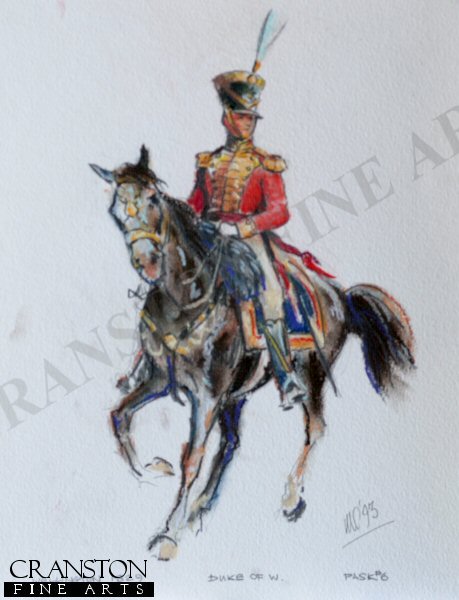
Duke of Wellington, 1829 by Mark Churms. (P) Study for the original painting March Past of the Grenadier Guards. |
2nd Life Guards Band 1829 by Mark Churms. (P) Study for the original painting March Past of the Grenadier Guards. |
Officer of the Queens Bays, Lucknow 1857 by Mark Churms. (P) Study for the original painting Charge and Pursue. |
Charge of the 16th Lancers at the Battle of Aliwal by Mark Churms. The 16th Lancers were part of General Sir Harry Smith's army consisitng of the British and Bengali army of 12,000 men and 30 guns against the Sikh army of 30,000 men and 67 guns of Ranjodh Singh during the First Sikh War which was fought on the 28th January 1846 in the Punjab in the North West of India. This painting depicts the 16th Lancers which were part of Brigadier Macdowell's brigade consisitng of the 16th Queen's Lancers, 3rd Bengal Light Cavalry and 4th Bengal Irregular Cavalry. The 16th Lancers charged several times during the action, breaking a number of Sikh infantry squares and overrunning a battery of Sikh artillery. The Lancers are shown wearing over their chapkas the white cotton cover which had been adopted for service in the tropics. |
The General's Escort by Mark Churms. Depicting Polish Lancers escorting a generals carriage as they pass through an infantry bivouac during the Hundred Days Campaign. |
Last Man Out by Mark Churms. Private Robert Jones. Decorated for conspicuous bravery and devotion to the wounded at Rorkes drift. Private Robert and William Jones, posted in a room of the Hospital facing the hill, kept up a steady fire against enormous odds, and while one worked to cut a hole through the partition into the next room, the other shot Zulu after Zulu through the loophooled walls, using his own and his comrades rifle alternatively when the barrels became to hot to hold owing to the incessant firing. By their united heroic efforts six out of the seven patients were saved by being carried through the broken partition. the seventh, sergeant Maxwell being delirious, refused to be helped, and on Robert Jones returning to take him by force he found him being stabbed by the Zulus in his bed, Robert Jones died in 1898 in Peterchurch Herefordshire . Both men were awarded the Victoria Cross. |
Crockett's Last Sunrise, at the Battle of the Alamo by Mark Churms. Crockett is shown at the Barricades at 6am on the 5th March 1836. The siege of the Alamo ended on March 6th, when the Mexican army attacked while the Alamo defenders were sleeping. The garrison defenders awakened, and the final fight began. One of the women who were gathered in the chapel witnessed Crockett running to his post, Crockett paused briefly in the chapel to pray. But when the Mexican soldiers breached the outer walls of the Alamo complex, most of Crocket and the defending Texians fell back to the barracks and the chapel area which had been the plan. Davy Crockett and his men were too far from the barracks to be able to take shelter and were the last remaining defenders within the mission to be in the open. The men desperatly defended the low wall in front of the church, using their rifles as clubs and using there knives in close combat as the Mexican troops were too close and made it impossible to reload their rifles. After a volley of fire and a charge with fixed bayonets, Mexican soldiers pushed the few remaining Texans back toward the church and soon after the Battle for the Alamo had ended after lasting 90 minutes. It is said that the body of Crockett was surrounded by up to 12 Mexican soldiers bodies and one with Crocketts knife in him. |
La Salle at the Battle of Wagram by Mark Churms Depicting General La Salle before his last charge before being killed at the Battle of Wagram. |
Confederate Officer, 15th Alabama Infantry Regiment 1863 by Mark Churms. Colonel William C Oates leads his regiment up the slopes of Little Round Top to attack the left flank of the Union army on the second day of fighting at the Battle of Gettysburg. |
Trumpeter Martin Lanfried, Hounslow 1854 by Mark Churms. (P) Study for the original painting Last Review Before the Charge. |
|
Contact Details |
Sign Up To Our Newsletter!
This website is owned by Cranston Fine Arts. Torwood House, Torwoodhill Road, Rhu, Helensburgh, Scotland, G848LE Contact: Tel: (+44) (0) 1436 820269. Email: cranstonorders -at- outlook.com
|