|
|
|
|
|
|
|
|
|
Cranston Fine Arts  Military Art and Artists Featured Current Military Artists Military Art and Artists Featured Current Military Artists  David Pentland David Pentland |
[UP] - Chris Collingwood - David Pentland - Mark Churms - Brian Palmer - Graeme Lothian - Jason Askew - Terence Cuneo - David Rowlands |
| More Pages : Tank Index - World War One - World War Two - Modern Wars - Ancient Era - Medieval Era - US Marines - The SAS - Original Paintings - Original Drawings - Postcards |
| David Pentland |
One of Europe's Leading Military and Aviation Artists, David Pentland has produced a wealth of Paintings for Cranston Fine arts, who are proud to have David as one of their leading Artists. As you browse down his wonderful work you may be interested to know that many of the Paintings are still available, and to a collector his work would certainly be a valuable addition. David's Paintings have gone up in value over the past 2 years, and have seen a growth in value of nearly 100%.
|
| Navigation | |
| Page 2 of 16 | Previous .. Page 2 .. Next |
|
|
|
|
|
|
|
|
|
|
|
|
|
|
|
|
|
|
|
|
|
| Navigation | |
| Page 2 of 16 | Previous .. Page 2 .. Next |
| Text for the above items : |
Motorcycle Attack by David Pentland. May 1940. At the forefront of the German panzer divisions and leading the advances into France were the Kradschutzen Truppen or motorcycle troops. Although mainly acting in the reconnaissance role they also had the firepower to hold objectives until reinforced. |
40 Kilometres to Damascus by David Pentland. Syrian commandos and Republican Guard T72M tanks in the Bekkaa valley during the Israeli Peace for Galilee operation. It should be noted that although belonging to an elite unit, these tanks usually appeared minus a number of standard items, including side skirts, snorkel and even headlights, giving them a generally dilapidated appearance. They also employed the old Duska 12.7mm HMG rather than the new NSVT UTES anti-aircraft machine gun system. |
De Gaulle's Defenders by David Pentland. May 1940. Designed by Renault to replace the ageing FT-17 in the light infantry tank support role, as such it was relatively heavily armoured and was armed with a low velocity 37mm gun. Like all French tanks of this time it used a single man turret, which put the commander/gunner under considerable pressure in combat. The R.35 entered service with the French army in 1935, and in 1940 it was upgraded to the R-40. In all 900 Renault tanks were in service when the Germans invaded. |
Carriers by David Pentland. Normandy, France, July 1944. Universal Carriers MkII of the Rifle Brigade, 11th Armoured Division, race forward at speed towards enemy positions. |
Vikings by David Pentland. Helmand Province, Afghanistan, 12th August 2008. Armoured personnel carriers from The Queen's Royal Lancers, Viking Group, tasked with providing security for the delivery of a new turbine being moved from the Kandahar Airfield to the Kajaki Dam. |
The Guns of Kajaki by David Pentland. L118 Light Guns from 7th Parachute regiment Royal Horse Artillery engage Taliban targets in support of 3 Para Battle Group, Kajaki Afghanistan 2008. |
The Polar Bears by David Pentland British 49th Infantry Division, Holland, September 1944. British Universal Carriers of 2nd Battalion, Kensington (Princess-Louise) Regiment, 49th West Riding Infantry Division, "the Polar Bears", in action during Operation Market Garden. The 2nd Kensington were the machine gun battalion of the division at this time. |
Lull in the Battle, Central Russia, December 1943 by David Pentland. Hornet self propelled 88mm anti-tank guns of Heavy Anti-tank Battalion 519 attached to 3rd Army, Army Group Center. Oberleutnant Erwin Kressmann commanded 1st company, while 1st platoon was led by the soon to be famous Lt Albert Ernst, who in an engagement during the Witebsk battles destroyed 14 Soviet tanks with just 21 rounds. |
The Firing Line, North of Malinava Latvia, 22nd July 1944 by David Pentland. Six Tiger I tanks including Albert Kersher and Lt. Otto Carius, of 2nd Company Heavy tank Battalion 502, prepare to take up ambush positions for the soon to arrive Soviet tank brigade. In the ensuing encounter, the Tigers destroyed the entire column of 28 Josef Stalin IIs. |
Forty Eight Hours, Wajsma, Central Russia, 11th - 12th December 1942 by David Pentland. Wachtmeister Fritz Amling was a gun commander in 3rd Battery, Sturmgeschutz Battalion 202, in the Wajsma sector of the front at the start of the Soviet Operation Mars. During the first days fighting Amling, along with his gunner Bruno Guskowski, accounted for 24 enemy tanks, five of these in one minute! By the end of the second day, despite being wounded they had destroyed a further 18 tanks, a total of 42 in 48 hours. |
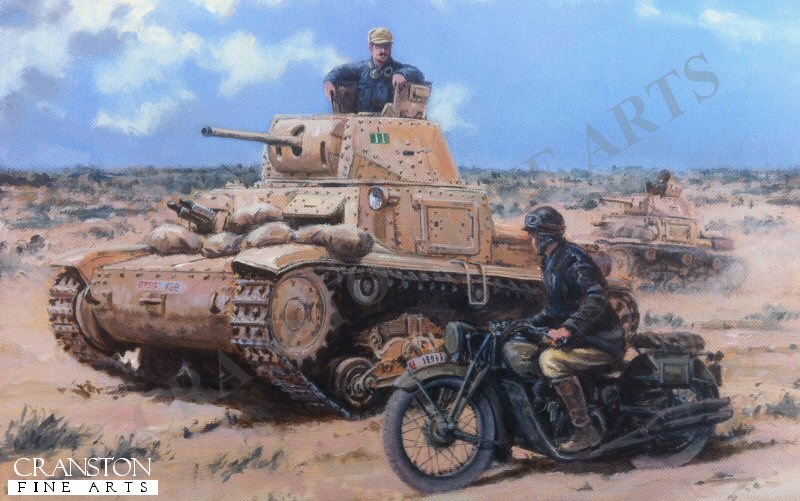
New Orders by David Pentland. July 1942. Italian M13/40 tanks of 132nd Armoured Regiment, Ariete Division stop to receive an urgent dispatch while advancing on the British defensive lines at El Alamein. |
Business as Usual, Glengall St, Belfast, December 1991 by David Pentland. A Provisional IRA bomb left outside the Unionist Party Headquarters, exploded prematurely injuring several police, army and civilians. At the same time it devastated the recently repaired Grand Opera House and Europa Hotel. |
Alfred Rubbel at Kursk by David Pentland. Central Russia, 4th-12th July 1943. For Operation Citadel the Heavy tank battalion 503 was split into separate companies and attached to various panzer divisions. Rubbels 1st company went to 6th Panzer Division, and as such take part in the epic breakthrough on the 10th and 11th which came close to the collapse of the soviet southern front! |
River Crossing, Dnepr River, Soviet Union, 11th July 1941 by David Pentland. River assault by men of the Grossdeutschland Division to establish a bridgehead for 10th Panzer Division and the rest of Panzergruppe 2. |
D-Day Recce by David Pentland. Juno Beach, Normandy, 6th June 1944. Sdkfz 232 armoured cars of 12th SS Reconnaissance Battalion commanded by Obersturmfuhrer Peter Hansmann observe the Canadian beachhead at Juno Beach. His small team was tasked with finding out if an invasion was actually underway and it drove some 80km, arriving at the coast near Tracy at 7.30 in the morning to witness the landings in progress. |
Char B at Stonne by David Pentland. France, 15th-17th May 1940. The French offensive at Stonne was of vital importance following the German capture of Sedan. The French could use it as a base from which to launch long-term attacks on the enemy bridgeheads. In this innocuous town, a vicious two-day battle took place in which the Germans came face to face with the premier French tank, the Char B-Bis for the only time. One of these tanks, commanded by Pierre Billotte, proved invulnerable to German anti-tank fire and took 140 hits, and knocked out 13 German tanks. The town changed hands 17 times but ultimately the French failed to hold it. |
Opening the Cherkassy Pocket by David Pentland. Heavy Tank Regiment Bake, 1st - 21st February 1944. |
The Road to Zeila by David Pentland. British Somaliland, 1940. Italian Carro Amato M11/39 tanks of the 'Compania Speciale Carri M' advance on the British held town of Zeila. These where only one of two medium tank companies of 12 tanks each which were deployed in Africa Orientale (Ethiopia, Eritrea, and Somaliland) by the Italian Army. |
Zwieroboj - Animal Hunters - Ponyri Station, Kursk, 7th July 1943 by David Pentland. Major Sankovsky, commander of the new SU-152 battery of 1442nd SP Art Regiment, assigned to the 13th Army was in support of the 307th Rifle Division around Ponyri Station when the XXXXI Panzer Corp attacked with 200 panzers. Leading the way were Tiger Is of Schwere Panzer Abteilung 505, and the Borgward BIV remote control mine clearance tanks. On this day it is believed the major himself knocked out 10 enemy tanks, and in the ensuing three weeks of combat at Kursk the battery accounted for some 12 Tigers and 7 Ferdidnands. It was this units results which the SU152 the nickname of Zwieroboj - Animal Hunter. |
Mussolini's Boys by David Pentland. Bir El Gubi , North Africa, 4th December 1941. Young soldiers of the 'Giovani Fascisti' Division man a 47mm Breda Anti Tank gun during bitter fighting against the 4th Indian Division. Comprised of volunteers aged from 17 to 21, the GGFF, earned a reputation for bravery, and the nickname Mussolini's Boys. |
The Balabonowka Pocket, Ukraine, 25th-30th January 1944 by David Pentland. Mountain troops and Panther tanks of Heavy Tank Regiment Bake, push towards Oratrow to complete the encirclement of several Red Army Corps. |
|
Contact Details |
Sign Up To Our Newsletter!
This website is owned by Cranston Fine Arts. Torwood House, Torwoodhill Road, Rhu, Helensburgh, Scotland, G848LE Contact: Tel: (+44) (0) 1436 820269. Email: cranstonorders -at- outlook.com
|