|
|
|
|
|
|
|
|
|
Over 60 low cost classic prints, all just £16. Cranston Fine Arts offer the best value for these prints - we have been publishing military art since the 1980s.
Cranston Fine Arts  Special Offers Special Offers  Large Size Classic Prints - £16 Large Size Classic Prints - £16 |
[UP] - Large Size Classic Prints - £16 - Half Price Prints - Clearance Military Prints - Clearance Aviation Prints - Clearance Naval Prints - Clearance Sports Prints |
| Navigation | |
| Page 2 of 3 | Previous .. Page 2 .. Next |
|
|
|
|
|
|
|
|
|
|
|
|
|
|
|
|
|
|
|
|
|
| Navigation | |
| Page 2 of 3 | Previous .. Page 2 .. Next |
| Text for the above items : |
The Battle of Maida by Philip James de Louthembourg. Following Napoleons deposition of Ferdinand IV, King of Naples in favour of his brother Joseph Bonaparte, the British government ordered General Sir John Stuart to land a force in Calabria, Southern Italy. On the 6th of July the French force of 4,000 infantry and 1,000 cavalry met the British force of 5,000 infantry. The battle was a British victory with losses of 330, compared to the French losses of 700 killed and 1,000 wounded with another 1,000 prisoners. |
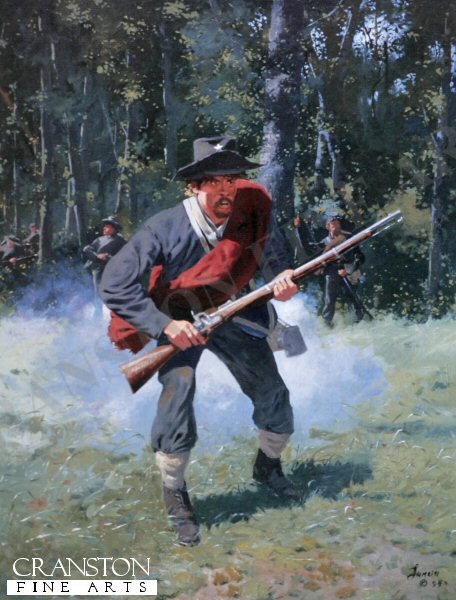
Sergeant 23rd Pennsylvania Infantry Zouaves 1863 by Jim Lancia. No text for this item |
Bringing Up the Guns by Gilbert Gaul. No text for this item |
Surrender of Ulm by Charles Thevenin. Napoleon at the height of his military career, receives the surrender of the city of Ulm after an almost bloodless victory. |
The Battle of Jemappes by Horace Vernet. On the 6th November 1792 Dumouriez defeated the Austrians under the Duke of Saxe Teshen and Clerfayt at Jemappes, near Mons. This led to the French Occupation of Belgium. |
Capture of the French Eagle by Sgt Ewart by Sulliven. Sgt Ewart is shown taking the French standard from the 45th French Infantry Regiment. Ewart cut down two French soldiers and the standard Bearer to keep hold of the Eagle and standard, he was ordered to take it to the rear. By being ordered to the rear, this probably saved his life and also the standard for the regiment, as the rest of the regiment continued charging forward to French artillery positions, much further than they should have gone, now with very tired horses and unable to rally, the Scots Greys were attacked by Farines Brigade of Cavalry (6th and 9th Cuirassiers.) and later by the 4th Lancers, very few managed to return to the British Lines. |
Siege of Sebastopol, by Alphonse de Neuville. The British assault on the Redan failed but the French under General de Mac-Mahon managed to seize the Malakoff redoubt making the Russian defensive position untenable. |
Scots Guards Saving the Colours at Alma by Lady Elizabeth Butler. Depicting Captain Lindsay of the Scots Guards advancing with the colours which were shot through and staff broken. By this example he helped to restore order after a Russian onslaught had put the regiment in disorder. |
Comrades by Robert Gibb. A dying soldier of the Black Watch is supported by his comrade, while another stands to protect them, as the ranks of the Highlanders march on, after the battles at Sebastopol during the Crimean war. |
Defeat of Darius by Alexander the Great 331BC by Francois Louis Joseph Watteau. The Battle of Guagamela 1st October 331BC. Alexander marched to Tyre, then to eastwood to cross the Euphrates and the River Tigris. Alexander was offered by Darius a large quantity of gold (worth over 500million pounds in todays terms) half his kingdom and the hand of his daughter. Alexander refused and a moth later the battle took place. Alexander was outnumbered 4 to 1 but he noticed a weak spot in the Persian line. He led the charge which was a great success and Darius fled the field. Seeing this panic spread through the Persian forces, Dariuss army crumbled. Later Darius was murdered by Persian nobles. |
The Battle of Waterloo by Sir William Allen. Showing Napoleons position at the La belle Alliance, during the Battle of Waterloo, in the distance you can see Wellington. |
1st Texas Infantry by Jim Lancia. No text for this item |
Battle of Montmirail by Horace Vernet. One of Napoleons last successes in France when he defeated the Russian General Sacken on 11th February 1814 at Montmirail near Paris. |
Oliver Cromwell after the Battle of Marston Moor by Ernest Crofts. At the Battle of Marston Moor, July 1644, prince Rupert had nearly won the battle after an initial cavalry charge routing three quarters of the Parliamentary Army, But he continued the pursuit to far. The remaining part of the New model army, including Cromwells regiment. after a long hard fight won the day. |
The Wounded Cuirassier by Theodore Gericault. No text for this item |
The Fusilier Battalion at Gros Guerschuen by Carl Rochling. No text for this item |
The Charge of the light Brigade by Robert Hillingford. Depicting the charge before they reach the Russian guns, the picture starts to show a confusion beginning to appear in the desperate charge. |
The Sabine Women by Jacques Louis David. The Romans have abducted the daughters of their neighbors, the Sabines. To avenge this abduction, the Sabines attacked Rome, although not immediately, since Hersilia, the daughter of Tatius, the leader of the Sabines, had been married to Romulus, the Roman leader, and then had two children by him in the interim. Here we see Hersilia between her father and husband as she adjures the warriors on both sides not to take wives away from their husbands or mothers away from their children. The other Sabine Women join in her exhortations. |
69th New York Infantry Company K by Jim Lancia. Zouave company of the Irish Brigade 1861 |
Prince Rupert at Edgehill by Stanley Berkeley. Prince Rupert beginning his career as a leader of the Royalist Cavalry drove the Parliamentarian Cavalry off the field. Prince Rupert was a nephew of King Charles I and commanded the Royalist cavalry during the English Civil War. Prince Rupert was born on 17th December1619 in Prague. His mother was Elizabeth, the sister of Charles I. Rupert became a soldier and fought in the Thirty Years War (1618 - 1648) and in 1642, he joined the army of Charles I in the English Civil War. He was soon appointed to lead the royalist cavalry and fought in the first major battle of the war at Edgehill in October 1642. His cavalry charge completely routed the parliamentarians but he got carried away and pursued them too far from the battlefield, losing the chance to inflict a decisive defeat. His reputation grew after a number of military. In 1644 Prince Rupert led the spectacular relief of the siege of York but his army was defeated by a parliamentary army at Battle of Marston Moor, losing York and the north to Cromwell In June 1645 he took part in the Battle of Naseby at which the royalists were defeated. In September Rupert surrendered Bristol to parliament and in response the king abruptly withdrew his commission. Rupert left for exile in Holland. After the restoration of the monarchy in 1660, Rupert held a series of British naval commands, fighting in the Second and Third Anglo-Dutch Wars. On 19th November 1682 Prince Rupert died. |
Charge of the Heavy Brigade by Orlando Norie. Showing the charge of the Scots Greys and the Inniskillings at Balaclava. |
|
Contact Details |
Sign Up To Our Newsletter!
This website is owned by Cranston Fine Arts. Torwood House, Torwoodhill Road, Rhu, Helensburgh, Scotland, G848LE Contact: Tel: (+44) (0) 1436 820269. Email: cranstonorders -at- outlook.com
|