|
|
|
|
|
|
|
|
|
Cranston Fine Arts  Landscape Art and Artists Countries England Cities London Landscape Art and Artists Countries England Cities London  Tower Bridge Tower Bridge |
| Tower Bridge Landscape Art Prints, Paintings and Drawings |
|
|
|
|
|
|
|
|
|
|
|
|
|
| Text for the above items : |
Caronia - Edwardian Elegance by Gordon Bauwens. When completed in 1905, TSS Caronia, at nearly 20,000 gross tons, was the largest Cunarder to date. She was an important liner for Cunard in that she and her sister ship, Carmania, were built by John Brown on the Clyde to directly compare the performance of standard reciprocating steam engines with the revolutionary new steam turbine propulsion plant. Known as the Pretty Sisters throughout their long and successful careers, Caronia and Carmania were identical other than in their propulsion units and were effectively test beds for the machinery of the two express transatlantic liners Cunard were planning - the giant sister ships, Lusitania and Mauretania. As the turbine-driven Carmania proved over two knots faster than Caronia, turbine engines were chosen for the subsequent record-breaking Lusitania and Mauretania liners and became the standard method of propulsion used right up until QE2 was built for Cunard in 1969 then re-engined with diesel-electric engines in the 1980s. Edwardian and Victorian engineering excellence are beautifully represented by TSS Caronia and London's Tower Bridge in this bustling Thames River scene. |
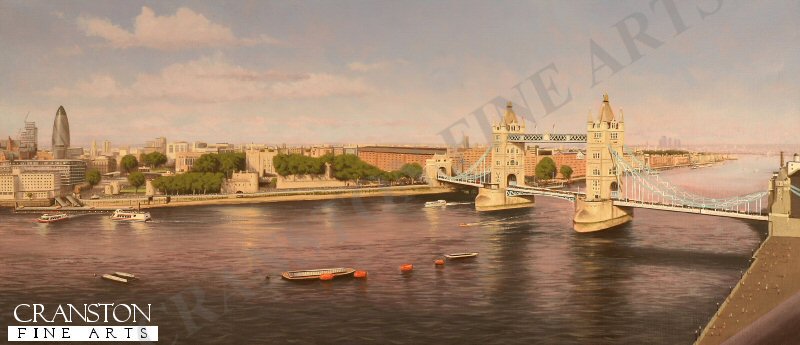
Tower Bridge and Tower of London by Graeme Lothian. Opened in 1894 and measuring 800 feet between the two towers, which house the machinery for raising the bascules (each weighing about 100 tons) in 90 seconds. The upper walkway is open to the public. To the left is the Tower of London started by William the Conqueror in 1078. It has been a fortress, royal residence, an arsenal and, more famously, a prison. |
Concorde - Early Morning Arrival by Stephen Brown. The sight of Concorde descending over London will forever remain etched in the memory of all who were fortunate to see this amazing aircraft. At Mach 2 Concorde could fly at 23 miles a minute - one mile every 2.5 seconds. A truly astonishing aircraft and one which to this day is sadly missed by its regular passengers and millions of admirers all over the world. |
Royal Yacht Britannia by Robert Taylor. The Royal Yacht Britannia is show in the Thames at her traditional mooring off Castle Point against the dramatic backdrop of Tower Bridge and the Tower of London. |
Spitfires Over London by John Young. No text for this item |
Battle of Britain by Stan Stokes. The Battle of Britain in 1940 was the biggest air battle ever fought in the history of armed conflict. After the fall of France Hitler hoped to sign a peace treaty with Britain allowing the Germans to dominate Europe, and ultimately attack Russia in the East. Being rebuffed by the British, Hitler and his senior military advisors formulated Operation Sea Lion. This was to involve an invasion of Britain after the Luftwaffe had attained total domination over the RAF. As plans evolved for knocking out the RAF, the Germans began assembling a large number of airfields in Holland, France, and Belgium to be used for the attack. In their arsenal the Germans had more than 800 medium range bombers including the Heinkel He-111, the Junker Ju-88, and the Dornier Do-17. They also had more than 200 Ju-87 Stuka dive bombers, and more than 900 Bf-109 and Bf-110 fighters to escort their attacking forces. The British had far less than 1000 defensive aircraft at their disposal with Hawker Hurricanes outnumbering Supermarine Spitfires about 2-to-1. Despite the Germans numerical superiority the British had at least five advantages in this epic Battle. First, radar allowed the Brits to determine where to target its fighter defenses. Second, when British aircraft were downed many of the pilots were recovered and returned to flight duty. When German aircraft were downed the pilots became British POWs. Third, the BF-109, Germanys best fighter, had limited range, and generally could spend only about twenty minutes over British soil before having to return to Europe. Fourth, the British dispersed their defensive forces widely into many small groups, eliminating the ability of the Luftwaffe to deliver a knockout punch on the ground. Fifth, the RAF pilots were surprisingly well trained, and while few in number were supplemented with volunteers from Canada, Australia, New Zealand, Poland, South Africa, and the United States. Also important was the tenacity of the RAF support staff that kept an amazing amount of the aircraft in the air. The man most responsible for the British victory was Air Marshal Sir Hugh Dowding, head of Fighter Command. In the first phase of the Battle the Luftwaffe focused its efforts on knocking out RAF airfields. The RAF lost 50 fighters in the first 10-days. This resulted in modified tactics permitting looser formation flying similar to that employed by the Germans. The Germans suffered too with the Bf-110 and Ju-87 proving particularly vulnerable. In August Hitler authorized a massive attack called Eagle Day that was designed to obliterate the RAF by attacking coastal radar stations. Again the German effort fell far short and later in August the Germans had one of their worst days losing 75 aircraft on Black Thursday. In late August the German tactics changed again with the focus now on destroying RAF fighters in the air. In a two-week period ending on September 6, the RAF lost 466 fighter aircraft, taking the Germans to their closest point of victory during the Battle. The turning point in the Battle is generally acknowledged to be September 7 when the Germans shifted focus to general attacks on London. This gave the RAF a breather, and on September 15 they took down 60 Luftwaffe aircraft. The losses on the 15th convinced the Germans that their strategy had failed and they slowly retrenched their attacks. September 15 is celebrated in Britain as Battle of Britain Day. |
Spitfire Over Tower Bridge by John Young. (AP) Spitfire from No. 54 squadron flies over London with Tower Bridge in the background. |
The View East from London Bridge by Graeme Lothian. Pleasure boats heading up river to Westminster after going out as far as Greenwich and the Thames flood barrier, a police launch makes its way eastwards to Tower Bridge. This was built in 1894 to allow ships further access up river. HMS Belfast is an 11,000 ton Navy cruiser which served throughout the Second World War and opened as a museum in 1971. In the distance can be seen Canada Tower, part of the Canary Wharf development. On the south bank, London Bridge City comprises of the Hays Galleria complex, a 100 foot high glass roof covers the former Hays Wharf where the great tea clippers once moored. |
Early Morning Arrival by Robert Watts. Robert Watts captures the romance of that golden era of passenger flight in his nostalgic painting of a L-1049 Constellation. Seen in American Airlines colors, a Connie descends over London in the soft early morning light after an overnight flight from New York. Without todays constraints of air traffic control, pilots had some latitude with the routes and altitudes they flew, and on this particular morning the pilot takes advantage of a beautiful sunrise to give his passengers a view of London and the winding river Thames, as he turns west for a landing into Londons Heathrow airport. |
View from City Hall by Graeme Lothian. (GS) No text for this item |
Guardian of Freedom by Timothy OBrien. A lone Spitfire of 266 Squadron is shown above the sunlit haze of London and the Thames, during the Battle of Britian. 266 Squadron was reformed on 30th October 1939 at RAF Sutton Bridge as a fighter squadron. The squadron was one of the Rhodesian gift squadrons and was named 266 (Rhodesia) Squadron in honour of the gift. Originally it was equipped with the Fairey Battle light bomber, but soon after in January 1940 it received the Supermarine Spitfire and became a fighter squadron. It was in action over Dunkirk in early June and fought in the Battle of Britain. |
Take it to the Bridge by Ivan Berryman. As cuts to the RAF and other armed services by the Labour Government were implemented in the late 1960s, Flt Lt Alan R Pollock of No.1 Sqn took it upon himself to stage a very personal protest whilst en route to West Raynham from Tangmere on 5th April 1968. Peeling away from the rest of his flight immediately after take off, Pollock flew low-level to London where he buzzed the Houses of Parliament three times before flying his Hawker Hunter FGA.9 under the upper spans of Tower Bridge. The incident is now part of British aviation folklore, but Pollock was immediately removed from flying duties for his audacity. He will always be recorded in history, however, as the first pilot to fly a jet aircraft through Tower Bridge. |
Tower Bridge at Sunrise by Graeme Lothian. (GS) No text for this item |
|
Contact Details |
Sign Up To Our Newsletter!
This website is owned by Cranston Fine Arts. Torwood House, Torwoodhill Road, Rhu, Helensburgh, Scotland, G848LE Contact: Tel: (+44) (0) 1436 820269. Email: cranstonorders -at- outlook.com
|