Please note that our logo is used on our website images only and does not appear on our products.

|
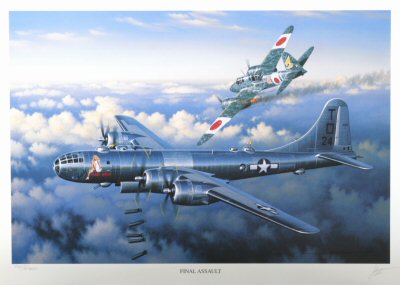
Final Assault by Stan Stokes.
The largest and most powerful bomber of WW II, the Boeing B-29 Super Fortress, played a major role in bringing about the defeat of Japan. In addition to accelerating Japans surrender following the bombing of Hiroshima and Nagasaki with atomic bombs, thousands of B-29 crews flew tens of thousands of bombing missions against Japan from bases in China, India, and later in the War from recaptured islands in the Pacific. B-29s entered service in 1943 following a lengthy, problem-filled, development process of three years in response to the governments request for a long range strategic bomber. Only Boeing and Douglas (the B-32 Dominator) responded to the governments requests, and the B-32 had even greater development problems than the B-29. Powered by four giant Wright R-3350-23 radial engines generating a total horsepower of 8,924, the Super Fortresses typically carried crews of ten. They were capable of a top speed of 357-MPH, and at slower cruising speeds had a range of more than 3,200 miles. The B-29 was a large aircraft for its time with a wingspan in excess of 140 feet and a length of just under 100 feet. The Super Forts also had pressurized forward and aft hulls, which made the long distance missions a bit more comfortable for the flight crews. B-29s typically carried defensive armament which included ten machine guns and a single tail-mounted canon. Because of the pressurized hull, the guns were operated by remote control. The first operational B-29 wing was the 58th which flew out of the China-Burma-India theater. On March 9, 1945 General Curtis LeMay ordered an unusual low altitude attack on Tokyo by hundreds of B-29s carrying incendiary bombs. Five such low level missions were scheduled over a ten-day period, and the combined destruction of these missions exceeded that of either of the atomic bomb missions. B-29s were also effectively used to mine Japanese ports and shipping lanes. The Kawasaki Ki-45 Toryu heavy fighter, which is depicted attacking the B-29 in Stan Stokes painting, entered production in 1941 following a lengthy four year development. About 1,700 of these aircraft, code named Nick by the allies, were produced. The Ki-45 never proved effective as a long range daylight interceptor. It was, however, used effectively in ground attack and night fighter roles. It was one of only a few Japanese aircraft that had some success against the onslaught of B-29s because it was able to attain the high altitudes necessary to intercept the high-flying Super Fortresses. This print is dedicated to the thousands of B-29 officers and crewmen who hastened the end of the Pacific War.
VIEW ALL STAN STOKES AVIATION ART
VIEW OUR WW2 AVIATION PRINTS PAGES
VIEW ALL SUPERFORTRESS AIRCRAFT ART
VIEW ALL NICK AIRCRAFT ART
|


 Buy 1 Get 1 Half Price!