|
|
|
|
|
|
|
|
|
Cranston Fine Arts  Special Offers Half Price Prints Special Offers Half Price Prints  Military Prints Military Prints |
[UP] - Military Prints - Aviation Prints - Naval Prints - Sports Prints |
| Navigation | |
| Page 1 of 21 | Page 1 .. Next |
|
|
|
|
|
|
|
|
|
|
|
|
|
|
|
|
|
|
|
|
|
| Navigation | |
| Page 1 of 21 | Page 1 .. Next |
| Text for the above items : |
Tiger Legend - Michael Wittmann by Jason Askew. (P) Two portraits of legendary tank commander Michael Wittmann, alongside a Tiger tank. |
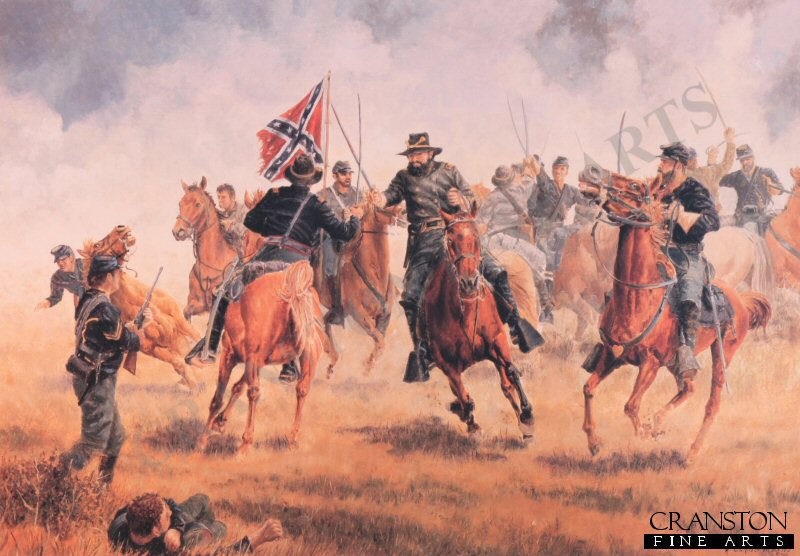
Hamptons Charge at Brandy Station by Clyde Heron. No text for this item |
Breaking the Gran Bridgehead by David Pentland. Hungary, 18th February 1945. The Soviet bridgehead across the lower river Gran threatened the important oilfields at Komorn. To deal with it, Heavy tank battalion 503 was attached to the elite Hoch und Deutschmeister Division. Then in conjunction with the 12th SS Hitlerjugend Division to the north the operation was launched and the bridgehead successfully crushed. |
Gordons and Greys to the Front by Stanley Berkeley. The charge of the Scots Greys with the Gordon Highlanders holding onto the stirrups. Although this is a point of argument as to the improbability, both regiments concur that this action did happen. |
The Battle of Quebec, 13th September 1759 by David Rowlands. Captain W Macleods Company, 1st Battalion Royal Artillery. Battle of Quebec 13th September 1759 was Wolfs final attempt to take the city. His army scaled the cliffs from Wolfes cove and fought the French army which was larger than Wolfes on the Plains of Abraham. During this battle General Wolfe was hit twice and eventually mortally wounded when a bullet passed through his lungs. As he lay dying he heard someone shout They run - see how they run. Wolfe gave his last order to cut of the enemies retreat and his last words being Now God be praised. I will die in peace. |
Whitehall by Ernest Crofts. The execution of Charles I, January 30th, 1649. |
The Tragedy of Ulster 1976 by Terence Cuneo. Terence Cuneo has depicted a scene of street violence. The angry mod hurls abuse, missiles and petrol bombs at the soldiers who are outnumbered and restricted in their ability to repsond. Rioting of this sort became less prevalent through the increased efficiency of the Police and Army in containing it, but Terence Cuneos reconstruction typifies the dangerous situation the secuirty forces in Ulster faced during the 1970s. Published in 1977 by the Army and Navy Club, Pall Mall, London. |
Assault on the Iranian Embassy by the Pagoda Troop 22 SAS by Graeme Lothian. No text for this item |
Napoleon at Friedland by Mark Churms. The year is 1807, the French Empire is at the pinnacle of its power. Although not yet 38 years of age the Emperor Napoleon Bonaparte is marching towards the heights of his military career. It is the anniversary of his great victory against the Austrians at Marengo seven years before. Since then the soldiers of The Grand Armee have faithfully followed The Little Corporal from victory to victory across Europe. Now, in eastern Prussia, the Russians alone are holding out against the might of France. Bennigsens army is strung out on a four mile front along the banks of the river Alle, near the town of Friedland. With their backs to the unfordable river the brave Russian soldiers are drawn up in a poor position to give battle. It is already midday when Napoleon arrives on the field. Much of the French force is still some miles away but the commanders keen eye immediately perceives an opportunity for victory. He decides to attack. The vigourous assault on the Russian lines commences at about 5.30 pm. Bennigsen, anticipating an engagement on the following day, is completely surprised by this ferocious attack so late in the afternoon. The fighting begins as his divisions are preparing to withdraw across the river Alle, to a stronger position. Napoleons master stroke throws the enemy into confusion. By 8.30 pm the French are masters of the field, the Russians have lost nearly a third of their army and 80 cannons. The town of Friedland is ablaze and the Tsars army in full retreat. In simple attire and characteristically astride a nimble arab grey, Napoleon Bonaparte rides forward with his reserves of the Guard to survey the final victory. Within a few days the defeated Tsar Alexander will embrace the French Emperor on a raft anchored in the middle of the Niemen at Tilsit. At their monumental meeting they will talk of peace, co-operation against the British, the division of Prussian Territories and France with Russia will form their uneasy alliance that will quickly collapse into open hostility and present Napoleon with his greatest challenge: The invasion of Russia itself. |
Easy Company, 101st Airborne Division by Jason Askew. Paratroopers of Easy Company,101st Airborne Division, take cover in a doorway during the Screaming eagles' penetration of the town of Sainte-Marie-du-Mont, France, on D-Day, June 6, 1944. |
The Empty Saddle by J P Beadle. Often called the Last Patrol, the painting depicts a scene from the Boer war, showing a party of Lancers bringing a riderless horse back from patrol. Art prints reproduced by kind permission of the 9th / 12th Lancers. |
Struggle for Sainte Mere Eglise by David Pentland. Normandy, 6th June 1944. At 04.30hrs, Lt. Col. Krause led the men of 3/505th PIR to take the town of Ste. Mere Eglise. For the rest of the day the 82nd Airborne troops fought off successive German attempts to retake the strategic town. |
The Charge of the Highlanders at the Battle of Prestonpans, by Mark Churms. Battle of Prestonpans. Bonnie Prince Charlie, after landing at Glenfinnan, in his bid to gain the British Throne. Lord George Murray with an army of 2,000 Jacobites marched southward where they were met at Prestonpans by General Sir John Cope and a Royal army of 3,000 men On the 21st September, the Jacobites charged the government troops and routed them. Hundreds of Government troops were killed or wounded and over 1,000 were captured, with the Jacobite losses less than 150. With this victory Charles Edward Stuart and the Jacobite army marched southwards into England capturing the towns of Carlisle, Penrith, Lancaster and Preston and getting as far as Nottingham before lack of supplies and new recruits forced him to head back to Scotland. Through the early morning Autumn mist, Highlanders of the Appin Regiment abandon their plaids and rush headlong across fields of stubble into the stunned ranks of Jonny Cope's army. The force sent by the Crown to destroy the rebellion and capture the Pretender is itself utterly routed in a matter of minutes. The first major engagement of the uprising is a swift and complete victory for the Prince's men. Except for the garrisons of Edinburgh, Stirling, Fort William and Fort Augustus, Scotland is now under the control of the Jacobites. |
Napoleon and his Staff by Jean Louis Ernest Meissonier. Painted in 1868, Napoleon wears the uniform of the Chasseurs and is followed by his generals and an Egyptian Marmaluke (extreme left) Added, it was said, at the express wish of Lord Hereford who purchased the painting. It is now in the Wallace Collection. |
The Charge of the light Brigade by Robert Hillingford. Depicting the charge before they reach the Russian guns, the picture starts to show a confusion beginning to appear in the desperate charge. |
Fight for the Standard by Richard Ansdell. Depicting sergeant Ewart dispatching a French cavalryman on his way back with the Eagle and Standard captured from the French 45th Regiment of Foot. |
Operation Overlord by David Rowlands. 9th (Irish) Field Battery firing on the Run-in-shoot to Queen Beach. They were the first rounds fired at the Normandy Coast, D-Day 6th June, 1944. Queen Beach, one of the 4 sectors of Sword Beach, |
Gold Beach, Normandy, 6th June 1944 by David Pentland. Royal Engineers Churchill AVREs of 6th Assault Regiment, 81st Squadron and DD Shermans of the 4/7th Dragoon Guards. Both units were part of perhaps the most important formation involved in the British and Canadian landings, the 79th Armoured Division or Funnies. Composed of a variety of armoured vehicles, designed to support the beach assault troops, they included mine flails, bunker busters, carpet layers, and amphibious tanks. |
2nd Life Guards Band 1829 by Mark Churms. (P) Study for the original painting March Past of the Grenadier Guards. |
The Winged Dagger by Simon Smith. 22 SAS Squadron in the Gulf, having been dropped by Chinook of the 7th Squadron RAF |
Prize J Un Drapeau Prussian Par Le 4th Regiment De Dragons En 1806 by Edouard Detaille. No text for this item |
|
Contact Details |
Sign Up To Our Newsletter!
This website is owned by Cranston Fine Arts. Torwood House, Torwoodhill Road, Rhu, Helensburgh, Scotland, G848LE Contact: Tel: (+44) (0) 1436 820269. Email: cranstonorders -at- outlook.com
|