|
|
|
|
|
|
|
|
|
Cranston Fine Arts  Military Art and Artists Featured Current Military Artists Brian Palmer Military Art and Artists Featured Current Military Artists Brian Palmer  Postcards Postcards |
[UP] - Ancient Era - Medieval Era - Napoleonic Art - American History - Zulu Wars - World War One - Original Paintings - Postcards |
| Navigation | |
| Page 2 of 3 | Previous .. Page 2 .. Next |
|
|
|
|
|
|
|
|
|
|
|
|
|
|
|
|
|
|
|
|
|
| Navigation | |
| Page 2 of 3 | Previous .. Page 2 .. Next |
| Text for the above items : |
Battle of Ulundi by Brian Palmer. (PC) After coming out of the British Square The 17th Lancers charge by the 58th Regiment. The Battle of Ulundi took place at the Zulu capital of Ulundi on 4th July 1879. Ulundi became the last battle to be fought during the Zulu war and the British victory finally broke the military power of the Zulu Nation. The battle began at 6 a.m. when Buller led out an advance guard of mounted troops and South African irregulars. The British force comprised of five companies of the 80th regiment in square in four ranks, with two Gatling Guns in the centres, two 9-pounders on the left flank and two 7-pounders on the right. The 90th Light Infantry with four companies of the 94th regiment made up the left face with two more 7-pounders. On the right face were the 1st Battalion of the 13th Light Infantry, four companies of the 58th Regiment, two 7-pounders and two 9-pounders. The rear face was composed of two companies of the 94th Regiment and two companies of the 2nd Battalion of the 21st Regiment. In the middle of the square were headquarters staff, No. 5 company of the Royal Engineers whhich was led by Lt John Chard who had commanded the troops at Rorkes Drift, the 2nd Native Natal Contingent, fifty wagons and carts with reserve ammunition and hospital wagons. Bullers horsemen protected the front and both flanks of the square. A rearguard of two squadrons of the 17th Lancers and a troop of Natal Native Horse followed. In total the British force stood at just over 5300 against the Zulu warrior regiments in total over 15000. The Zulu warriors charged again and again at the square but with the strong British firepower of tifle and gatling gun, they could not get close. As the Zulu warriors strength weakened, Lord Chelmsford ordered the cavalry to mount, and the 17th Lancers and the 1st Kings Dragoon Guards along with colonial cavalry were ordered to charge the now fleeing Zulus. The Zulus fled towards the high ground with the cavalry in pursuit. The Lancers were checked at the Mbilane stream by the fire of a concealed party of Zulus, causing a number casualties before the 17th Lancers overcame the Zulu resistance. The pursuit continued until not one living Zulu remained on the Mahlabatini plain, with members of the Natal Native Horse, Natal Native Contingent and Woods Irregulars slaughtering the Zulu wounded, done in revenge for the massacre at Isandlwana. |
Battle of the Boyne by Brian Palmer. (PC) William of Orange (later William III) encourages his infantry and cavalry at the Battle of the Boyne. |
The Battle of Thermopylae by Brian Palmer. (PC) Depicting the last stand of the 300 Spartans who fought to the death against an overwhelming Persian Army. |
The Battle of Teutoburg Forest, AD 9 by Brian Palmer. (PC) In AD 9, three Roman legions - 20,000 men plus camp followers - commanded by Governor Varus crossed the Rhine into what they believed to be friendly territory on their way to putting down a local uprising. A young chieftain of the Cherusci tribe, Arminius, had guaranteed them safe passage through his lands. However, Arminius who held a grudge against the Romans, deliberately deceived Varus and in a four-day running battle in the forest overwhelmed and slaughtered the Romans almost to a man. Varus, along with his surviving senior officers, took their own lives to avoid capture. |
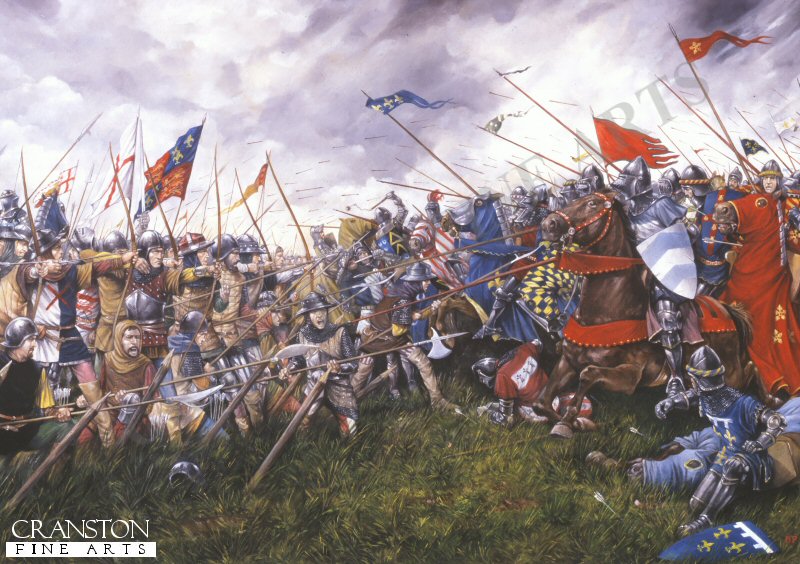
The Battle of Agincourt by Brian Palmer. (PC) The French Knights attack Henry Vs English infantry lines and are repelled during the Battle of Agincourt, a victory for Henry V. |
1st Regiment of Foot Guards at Waterloo by Brian Palmer. (PC) The light company of the 1st Foot Guards commanded by Lord Saltoun, defending the hollow way, behind Hougoumont. |
Nery by Brian Palmer. (PC) Action at Nery, 1st September 1914. During the fighting retreat from Mons, battery L of the Royal horse artillery bivouacked by a small town of Nery. Their temporary halt was interrupted during the early morning cavalry patrol warning of the imminent arrival of a large German force of cavalry, infantry and artillery. almost immediately German shells began bursting amongst the battery, accompanied by a rifle and machine gun fire. 3 guns were knocked out before they could be brought into action and two more were disabled soon afterwards, while the British gunners sustained heavy casualties. the remaining no. 6 gun with a scratch crew managed to maintain a steady fire for some two hours inflicting heavy casualties on the Germans until reinforcements arrived, driving off the surviving German unties. Three Victoria crosses (one posthumously) and two French medaille militaire were awarded and two NCOs were commissioned after the action. |
Remember the Alamo by Brian Palmer. (PC) No text for this item |
A Viking Raid by Brian Palmer. (PC) No text for this item |
Richard the Lionheart by Brian Palmer. (PC) Richard the Lionhearts tactical skills and military training played a substantial role in the capture of Acre in 1191 by the Crusaders. But Richard the Lionheart was ruthless and after the capture of the city he marched 2,700 Muslim soldiers onto the road of Nazareth and in front of the Muslim army positions, had them executed one by one. But Richard the Lionheart was up against a great leader in Saladin and the crusades did not always go his way. After he negotiated the Treaty of Jaffa with Saladin and secured the granting of special rights of travel around Palestine and in Jerusalem for Christian pilgrims, Richard the Lionheart started his journey back to England in 1192. He was shipwrecked, and captured by the German Emperor Henry VI, only being released after a 150,000 mark ransom was paid. This money was raised by taxes in England. |
Battle of Stamford Bridge by Brian Palmer. (PC) King Harold defeats the Viking invaders at Stamford Bridge before his long march south to face William the Conqueror at the Battle of Hastings. |
The Battle of Kadesh - circa 127 BC by Brian Palmer (PC) In 1275 BC there were two superpowers in the ancient near east, in the south the Egyptians and in the north the Hittites from Anatolia in modern day central Turkey. A clash between these two powers was inevitable. The Egyptian Pharaoh Rameses II marched an army north into Syria to confront the Hittites and their allies under King Muwatallis. Reaching Kadesh Rameses camped under the walls of the city with his leading division, Amun, and awaited the arrival of the rest of his army. Poor intelligence had led Rameses to believe the Hittites were far to the north, in fact they were only 2 - 3 miles away. Muwatallis delivered a surprise attack against Rameses camp but the Egyptians managed to hold on until re-enforcements arrived. Despite retreating from the field after a day long battle it was Rameses who claimed a victory. The two armies never clashed again and eventually a peace treaty was signed between the Egyptians and the Hittites. |
Charge of the Dutch Lancers against the British Squares at Waterloo by Brian Palmer. (PC) Mistaking the withdrawal of wounded troops from the plateau of Mount St John for a general retreat , Marshal Ney ordered 5000 heavy and light cavalry to charge the allied position. Far from retreating, Wellington was in fact reinforcing his beleaguered front line. Wave after wave of French cavalry repeatedly threw themselves at the allied squares for over an hour but failed to make an impact. Here we see the 30th Regt - now the Queens Lancashire Regt - formed in square repelling The Dutch (Red) Lancers of the Imperial Guard. |
1st Regiment French Light Infantry at Waterloo by Brian Palmer. (PC) No text for this item |
Battle of Bosworth by Brian Palmer. (PC) In 1485, the Lancastrian contender for the throne of England, Henry Tudor, sailed from France with a small force of mainly continental mercenaries determined to wrestle the crown from Richard III. Gathering many supporters along the way he eventually arrived at Bosworth with an army numbering 5000 against Richards 8000. Things began well enough for Richard but it became apparent during the battle that the neutral Stanley Brothers, Sir William Stanley and Lord Thomas Stanley and their men who had remained on the sidelines, had elected to fight for Henry. Richard charged for Henry in person but was overwhelmed and killed. He was the last English King to die in battle. Although not the final battle of the War of the Roses, the victory for Henry at Bosworth secured the crown and began the Tudor dynasty. |
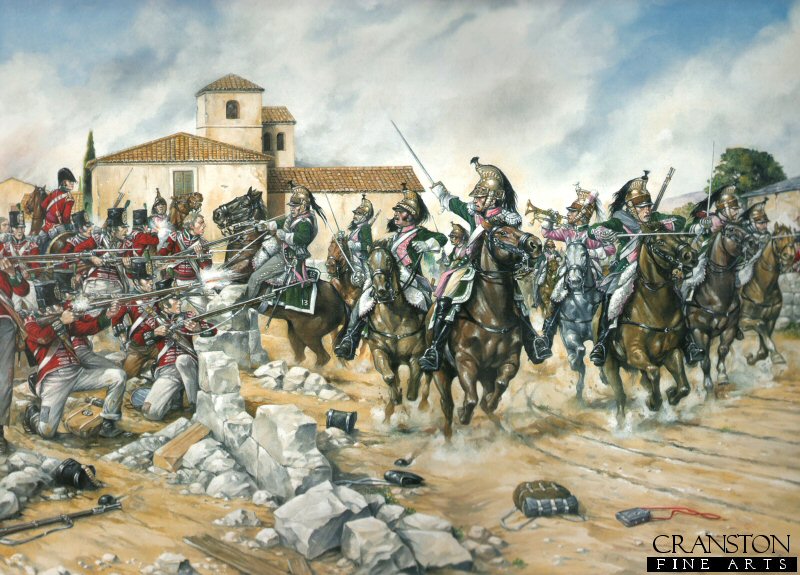
87th Regiment at the Battle of Vitoria by Brian Palmer. (PC) The 87th Regiment defend the walls against the French 13th Dragoons as they charge by during the Battle of Vitoria. |
Waterloo, 18th June 1815 - Charge of the 6th (Inniskilling) Dragoons by Brian Palmer. (PC) To the cheers of Vive L'Empereur 17,000 men of d'Erlon's Corps advanced on the allied left centre in an attempt to break Wellington's line that was already shaken by a massive artillery bombardment. To counter this threat, Wellington launched his heavy cavalry. Forming the centre of the Union Brigade, so called from the composition of English, Irish and Scottish regiments, the Inniskillings charged through the allied infantry and artillery straight to d'Erlon's advancing coloumns inflicting serious casualties and taking many prisoners. Despite appalling losses, the heavy cavalry had gained a welcome respite for Wellington's hard pressed infantry. |
Defence of Rorkes Drift by Brian Palmer. (PC) Men of the 24th Foot defend Rorkes Drift against an overwhelming number of Zulus near the barricades, and the hand to hand fighting. Surgeon Reynolds can be seen attending a wounded soldier. |
Battle of Marathon by Brian Palmer. (PC) The Battle of Marathon 490 BC during the Persian Greek Wars. King Darious I of Persia sent his son in law Mardonius to invade Greece in 492 BC. The Persian Forces conquered Thrace and Macedonia before their fleet was devastated by a storm. Mardonia was forced to return to Asia. A second Persian invasion force crossed the Aegean sea. After conquering Eretria, the Persian Army under Datis (15,000 strong) landed near Marathon. (Marathon is 24 miles northeast of Athens.) General Miltiades, general in the Greek army gathered a force of 10,000 Athenians and 1,000 Plataean citizen Soldiers. |
The 12th (Suffolk Regiment) at the Battle of Minden. 1st August 1759 by Brian Palmer. (PC) During the Seven Years War (1756 - 63) a large French army of 52,000 men commanded by Marshal Contades moved from the Rhine to take Minden and threaten the Electorate of Hanover, one of Britains allies in the war. Ferdinand of Brunswick commanding an allied army consisting of British, Brunswick, Hanoverians and Hessen - Cassell troops numbering 42,000 stood in their way. The battle began at first light with the allies forming up in 8 columns preparing to advance. Due to a misunderstanding of orders two brigades, which included the 12th, went into the attack before the rest of the line had properly formed. With drums beating and colors flying they launched a frontal attack on French cavalry, and against all odds held firm and threw them back in confusion. By this time the rest of the infantry had arrived in support and the French army was routed. Minden is remarkable for this unique attack by infantry in line against a mass of cavalry. |
The Cameron Highlanders at Waterloo by Brian Palmer. (PC) No text for this item |
|
Contact Details |
Sign Up To Our Newsletter!
This website is owned by Cranston Fine Arts. Torwood House, Torwoodhill Road, Rhu, Helensburgh, Scotland, G848LE Contact: Tel: (+44) (0) 1436 820269. Email: cranstonorders -at- outlook.com
|