|
|
|
|
|
|
|
|
|
Cranston Fine Arts  Military Art and Artists Medieval History War of the Roses Military Art and Artists Medieval History War of the Roses  Battle of Bosworth Battle of Bosworth |
[UP] - Richard III - Battle of St Albans - Battle of Northampton - Battle of Wakefield - Battle of Towton - Battle of Barnet - Battle of Tewkesbury - Battle of Bosworth |
|
|
|
|
|
|
|
|
|
|
|
|
|
| Text for the above items : |
Battle of Bosworth by Brian Palmer. In 1485, the Lancastrian contender for the throne of England, Henry Tudor, sailed from France with a small force of mainly continental mercenaries determined to wrestle the crown from Richard III. Gathering many supporters along the way he eventually arrived at Bosworth with an army numbering 5000 against Richards 8000. Things began well enough for Richard but it became apparent during the battle that the neutral Stanley Brothers, Sir William Stanley and Lord Thomas Stanley and their men who had remained on the sidelines, had elected to fight for Henry. Richard charged for Henry in person but was overwhelmed and killed. He was the last English King to die in battle. Although not the final battle of the War of the Roses, the victory for Henry at Bosworth secured the crown and began the Tudor dynasty. |
Richard III at the Battle of Bosworth, 22nd August 1485 by Mark Churms. The decisive battle of the War of the Roses was fought near Market Bosworth. Richard of Gloucester, the last Plantagenate King of England was to try consequences with Henry Tudor, Earl of Richmond. The bloody conflict began in the traditional manner with the opposing armies drawn up in line. facing one another, except for the forces of Thomas Neville, Lord Stanley, as yeyt uncommitted to either side. King Richard, the Third of that name, is seated astride his grey charger in his fine blued harness. He is accompanied by his personal standard and the royal standard, alongside that of Lord Zouch to his right. His herald, trumpet are at his side. To his left Richards Chamberlain and Admiral, Viscount Lord Lovel, sits ready, astride his mount. To the rear we see the rest of the household and choice force of cavalry, kept out of shot to avoid unnecessary casualties amongst the expensive war horses. After the opening deadly arrow storm, boys hurriedly collect fallen arrows for Richards men to shoot back. In the front line crossbowmen return fire from behind the safety of their decorated pavaises (painted with the suns and white roses of York and the white boar, Richards badge). Close by a gentleman at arms, mortally wounded by an iron ball fired from a hand gonne is dragged from the field by his page. Sir Walter Devereux (Lord Ferrers) accompanied by his standard is encouraging his household (soldiers wearing his livery colours ) to attack. However, there is a marked reluctance on both sides to join the vicious close quarter combat of handstrokes and only in the centre is there any heavy fighting. Richard is informed by his herald that Henry and his household have been recognised and are now within charge distance. Faced with his armies reluctance to come to grips with the enemy, he decides to force battle himself by leading his own household, the Choice Force, in a desperate charge against Henry seeking to engage him in single combat. Characteristically leading from the front Richard slays many a knight, including William Brandon (Henrys standard bearer) in his vain attempt to kill his rival. At this crucial moment Lord Stanley decides to join Henrys cause, attacks the choice force and drives it from the field. In the brutal hand to hand fighting the king is unhorsed and though surrounded, fights to the end. -KingRichard alone was killed fighting manfully in the thickest press of his enemies - his courage was high and fierce and failed him not even at the death which when his men forsook him, he preferred to take by the sword, rather than by foul flight to prolong his life- (Polydore Virgil) |
The March from Leicester by Graham Turner King Richard III leads his army out of Leicester, past Austin Friars and over Bow Bridge, en-route to Bosworth and his fateful confrontation with the invading army of his adversary for the throne, Henry Tudor. |
The Battle of Bosworth - the Melee - Norfolk versus Oxford by Graham Turner When Richard III succeeded his brother, Edward IV, in 1483, he found his throne threatened by the Lancastrian Henry Tudor, who was then exiled in France. Two years later, Henry landed in Wales with a small force and on the 22nd August 1485, he confronted the Royal army near Market Bosworth in Leicestershire. |
The Battle of Bosworth - King Richard IIIs Charge by Graham Turner After three decades of civil strife between the Royal houses of Lancaster and York, now known as the Wars of the Roses, the army of the Yorkist King, Richard III, confronted the invading force of Henry Tudor, the Lancastrian claimant to the English throne, on the 22nd August 1485 near Market Bosworth in Leicestershire. With the two armies locked together in fierce hand to hand combat, Henry, surrounded by only a small body of men, becomes isolated from his main force. Seeing a chance to end the battle with one decisive stroke, Richard leads his household knights and retainers in a thunderous charge, seeking out his adversary. The unfortunate Sir William Brandon is unhorsed by the Kings lance and Tudors Red Dragon standard falls to the ground. To the left, Sir John Cheyney spurs his horse on to challenge the King and Henry Tudors mount rears up, startled by the deafening noise of battle. However, the hitherto uncommitted forces of Sir William Stanley can be seen approaching and their intervention on Tudors side will lead to the defeat and death of Richard III, the last Plantagenet King of England, and the succession of Henry Tudor as Henry VII. |
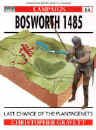
Bosworth 1485, Last Charge of the Plantagenets by Christopher Gravett. On 22 August 1485 a king and a challenger for the throne faced each other on a battlefield for the first time in the Wars of the Roses, at stake was the throne itself. The Battle of Bosworth is therefore one of the most important battles in English history as it effectively put an end to the dynastic struggle of the Wars of the Roses and placed the Tudor house on the throne of England. Since his death in battle against Henry Tudor, argument has raged around the central figure to the story, the controversial King Richard III. Shakespeare's image of a twisted and tortured king remains influential despite years of academic study, whilst the mystery of the Princes in the tower still retains its potency. Christopher Gravett cuts through this myth and propaganda to detail the course of this pivotal campaign that decided the fate of a dynasty. |
Bosworth 1485 - Halberdier, Crossbowmen and Handgunner by Mark Churms. (P) Study for the original painting Richard III at the Battle of Bosworth. |
Bosworth 1485 - Knight by Mark Churms. (P) Study for the original painting Richard III at the Battle of Bosworth. |
Page to Richard III, Bosworth 1485 by Mark Churms. (P) Study for the original painting Richard III at the Battle of Bosworth. |
Crossbowmen - Bosworth 1485 by Mark Churms. (P) Study for the original painting Richard III at the Battle of Bosworth. |
Halberdiers - Bosworth 1485 by Mark Churms. (P) Study for the original painting Richard III at the Battle of Bosworth. |
Bosworth 1485 - Standard Bearer to Lord Ferrers by Mark Churms. (P) Study for the original painting Richard III at the Battle of Bosworth. |
Bosworth 1485 - Sir Walter Devereux by Mark Churms. (P) Study for the original painting Richard III at the Battle of Bosworth. |
|
Contact Details |
Sign Up To Our Newsletter!
This website is owned by Cranston Fine Arts. Torwood House, Torwoodhill Road, Rhu, Helensburgh, Scotland, G848LE Contact: Tel: (+44) (0) 1436 820269. Email: cranstonorders -at- outlook.com
|