|
|
|
|
|
|
|
|
|
Cranston Fine Arts  Aviation Art and Artists World War Two Veteran Signatures UK and Commonwealth T Aviation Art and Artists World War Two Veteran Signatures UK and Commonwealth T  Tappin, H Tappin, H |
[UP] - Tait, James - Tappin, H - Tapson, Derek - Tatham, Basil - Tattersall, John - Taussig, Kurt - Taylor, Jimmy - Taylor, P - Tempest, Ken - Temple, Julian - Tetlow, Phil - Thom, Alex - Thomas, Harry - Thomas, J - Thomas, Ken - Thompson, Anthony - Thompson, Sam - Thompson, Tommy - Thomson, George - Thomson, Thomas - Thorburn, John - Thorogood, Laurence - Tidy, Douglas - Tilley, F - Tilley, Reade - Todd, Noel - Todd, Richard - Toombs, John - Townsend, Bill - Townsend, Peter - Townsend, Rusty - Trent, Leonard - Trotman, John - Tucker, Arthur - Tuhill, Pat - Tunstall, Fred - Tyack, F - Tyson, Geoffrey |
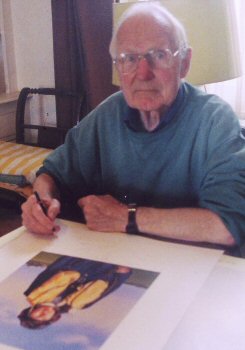
H. E. Tappin
Started flying, as an N.C.O. pilot, with the R.A.F.V.R. at No.3 E.& R.F.T.S. run by Air Service Training, at Hamble near Southampton.in April 1937. Awarded Pilot's Flying Badge (wings) in May 1938. Moved to 26 E.& R.F.T.S. run by Marshalls Flying School at Kidlington, near Oxford in September 1938. Flying Instructor's Course, November/December 1938 Started instructing 30th December 1938. School at-Kidlington closed on outbreak of hostilities, staff moved to 22 E.F.T.S. at Carpbridge. Instructed at Cambridge until April 1941, when posted to 52 O.T.U. (Hurricane) at Debden. Commissioned December 1940. 52 O.T.U. April/May 1941. Posted to 3 Squadron (Hurricane) at Martlesham Heath 2nd June 1941, became Flight Commander in March 1942. Posted to 534 Squadron (Turbinlite) as Hurricane Flight Commander September 1942. Tutbinlite Project abandoned February 1943,,posted to 157 Squadron (Mosquito) at Castle Camps. Became Flight Commander July 1943. Posted from 157 at Predannack, March 1944 to 51 O.T.U. at Cranfield and Twinwood Farm, near Bedford, as W/Cdr Flying. January 1945 posted to Mediterranean to command 108 Squadron (Beaufighter), to learn on arrival that the Squadron was to be disbanded. I spent a short period with 334 (Special Duties) Wing at Brindisi, in Southern Italy, and in March 1945 was posted to Command 256 Squaron (Mosquito) with the Desert Air Force at Forli, iii-Northern Italy. In September 1945 the Squadron moved to Egypt,, from where I returned home in December of that year. In February 1946 1 returned to Cambridge to continue my work with Marshalls as a civilian pilot, where the work was varied and interesting, covering flying-instruction, charter work and testflying on a variety of aircraft, including the Vampire, Venom, Canberra, Valiant, Viscount and Ambassador. I left Cambridge in January 1961 to instruct at The College of Air Training at Hamble, which had been set up by B.E.A. and B.O.A.C., (taking over the Air Service Training facilities) to train new pilots ?,rom scratch, as the supply of ex-service pilots was running short. It proved to be very successful. Retired from Hamble January 1972. Service Numbers: N.C.O. 740167. Commissioned Officer 89304. D.F.C. September 1942 Bar to D.F.C. April 1944. Died 8th January 2007.
 | |
| Distinguished Flying Cross | Bar to the Distinguished Flying Cross |
| H. E. Tappin - Signed Aviation Art |
|
|
|
|
|
|
|
|
|
|
| Text for the above items : |
Hurricane Patrol by Graeme Lothian. After taking part in the Battle of France early in 1940, 85 Squadron moved to Croydon on the 19th August, where, led by renowned squadron leader Peter Townsend DSO DFC, the squadron played a notable part in the Battle of Britain. Thirty Hurricane squadrons participated in the Battle of Britain compared to only eighteen Spitfire squadrons, claiming 80 percent of the RAF victories. Sir Sidney Camms innovative design ensured the Hurricane became a classic fighter. Hurricane Patrol portrays Squadron Leader Peter Townsend leading 85 Squadron on a high altitude sortie during the long hot summer of 1940. |
Battle of Britain Hurricanes by Graeme Lothian. (P) Hurricanes of the Royal Air Force scramble to take on the Luftwaffe during the Battle of Britain in the summer of 1940. |
Polish Spitfire by Graeme Lothian. (P) Spitfire Z-FA of No.308 Sqn (Polish) thunders over a picturesque village in April 1941. |
Time To Go by Philip West. Late 1944 and as the sun sets, Mark XIX Mosquito night fighters from 85 and 157 Squadrons based at RAF Swannington crew up for their next operation over hostile territory. These Mosquitoes scored many victories in the defence of Bomber Command aircraft and their crews during their relentless and dangerous missions over Germany. |
Spitfires of No.54 squadron during the Battle of Britain by Graeme Lothian. (P) Air Commodore Alan Deere DSO DFC* and other Spitfires of No.54 squadron during the Battle of Britain, attacking He111 bombers which are being escorted across the Channel by Me109 fighters |
Standing Guard by Graeme Lothian. (P) A soldier of the Home Guard watches over a downed Me109 fighter as a squadron of RAF Hurricanes fly overhead. More Hawker Hurricanes flew during the Battle of Britain than Spitfires, guarding Britain against the might of the Luftwaffe. |
Hurricanes - 85 Squadron by Graeme Lothian. (P) Hawker Hurricanes of No.85 Sqn RAF take off to intercept another enemy raid during the Battle of Britain. |
Spitfire - Fighting Lady by Graeme Lothian. (P) Johnnie Johnsons Spitfire on patrol over the British coastline. This is the original sketch for the oil painting Fighting Lady. |
32 Squadron Hurricanes - Battle of Britain by Graeme Lothian. (P) Pete Brothers in GZ-L leads Hurricanes of No.32 Squadron on patrol during the Battle of Britain. |
D-Day Spitfire - Johnnie Johnson by Graeme Lothian. (P) WW2 Ace Johnnie Johnson in his Spitfire JE-J, shown with black and white D-Day invasion stripes. |
|
|
|
|
H E Tappin signing the print - High Patrol - by Graeme Lothian |
H E Tappin signing the print - Fighter Pilot of the RAF - by Graeme Lothian |
| H. E. Tappin Aircraft details |
 Canberra Manufacturer : English Electric | Canberra The English Electric Canberra first flew on Friday 13 May 1949 when its performance created a sensation. Such was the quality of the original design that in May 1951, when the first B2 Canberras entered service with No 101 Squadron at RAF Binbrook they could out manoeuvre all the fighters of the period and fly with impunity more than 10,000 feet above them. Operated by 17 airforces in more than 20 different variants, Canberras have been to war at Suez and in India, in Vietnam and the Falklands campaign, and in 1996 Canberra PR9s were engaged in operational reconnaissance flights over Bosnia and in other regions. It is widely and justifiably regarded as one of the greatest aircraft designs of all time. |
 Hurricane Manufacturer : Hawker Built : 14533 | Hurricane Royal Air Force Fighter, the Hawker Hurricane had a top speed of 320mph, at 18,200 feet and 340mph at 17,500, ceiling of 34,200 and a range of 935 miles. The Hurricane was armed with eight fixed wing mounted .303 browning machine guns in the Mark I and twelve .303 browning's in the MKIIB in the Hurricane MKIIC it had four 20mm cannon. All time classic fighter the Hurricane was designed in 1933-1934, the first prototype flew in June 1936 and a contract for 600 for the Royal Air Force was placed. The first production model flew ion the 12th October 1937 and 111 squadron of the Royal Air Force received the first Hurricanes in January 1938. By the outbreak of World war two the Royal Air Force had 18 operational squadrons of Hurricanes. During the Battle of Britain a total of 1715 Hurricanes took part, (which was more than the rest of the aircraft of the Royal air force put together) and almost 75% of the Victories during the Battle of Britain went to hurricane pilots. The Hawker Hurricane was used in all theatres during World war two, and in many roles. in total 14,533 Hurricanes were built. |
 Mosquito Manufacturer : De Havilland Built : 7781 | Mosquito Used as a night fighter, fighter bomber, bomber and Photo-reconnaissance, with a crew of two, Maximum speed was 425 mph, at 30,300 feet, 380mph at 17,000ft. and a ceiling of 36,000feet, maximum range 3,500 miles. the Mosquito was armed with four 20mm Hospano cannon in belly and four .303 inch browning machine guns in nose. Coastal strike aircraft had eight 3-inch Rockets under the wings, and one 57mm shell gun in belly. The Mossie at it was known made its first flight on 25th November 1940, and the mosquito made its first operational flight for the Royal Air Force as a reconnaissance unit based at Benson. In early 1942, a modified version (mark II) operated as a night fighter with 157 and 23 squadron's. In April 1943 the first De Haviland Mosquito saw service in the Far east and in 1944 The Mosquito was used at Coastal Command in its strike wings. Bomber Commands offensive against Germany saw many Mosquitos, used as photo Reconnaissance aircraft, Fighter Escorts, and Path Finders. The Mosquito stayed in service with the Royal Air Force until 1955. and a total of 7781 mosquito's were built. |
 Valiant Manufacturer : Vickers | Valiant No profile available |
 Vampire | Vampire No profile available |
 Venom | Venom No profile available |
 Viscount Manufacturer : Vickers | Viscount No profile available |
| H. E. Tappin Squadron details |
No.157 Sqn RAF Country : UK Disbanded 16th August 1945 Known Codes : , RS, | No.157 Sqn RAF Our cannon speak our thoughts |
No.256 Sqn RAF Country : UK Disbanded 21st January 1959 Known Codes : , JT, | No.256 Sqn RAF Addimus vim viribus - Strength to strength |
No.3 Sqn RAF Country : UK Known Codes : , QO, JF, J5, OP, | No.3 Sqn RAF Tertius primus erit - The Third shall be first |
No.534 Sqn RAF Country : UK Disbanded 25th January 1943 | No.534 Sqn RAF |
|
Contact Details |
Sign Up To Our Newsletter!
This website is owned by Cranston Fine Arts. Torwood House, Torwoodhill Road, Rhu, Helensburgh, Scotland, G848LE Contact: Tel: (+44) (0) 1436 820269. Email: cranstonorders -at- outlook.com
|