|
|
|
|
|
|
|
|
|
Cranston Fine Arts  Aviation Art and Artists World War Two Veteran Signatures UK and Commonwealth W Aviation Art and Artists World War Two Veteran Signatures UK and Commonwealth W  Webb, Maurice Webb, Maurice |

Flying Officer Maurice Webb DFM
Maurice joined the RAF in 1942, and trained as an observer/ wireless operator/ gunner. In October 1943 he was posted to 235 Squadron based at RAF Portreath, flying Beaufighters attacking shipping and harbour installations. In 1944 he converted to Mosquitos, and joined 248 Squadron, moving on to serve with the Banff Strike Wing until March 1945. He was awarded the DFM in August 1944, and then spent time flying in a RAF Walrus on Air Sea Rescue operations. He had flown with Harold Corbin as his co-pilot / observer from 1943 until the end of the war.
|
| |
|
|
|
|
| |
|
| |
 |
| Distinguished Flying Medal |
| Flying Officer Maurice Webb DFM - Signed Aviation Art |
|
|
|
|
|
|
|
| Text for the above items : |
Strike and Strike Again by Robert Taylor. By the spring of 1945, Germanys once all-conquering submarine fleet, driven by allied forces from its bases in estern France, had fled to the relative safety of the Norwegian fjords - territory still remaining under German occupation since 1940. In one of Hitlers last stands, more than 100 U-Boats, merchant freighters, flakships, and other military vessels were hathered in the narrow fjords, laying up by day and sailing undercover of darkness. They were a menace that had to be dealt with. Tasked with the difficult job of eliminating this force were the Beaufighters and Mosquitos of RAF Coastal Commands Strike Wings based in Scotland. - Our job was to go after this shipping and sink it - recalled Wing Commader Colin Milson, C.O. of No. 455s Beaufighters. - The fjords were often just 200 - 300 yards across with cliffs rising vertically up 2000 feet, the deep water allowing the German shipping to get in beneath these high overhanging cliffs. This made for difficult and dangerous flying, exacerbated by the heavy flak and machine gun fire that always welcomed us. |
The Mosquito's Sting by Ivan Berryman. Banff Mosquito H of 404 Squadron flown on its first operational mission by Flying Officer A Catrano and Flight Lieutenant A E Foord spots a German Blohm and Voss Bv138 anchored off Kjevik. They attacked the Bv138 which blew up before going on to attack a Heinkel He115 floatplane which was in the vicinity. This drawing shows the Mosquito beginning its attack on the Bv138. |
Vital Support by Robert Taylor. Crucial to every squadron in the RAF were the unsung heroes of World War II - the ground crew. Without the vital support of these dedicated men who refuelled the aircraft, rearmed them, maintained them and kept them flying, the pilots and aircrew would, quite simply, never have got into the air. Robert Taylors drawing Vital Support shows ground crew bombing up a Mosquito of RAF Bomber Command. |
Rover Patrol by Richard Taylor Operating from two airfields in northern Scotland were the Banff and Dallachy Strike Wings, their sole purpose was to attack all German shipping along the Norwegian coast, and they fought a bitter and dangerous campaign against Hitlers once mighty submarine fleet. Heavily defended by shore batteries, Flak ships with terrible firepower, and marauding Luftwaffe fighters, the Mosquitos and Beaufighters of Coastal Command came under intense fire during almost every sortie they flew. Powered by two big Merlin engines, fastest of these fighter-bombers was the sleek, all-wood highly manoeuvrable two seat Mosquito. Armed with four 20min cannon, four .303 Browning machine guns, and with eight 251b solid armourpiercing rockets, this graceful strike aircraft packed a lethal punch. Typically, sorties began in the dark, with pilots flying loose formation at 50 feet across the North Sea, to arrive over the target area at first light. Then, the ever-present barrage of defensive gunfire as pilots hurtled past sheer cliff faces, twisted and turned through narrow sounds, and dived in pursuit of their prey Suddenly, from the quiet peace of early dawn, the still air was shattered by the roar of Merlins, rockets, gunfire, and explosions, resounding off mountain sides in a deafening cacophony of battle. And within minutes they were gone, leaving a trail of smoke, twisted metal, and another nail in the coffin of the Third Reich. |
A De Havilland Beauty by Ivan Berryman. A Mosquito Mk.BIX above the clouds in late 1943. Mosquito B.IX LR503 holds the record for the most combat missions flown by a single Allied bomber in the Second World War, serving 213 sorties. |
Knockout Blow by Ivan Berryman. Banff Mosquito H of 404 Squadron flown on its first operational mission by Flying Officer A Catrano and Flight Lieutenant A E Foord spots a German Blohm and Voss Bv138 anchored off Kjevik. They attacked the Bv138 which blew up before going on to attack a Heinkel He115 floatplane which was in the vicinity. This drawing shows the Mosquito making its attack on the Heinkel as the Bv138 explodes in the distance. |
Prowler's Return by Ivan Berryman. Rocket rails empty, Mosquito FB.VI RS619 (LA-F) of 235 Sqn races home low and fast after another successful anti-shipping strike in the Fjords of Norway. On a subsequent mission on 5th April 1945, this aircraft crash-landed in Denmark after suffering a glycol leak. Its crew, Ray Harrington and Bert Winwood, managed to get back home to the UK with the help of the Danish Resistance. |
|
|
|
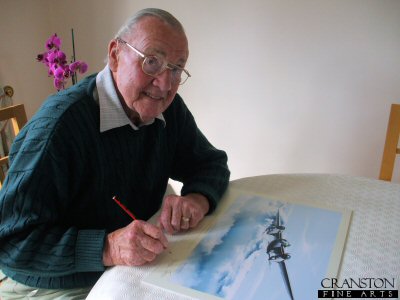
Maurice Webb signing the print A De Havilland Beauty |
Maurice Webb signing the print The Mosquito's Sting |
| Flying Officer Maurice Webb DFM Aircraft details |
 Beaufighter Manufacturer : Bristol Built : 5564 | Beaufighter BRISTOL BEAUFIGHTER The Bristol Beaufighter was a Torpedo Bomber and had a crew of two. with a maximum speed of 330mph and a ceiling of 29,000 feet. maximum normal range of 1500 miles but could be extended to 1750 miles. The Bristol Beaufighter carried four 20mm cannon in the belly of the aircraft and upto six .303in browning machine guns in the wings. it could also carry eight 3 -inch rockets, 1605 lb torpedo or a bomb load of 1,000 lb. The Bristol Beaufighter first flew in July 1939 and with some modifications entered service with the Royal Air Force in July 1940. In the winter of 1940 - 1941 the Beaufighter was used as a night fighter. and in March 1941 the aircraft was used at Coastal Command as a long range strike aircraft. and in 1941, the Beaufighter arrived in North Africa and used as a forward ground attack aircraft. The Bristol Beaufighter was used also in India, Burma and Australia. A total of 5,564 Beaufighters were built until production in Britain finished in 1945, but a further 364 were built in Australia for the Australian Air Force |
 Mosquito Manufacturer : De Havilland Built : 7781 | Mosquito Used as a night fighter, fighter bomber, bomber and Photo-reconnaissance, with a crew of two, Maximum speed was 425 mph, at 30,300 feet, 380mph at 17,000ft. and a ceiling of 36,000feet, maximum range 3,500 miles. the Mosquito was armed with four 20mm Hospano cannon in belly and four .303 inch browning machine guns in nose. Coastal strike aircraft had eight 3-inch Rockets under the wings, and one 57mm shell gun in belly. The Mossie at it was known made its first flight on 25th November 1940, and the mosquito made its first operational flight for the Royal Air Force as a reconnaissance unit based at Benson. In early 1942, a modified version (mark II) operated as a night fighter with 157 and 23 squadron's. In April 1943 the first De Haviland Mosquito saw service in the Far east and in 1944 The Mosquito was used at Coastal Command in its strike wings. Bomber Commands offensive against Germany saw many Mosquitos, used as photo Reconnaissance aircraft, Fighter Escorts, and Path Finders. The Mosquito stayed in service with the Royal Air Force until 1955. and a total of 7781 mosquito's were built. |
 Walrus | Walrus No profile available |
| Flying Officer Maurice Webb DFM Squadron details |
No.235 Sqn RAF Country : UK Disbanded 10th July 1945 Known Codes : , LA, VV, | No.235 Sqn RAF Jaculamur humi - We strike them to the ground |
No.248 Sqn RAF Country : UK Disbanded 30th September 1946 Known Codes : , RK, DM, WR, | No.248 Sqn RAF Il faut en finir - It is necessary to make an end of it |
|
Contact Details |
Sign Up To Our Newsletter!
This website is owned by Cranston Fine Arts. Torwood House, Torwoodhill Road, Rhu, Helensburgh, Scotland, G848LE Contact: Tel: (+44) (0) 1436 820269. Email: cranstonorders -at- outlook.com
|