|
|
|
|
|
|
|
|
|
Cranston Fine Arts  Aviation Art and Artists World War Two Veteran Signatures UK and Commonwealth B Aviation Art and Artists World War Two Veteran Signatures UK and Commonwealth B  Briggs, Don Briggs, Don |
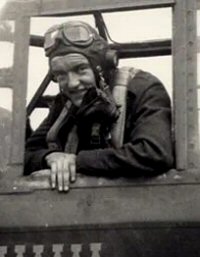
Flt Lt Don Briggs DFM
Don Briggs spent two years at RAF Halton qualifying as an engine fitter before serving on RAF flying units until he volunteered in December 1943 for the new aircrew trade of Flight Engineer. After a period of training he joined No.156 Squadron equipped with the Lancaster. The unit was part of Bomber Command's Pathfinder Force. The flight engineer was the pilot's mate who managed the engines, fuel systems and the ancillary equipment. He teamed up with Flying Officer Bill Neale and they were to complete sixty-two bombing operations together. Their first sortie was on June 11th, 1944 when Bomber Command was attacking targets in support of the Allied landings in Normandy. Railway marshalling yards, supply dumps and construction sites for the V-1 flying bombs and storage sites for the V-2 rocket were their primary targets. By late August, Bomber Command resumed its campaign against the industrial cities in Germany and Briggs attacked Russelheim, Kiel, Stettin and cities in the Ruhr. His crew marked targets with flares to allow the main force to mount accurate attacks. After the war, Briggs flew long-range transport sorties in York aircraft (based on the Lancaster) before spending three years at the Empire Test Pilot's School at Farnborough. In July 1951 he started training as a pilot and, after converting to jets, he joined the newly-formed No.10 Squadron to fly the twin-engine Canberra bomber. In August 1955 he trained on the first of the RAF's V-bombers, the Valiant. He joined the first squadron, No.138, and a year later he transferred to No.49 Squadron, which was being formed for the task of conducting the nuclear weapons trials in the Pacific. Operation Grapple was mounted in 1957 to test Britain's first thermonuclear megaton weapon, the Hydrogen Bomb. The site chosen for the test was Malden Island 400 miles south of Christmas Island in the South Pacific. Briggs was the second pilot in the crew of Squadron Leader Arthur Steele. They flew their Valiant bomber to the newly constructed airfield on March 18, 1957 and began a period of intensive training. On May 15th, No.49 Sqn's commanding officer, Wing Commander Ken Hubbard, dropped the first weapon successfully. For the second drop on May 31st, Steele, Briggs and their crew flew the reserve aircraft and for the third and final test, they were tasked for the sortie. On June 19th, they took off and climbed to 45,000 feet, and carried out a practice run over the target before clearance to drop the bomb was given. Fifty seconds after release, the bomb exploded at the pre-determined height of 8,000 feet. Steele and Briggs had erected the anti-flash screens in the cockpit of their aircraft before making a precisely executed turn away from the explosion and before the shock wave was felt in the aircraft. The drop was completely successful. A few days after their flight, the squadron returned to Wittering. By the end of the year, Briggs had completed a Valiant captain's course and he transferred to No.138 Squadron where he spent the next three years. This was followed by almost three years as a pilot instructor on Valiants and it was during this period he also converted to the Victor bomber. In 1964 he trained as a flying instructor and spent three years instructing trainee pilots at an RAF flying school near Newark. In January 1967 he converted to the third of the RAF's V-bombers, the Vulcan, and was to spend the next five years as an instructor on the iconic delta-wing aircraft before joining No 9 Squadron shortly before it moved to its new base in Cyprus. After 34 years service, he retired at the end of 1973. There were 88 Vulcan 2s produced and Briggs flew 57 of them during his seven years with the force. He spent 15 years at the Oxford Air Training School training pupils to become commercial airline pilots. He retired aged 65 when he joined the RAF Microlight Association at Halton where his RAF career had begun and where he became the chief flying instructor. Finally, at the age of 84 he decided to finish his flying career having flown 71 different types of aircraft and gliders. He died in July 2018.
 |
| Distinguished Flying Medal |
| Flt Lt Don Briggs DFM - Signed Aviation Art |
|
|
|
|
|
|
|
|
|
|
| Text for the above items : |
Vulcan Sunset by Geoff Lea. Vulcan B2 bomber XM602 in its white paint scheme of the early 1960s. Delivered in November 1963 to No.12 Sqn, it subsequently formed part of the Coningsby Wing which moved to Cottesmore in 1964. This aircraft exchanged to the Waddington Wing in 1968, and joined 9 Sqn, 50 Sqn and 101 Sqn in 1975, 1979 and 1980 respectively. XM602 was preserved at St. Athan in 1982, but was eventually scrapped in 1993, with the nose section recovered by the Avro Aircraft Heritage Society. |
Avro Lancaster B.1 by Ivan Berryman. R5689 (VN-N) - a Lancaster B.1 of 50 Squadron based at Swinderby. This aircraft crash-landed in Lincolnshire while returning from a mission on 19th September 1942, after both port engines failed as the aircraft was preparing to land. The aircraft never flew again. The crew on the final mission were : Sgt E J Morley RAAF, P/O G W M Harrison, Sgt H Male, Sgt S C Garrett, Sgt J W Dalby, Sgt J Fraser and Sgt J R Gibbons RCAF, the sole member of the crew killed in the crash. |
Lancaster Lift-Off by Gerald Coulson. Sold out at publisher. We have the last 170 remaining prints. |
Outbound Lancaster by Gerald Coulson. An all time classic image of the Lancaster bomber of Bomber command at altitude crossing the coast on its way to another bombing mission in Europe. In this atmospheric classic image, Gerald Coulson has shown this stalwart of the Royal Air Forces Bomber Command during the second world war. A superb partner painting to the other classic Gerald Coulson image, Off Duty Lancaster. |
Falklands Vulcan by Ivan Berryman. The legendary Vulcan bomber en route to the Falklands on what was the longest bombing mission in history. The Black Buck missions began on Ascension Island, 7500 kilometres from the target, requiring multiple refuels and impeccable planning. |
Vulcan at Ascension, 1982 by Ivan Berryman. (P) During the Falklands conflict in 1982, the tiny mid-Atlantic volcanic island of Ascension became the starting point for the Black Buck missions - a relay of tanker aircraft refueling two Vulcan bombers to attack Argentine positions and damage the runway at Port Stanley to prevent the use of fast jets. At the time these were the longest range bombing missions in history. |
Vulcan Refuel by Ivan Berryman. Vulcan B2 XM607 of No.44 Sqn refuels from a Victor tanker of No.55 Sqn. One of several fuel stops in the 16 hour mission to the Falklands and back. |
Ascension Departure by Ivan Berryman. (P) During the Falklands conflict in 1982, the tiny mid-Atlantic volcanic island of Ascension became the starting point for the Black Buck missions - a relay of tanker aircraft refueling two Vulcan bombers to attack Argentine positions and damage the runway at Port Stanley to prevent the use of fast jets. At the time these were the longest range bombing missions in history. |
Vulcan Return by Ivan Berryman. A Vulcan bomber returns from one of the Black Buck missions to the Falklands, preparing to touch down at RAF Ascension Island after what was the longest range bombing mission in history. |
Lancaster Dawn by Anthony Saunders. Depicts a 103 squadron Lancaster returning from a night-time bombing mission. |
| Flt Lt Don Briggs DFM Aircraft details |
 Canberra Manufacturer : English Electric | Canberra The English Electric Canberra first flew on Friday 13 May 1949 when its performance created a sensation. Such was the quality of the original design that in May 1951, when the first B2 Canberras entered service with No 101 Squadron at RAF Binbrook they could out manoeuvre all the fighters of the period and fly with impunity more than 10,000 feet above them. Operated by 17 airforces in more than 20 different variants, Canberras have been to war at Suez and in India, in Vietnam and the Falklands campaign, and in 1996 Canberra PR9s were engaged in operational reconnaissance flights over Bosnia and in other regions. It is widely and justifiably regarded as one of the greatest aircraft designs of all time. |
 Lancaster Manufacturer : Avro Built : 7377 | Lancaster The Avro Lancaster arose from the avro Manchester and the first prototype Lancaster was a converted Manchester with four engines. The Lancaster was first flown in January 1941, and started operations in March 1942. By March 1945 The Royal Air Force had 56 squadrons of Lancasters with the first squadron equipped being No.44 Squadron. During World War Two the Avro Lancaster flew 156,000 sorties and dropped 618,378 tonnes of bombs between 1942 and 1945. Lancaster Bomberss took part in the devastating round-the-clock raids on Hamburg during Air Marshall Harris' "Operation Gomorrah" in July 1943. Just 35 Lancasters completed more than 100 successful operations each, and 3,249 were lost in action. The most successful survivor completed 139 operations, and the Lancaster was scrapped after the war in 1947. A few Lancasters were converted into tankers and the two tanker aircraft were joined by another converted Lancaster and were used in the Berlin Airlift, achieving 757 tanker sorties. A famous Lancaster bombing raid was the 1943 mission, codenamed Operation Chastise, to destroy the dams of the Ruhr Valley. The operation was carried out by 617 Squadron in modified Mk IIIs carrying special drum shaped bouncing bombs designed by Barnes Wallis. Also famous was a series of Lancaster attacks using Tallboy bombs against the German battleship Tirpitz, which first disabled and later sank the ship. The Lancaster bomber was the basis of the new Avro Lincoln bomber, initially known as the Lancaster IV and Lancaster V. (Becoming Lincoln B1 and B2 respectively.) Their Lancastrian airliner was also based on the Lancaster but was not very successful. Other developments were the Avro York and the successful Shackleton which continued in airborne early warning service up to 1992. |
 Meteor Manufacturer : Gloster Built : 3947 | Meteor The Gloster Meteor was the first British jet fighter and the Allies' first operational jet. Designed by George Carter, and built by the Gloster Aircraft Company, Armstrong-Whitworth, the Meteor first flew in 1943 and commenced operations on 27 July 1944 with 616 Squadron of the Royal Air Force (RAF). The Gloster Meteor was not an aerodynamically advanced aircraft but the Gloster design team succeeded in producing an effective jet fighter that served the RAF and other air forces for decades. Meteors saw action with the Royal Australian Air Force (RAAF) in the Korean War and other air forces used the Meteor. The Royal Danish Air Force, The Belgian Air Force and Isreali Air Force kept the Meteor in service until the early 1970's. A Total of 3947 meteors were built and two Meteors, WL419 and WA638, remain in service with the Martin-Baker company as ejection seat testbeds. |
 Valiant Manufacturer : Vickers | Valiant No profile available |
 Victor Manufacturer : Handley Page | Victor The Handley Page Victor was a British jet bomber aircraft produced by the Handley Page Aircraft Company. It was the third and final of the "V bombers" which provided Britain's nuclear deterrent. The other two V-bombers were the Avro Vulcan and the Vickers Valiant. The Victor was the last of the V-bombers to enter service and the last to retire, nine years after the last Vulcan (The Handley Page Victor saw service in the Falklands War and 1991 Gulf War as an in-flight refuelling tanker. The only Offensive mission that the Victors was during the Bornio Conflict in 1962 to 1966 where two B.1A Victors flew missions. |
 Vulcan Manufacturer : Avro | Vulcan The Avro Vulcan was the worlds first delta winged heavy bomber. the first prototype flew on the 30th August 1952 and the first production Vulcan flew in February 1955. The first Avro Vulcan's arrived for service with the Royal Air Force with 230 operational Conversion Unit (OCU) at RAF Finningley in May 1956. with the first squadron to receive the Vulcan in July 1957 was 83 squadron. In April 1968 Bomber Command merged into the Newly created Strike Command with eight Squadrons being equipped with Vulcan's. A terrain Hugging variant was introduced (the Vulcan SR2) in 1973, to all squadrons except no. 27 squadron (Flying Elephants) which was a Maritime reconnaissance Sqd. The Last Major role for the Avro Bomber was the bombing of Argentinean Airfields in the Falkland Islands During The Falklands Conflict The Avro Vulcan high Altitude Bomber with a crew of five. Top Speed 650 mph with a ceiling of 60,000 feet. maximum range of 5750 miles (with in flight refuelling). with a conventional bomb load of 21 x 1000 lb bombs |
| Flt Lt Don Briggs DFM Squadron details |
No.156 Sqn RAF Country : UK Disbanded 25th September 1945 Known Codes : , GT, | No.156 Sqn RAF Pathfinder Squadron We light the way |
|
Contact Details |
Sign Up To Our Newsletter!
This website is owned by Cranston Fine Arts. Torwood House, Torwoodhill Road, Rhu, Helensburgh, Scotland, G848LE Contact: Tel: (+44) (0) 1436 820269. Email: cranstonorders -at- outlook.com
|


