Order Enquiries (UK) : 01436 820269

You currently have no items in your basket


Buy with confidence and security!
Publishing historical art since 1985

Don't Miss Any Special Deals - Sign Up To Our Newsletter!
Product Search         
ALWAYS GREAT OFFERS :
20% FURTHER PRICE REDUCTIONS ON HUNDREDS OF LIMITED EDITION ART PRINTS
BUY ONE GET ONE HALF PRICE ON THOUSANDS OF PAINTINGS AND PRINTS
FOR MORE OFFERS SIGN UP TO OUR FREE NEWSLETTER

SE5

Manufacturer :
Number Built :
Production Began : 1917
Retired :
Type : Fighter

The third S.E.5 produced (A4563) became, in effect, the prototype S.E.5a with a 200hp Hispano Suiza power plant and shorter span wings. The S.E.5.a went to No56, No.40 and No.60 squadrons from June 1917, and by the end of the year No's 24, 41, 68 and 84 squadron had taken them on charge. After troubles with the reduction gear of the Hispano Suiza together with a general shortage of these power plants, the direct drive Wolseley Viper became the standard S.E.5a power unit. The S.E.5.a built a fine reputation for strength, performance and general flying quality, which together with the Sopwith Camel was the main reason for the Allies gaining and maintaining air superiority during 1918. Some aircraft were fitted with four 25lb (11kg) Cooper bombs on under fuselage racks. The S.E.5.a also service in the Middle East and several home defence units in 1918. At the end of World War I over 2,000 S.E.5.a aircraft were in service with the RAF. The type had served with 24 British, 2 US and 1 Australian Squadrons. After its 'demob' 50 of these aircraft were supplied to Australia, 12 to Canada with several more to other countries including South Africa, Poland and the United States of America. 50 came onto the British register and were used for developing the art of sky-writing. The S.E.5.a will always remain one of aviation's great warplanes.

SE5

Latest SE5 Artwork Releases !
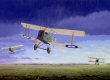
 Grid Caldwell, the top New Zealand Ace with 25 victories in his SE5A of 74 Squadron, is shown taking off from his home airfield during the Great War. Keith Logan (Grid Caldwell) was born 16th October 1895.  At the outbreak of World War One, Caldwell joined the territorial army.  He attempted to enlist with the New Zealand expeditionary force destined for Gallipoli but was refused.  In October 1915 he paid the sum of £100 to join the first class of the New Zealand Flying School.  In January 1916 Grid Caldwell arrived in England and was commissioned into the Royal Flying Corps in April that year.  In July 1916 he was posted to No.8 Squadron, flying BE2Cs and Ds on observation duty.  It was on 18th September 1916 his first aerial victory was scored, shooting down a Roland CII.  He transferred to 60 Squadron in November and flew Nieuport 17 fighters and was promoted to Captain in February 1917.  During this period he scored further victories, shooting down Albatros Scouts, and on 17th September was awarded the Military Cross.  In October 1917 he was posted back to England as an instructor.  In March 1918, promoted to Major, he was given command of 74 Squadron RAF flying SE5As.  The squadron under his command was credited with 140 aircraft destroyed and 85 out of control.  This tally was scored in the last eight months of the war with the loss of only 15 pilots killed or taken prisoner.  During his wartime flying, he had fought dogfights with German aces Werner Voss and Herman Becker, and he once survived a mid-air collision, bringing his badly damaged aircraft to ground level, jumping out before it crashed.  He was credited with 11 aircraft destroyed, 3 shared destroyed or captured and 10 out of control, and 1 further shared out of control.  During World War Two he was station commander at Woodbourne and later Wigram and posted to India in 1944.  After the war he was made commander of the British Empire.  He retired from the RNZAF in 1956, and sadly died of cancer in Auckland on 28th November 1980.

Grid Caldwell by Graeme Lothian. (PC)
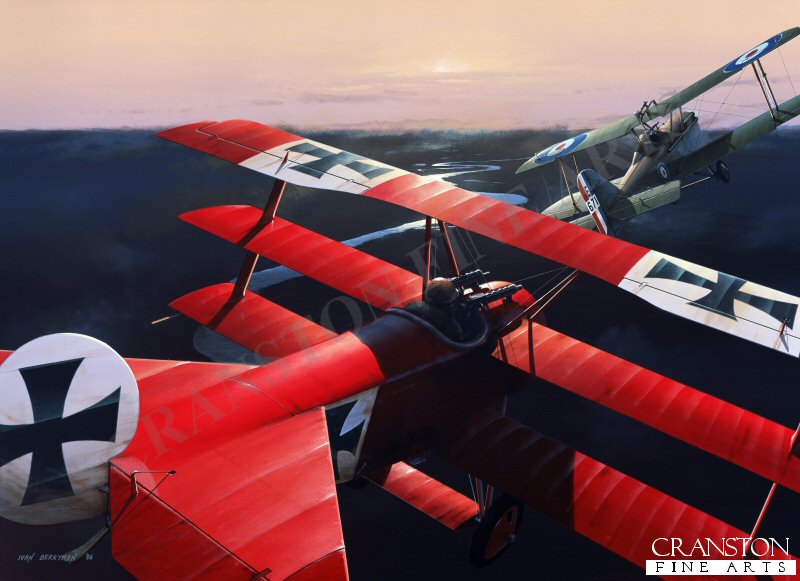
 Credited with no fewer than 80 victories, Manfred Von Richthofen, The Red Baron, became legendary, not least for the 17 kills scored whilst flying the diminutive Fokker DR1 Triplane.  Contrary to popular belief, however, only one of his aircraft is known to have been painted all red. Serial no. 477/17 is shown here dicing with an SE5.

Seeing Red by Ivan Berryman. (PC)
 On the evening of 7th May 1917, a fierce battle took place involving aircraft of Jasta 11 and 56 Sqn RFC, the former led by the brother of the Red Baron, Lothar von Richthofen. As the sun dipped beneath the heavy clouds, most expected the dogfight to break off in the fading light, but an extraordinary duel between the RFCs Captain Albert Ball and Lothar von Richthofen broke out, the two aircraft flying directly at each other, firing continuously, then turning and repeating the manoeuvre. Lothars all red Albatross was damaged, but landed safely. Albert Balls SE5, however, was seen by observers to fall through the heavy cloudbase inverted, before crashing heavily, fatally wounding Ball.

Oberleutnant Lothar Freiherr von Richthofen by Ivan Berryman. (PC)
 New Zealand's highest scoring ace, with 25 victories to his credit, proved himself to be an extraordinary and resourceful leader.  Whilst on a routine patrol in September 1918, Keith Logan 'Grid' Caldwell's 74 Sqn SE5a was involved in a mid-air collision with another SE5a, the impact breaking one of Caldwell's struts and destroying the aerodynamics of his aircraft, which promptly dropped 1,000 ft and went into a flat spin.  Incredibly, Caldwell climbed from the cockpit of his stricken machine and held the broken strut together with his left hand whilst keeping his right hand on the joystick, somehow steering his wayward fighter out of danger and over friendly territory.  With no hope of a safe landing, the Kiwi jumped clear of the SE5a just a second or so before it impacted with the ground. Astounded British soldiers in a nearby trench saw Caldwell stand, dust himself off and walk casually toward them.  He returned to his unit and continued flying until the end of the war.

The Tenacious Grid Caldwell by Ivan Berryman. (PC)

SE5 Artwork Collection


SE5 Aircraft side view by M A Kinnear.


McCudden, VC by Ivan Berryman.


The Tenacious Grid Caldwell by Ivan Berryman.


Dawn Dog Fight, Mick Mannock VC by Graeme Lothian.


Grid Caldwell by Graeme Lothian.


Last Dogfight of Werner Voss by Ivan Berryman.

Seeing Red by Ivan Berryman.


James McCudden by Ivan Berryman.


Oberleutnant Lothar Freiherr von Richthofen by Ivan Berryman.


Leutnant Josef Mai by Ivan Berryman.


Major Edward Mannock by Ivan Berryman.


Captain Andrew Beauchamp-Proctor by Ivan Berryman.


Knights of the Sky by Nicolas Trudgian


Brief Encounter by Gerald Coulson.


The Lonely Sky by Gerald Coulson.

SE 5/5a Aces of World War One.


Magnificent Courage by Stan Stokes.

Top Aces for : SE5
A list of all Aces from our database who are known to have flown this aircraft. A profile page is available by clicking the pilots name.
NameVictoriesInfo
William Billy Bishop72.00The signature of William Billy Bishop features on some of our artwork - click here to see what is available.