|
|
|
|
|
|
|
|
|
Cranston Fine Arts  Aviation Art and Artists Modern Era Aircraft More Aircraft Initials P - Z Aviation Art and Artists Modern Era Aircraft More Aircraft Initials P - Z  Vampire Vampire |
[UP] - Panther - Paradak - PBM - Peacemaker - Phantom (RAF) - Sabre - Saro SR45 Princess - Saro SR53 - Saro SRA1 - Sea Fury - Sea Harrier - Sea Vixen - Sentry - Shackleton - Skyhawk - Skyraider - Space Shuttle - Spearfish - Starfighter - Stratofortress - Strikemaster - SU27 - Swift - T-Bird - Tomcat (F-14) - Tristar - Twin Pioneer - Typhoon Eurofighter - U2 - Valiant - Valkyrie - Vampire - VC10 - Venom - Victor - Vigilante - Viper - Wyvern - X-15 |
| Vampire Aviation Prints |
|
|
|
| Text for the above items : |
De Havilland Vampire T.11 by Ivan Berryman. One of the final versions of the ubiquitous De Havilland Vampire to be built was the T.11, a two-seat trainer, one example of which was XE998, shown here in the colours of No.8 Flying School at RAF Swinderby in the early 1960s. This aircraft is now preserved and on display in the Solent Sky Museum, although currently in the livery of the Swiss Air Force. |
Tribute to Lt Cdr Eric 'Winkle' Brown by Ivan Berryman. One of the most experienced and respected test pilots in history, Eric 'Winkle' Brown carried out the first landing and take off by a jet aircraft on an aircraft carrier on 3rd December 1945. This was accomplished in the second prototype De Havilland Vampire LZ551/G which had been extensively modified for the sole purpose of carrier operations. Not only was an arrester hook added, but the aircraft featured larger flaps and was fitted with the more powerful Goblin 2 engine. The first take off by a jet from an aircraft carrier is depicted here as Lt Cdr Brown lifts away from the deck of HMS Ocean on that momentous day. |
Vampire Sunset by Michael Rondot. The popular and versatile Vampire served with front line RAF fighter squadrons until 1955 and continued in use as a trainer until 1966. This edition portrays Vampire FB9s over their Lincolnshire base at sunset pulling up into a formation loop. |
| Top Aces for : Vampire | ||
| A list of all Aces from our database who are known to have flown this aircraft. A profile page is available by clicking the pilots name. | ||
| Name | Victories | Info |
| Don E Kingaby | 23.00 | The signature of Don E Kingaby features on some of our artwork - click here to see what is available. |
| James Douglas Lindsay | 7.00 | The signature of James Douglas Lindsay features on some of our artwork - click here to see what is available. |
| Vampire Pilot and aircrew signature details |
  Squadron Leader J R Cassels DFC* Our estimated value of this signature : £50 Died : 2008 | Squadron Leader J R Cassels DFC* Nos 14, 29, 98, 106, 125, 139 (Jamaica), and 162 Squadrons. April, 1941 - Enlisted in Edinburgh and accepted for pilot training. April 1941 to April 1942 - No 4 I.TW. Paignton, No 9 E.F.T.S. Ansty, Coventry, No 12 S.F.T.S. Spittlegate, Grantham, (22/01/1941 Received wings as Sgt. Pilot) No 14 O.T.U. Cottesmore flying Hampdens. April 1942 - No 106 Squadron, RAF Coningsby commanded by Wing Commander Guy Gibson, DSO, DFC. I was second pilot on Manchesters and did 4 operational sorties. Converted to Lancasters as first pilot and did 26 operational sorties, including Le Creusot raid on 17 October '42, between June and December 1942. Final sortie on 8 December 1942. December 1942 to March 1943 - Survived several attempts to turn me into a flying instructor. March 1943 - No 1485 Conversion Unit ie. No 5 Group Gunnery Flight training air gunners. October- November 1943 - No 1655 Mosquito Training Unit. November 1943 to June 1944 - No 8 Group, Pathfinder Force - No 139 (Jamaica) Squadron. H2S Mosquito Marking Squadron, RAF Wyton and Upwood. Completed 44 operational sorties before ending up interned in Sweden. 12 June 1944 to 20th September 1944 interned at Falun, Sweden. October 1944 to June 1945 - rejoined No 139 (Jamaica) Squadron at RAF Upwood after an air crew medical where a Group Captain M.0. told me that, as I was warm and my goolies didn't drop oftwhen I coughed, I was back to war. Completed 46 operational sorties before V.E. day. Total sorties on 139 squadron 90. June 1945 to July 1946 - Transport Command, No 162 Squadron flying Mosquitos (ALDS ic, Air Delivery Letter Service) RAF Blackbush. August 1946 to February 1950 - No's 14 and 98 Squadrons, No 139 Wing, RAFO, at RAF Wahn and Celle. February 1950 to August 1950 - abortive EIPS Course. August 1950 to October 1951 - Air Traffic Controllers Course and ATC Officer at RAFWest Raynham. November 1951 to October 1952 - No 29 Night Fighter Squadron, RAF Tangmere. Meteor NFXI. October 1952 to April 1953 - Air Ministry and All Weather Wing, RAF West Raynliam. April 1953 to November 1955 - No 12 Group Headquarters, Group Accidents Officer. November 1955 to April 1957 - No 125 Night Fighter squadron, RAF Stradishall, Meteor NFM and Venom NF. April 1957 to August 1959 - Eastern Sector Operations Centre, Recovery Executive. RAF Neatishead. October 1959 to July 1962 - Hg FEAF, Joint Intelligence Staff. Commissioner Generals Office and RAF Changi. July 1962 to March 1965 - No 3 Group Hg, OC HQ Unit and RAF Liaison Officer to USAF Mildenhall. Retired from RAF as Squadron Leader March 1965. Employed by Airwork Services Ltd, as pilot. March 1965. March 1965 to August 1970 - No 3 (Civilian Anti Aircraft Unit) Exeter Airport. Vampire TX1 and Meteor T=. September 1970 to April 1977 - FRADU ( Fleet Requirements Air Defence Unit) RNAS Yeovilton. Hunter GAII and Mk 8. September 1977. Aged 55. RN age limit for fast jet flying. September 1970. Commissioned in RA17VR M. September 1970 to May 1982 - No 4 AEF, Exeter Airport, Chipmunk. Retired from RAFVRM aged 60, May 1982. Total Flying Hours - 11,300 Ins. Sadly passed away 19th December 2008. |
  Flight Lieutenant J Castagnola DSO DFC Our estimated value of this signature : £50 | Flight Lieutenant J Castagnola DSO DFC Joining the RAF in 1941 he graduated as a pilot after completing his training in America. Returning to England he joined 51 Squadron in early 1943 flying from RAF Snaith. Born in 1922 in Islington, Cass as he was known to all, enlisted in 1941 and trained in North America. Returning to England he crewed up at OTU and after completing their HCU course the crew, captained by a newly commissioned Cass, joined 57 Squadron in December 1943 for their first tour of operations. They were to be blooded with a series of attacks against Berlin, completing three operations against this target in four nights during January 1944. In all Cass was to visit the Big City eight times during his tour. During the Nuremberg operation of 30/31 March 1944 his Lancaster's rear turret guns froze up but a burst from the mid-upper caused an approaching Me 210 to break away. On return his gunners also claimed one Ju 88 destroyed and another damaged. On 5 April 1944 the crew were one of six attached along with their aircraft to the Squadron at Woodhall Spa, to provide an H2S capability. After an initial trip as passenger with Fg Off Fearn for the attack against the Luftwaffe Depot at St Cyr on 10 April to observe the Squadron's methods, Cass found himself non-operational for a month as the Squadron trained intensively for Operation Taxable. Teamed up with Nick Knilans he completed the D-Day deception operation and three nights later he was operating against the Saumur railway tunnel. Unable to carry Tallboy, his H2S equipped aircraft was loaded with thousand pounders to be aimed at the adjacent railway bridge across the Loire. His next three trips were as an additional member of Knilans'crew. By July Cass had been posted back to 57 Sqn at East Kirkby and would complete his first tour with them.He was not away from Woodhall for long, arriving back on the Squadron on 15 August to start his second tour. This was to be much more satisfying. With his trademark 'operationally battered' cap, Cass and his crew soon proved themselves a popular and valuable asset to the Squadron. Starting with a trip to Brest on 27 August and now carrying Tallboy they were part of the high level force for the attack on the Kembs Dam, and took part in all three operations against Tirpitz, claiming a direct hit in the middle of the superstructure during the final attack. During the attack on Bergen on 12 January 1945 his aircraft came under fighter attack and Cass dived to within the range of the flak batteries; the fighter deigned to follow. Heading out to sea he spotted Ian Ross' aircraft at low level, on fire and under fighter attack. With his bomb aimer manning the front turret and without thinking of his own safety Cass dived to offer whatever assistance he could. He was successful in driving the fighter away, but Ross was forced to ditch, while Cass circled overhead dropping an emergency radio wrapped in Mae Wests when it was seen that Ross' dinghy had not deployed. Climbing to 500 feet they signalled the ditched Lancaster's position and remained in the area, seeking cloud cover when a German fighter came too close. With fuel running low he was eventually forced to leave the stricken crew to their fate. The remaining months saw a new routine develop, railway viaducts replacing U-boat pens as targets during February and March, before returning to April's target list, along with other naval targets during the last month of hostilities. After a total of 62 operations Cass' war came to an end on 19 April 1945 with an attack on the island fortress of Heligoland. The latter part of 1945 saw him as the Squadron's Inspector Pilot as they worked up for 'Tiger Force' – the RAF's projected contribution to the Pacific War but, with the squadron prepared to go overseas to India, in January 1946 he was posted to RAF Snaith, to conduct aircrew training. Having been awarded the DFC for his time on 57 Sqn, Cass was to receive a bar in March 1945 for his service with 617 and a further award of the DSO in October 1945.Awarded a permanent commission in 1947, he was posted to the Central Flying Establishment, RAF West Raynham, flying Mosquitos, Vampires and Meteors, before transferring to the Empire Test Pilots School, RAE Farnborough, in March 1950. After qualifying as a test pilot his experience was put to good use for four years at the Aeroplane and Armament Experimental Establishment, Boscombe Down. Cass transferred to fighters in April 1954 and served in the Middle East and Germany before becoming Officer Commanding No. 41 Sqn, Biggin Hill, flying the Hunter F 5. In keeping with a number of pilots following their fighter tour, at the beginning of 1958 he was sent on a radar control course prior to being posted to Neatishead radar station, Norfolk, as Control Executive. After a final tour as a Staff Officer with HQ No. 13 Group, at Ouston, he left the RAF in November 1961 as a Squadron Leader, joining British Airways as a captain on Comets and Tridents until his retirement in 1980. We have learned that James Castagnola has died, but have no information as to when. |
Squadron Leader A M Charlesworth DFC Our estimated value of this signature : £25 | Squadron Leader A M Charlesworth DFC Joined the RAF straight from school just before his 18th birthday in the summer of 1940 with the sole purpose of becoming a fighter pilot. After training, at age just 18, he was posted to RAF Ibsley, Hampshire, to 118 Sqdn, flying Spitfire 2Bs. Here he took part in his first scramble. After a month he was posted where the action was thickest, to a 11 Group Station, RAF Kenley, where he joined 602 Sqdn. His Squadron Commander was Al Deere, by this time a highly decorated ace; Al was 23 then and had already been shot down nine times. 602 Squadron was equipped with the more advanced Spitfire VBs which had two 20mm cannons, firing at 1200 rounds a minute, plus four very useful Browning 50mm machine guns firing at an even higher rate per minute. Al Deere was eventually posted to another squadron and Paddy Finucane took over - 'possibly the finest fighter pilot I came across', Max. Charlesworth continues, 'I remember him trying to get his 21st victory before his birthday and I often flew No. 2 to him. These were twitchy and tiring days when three sweeps a over occupied France day were the norm, to be met each time by several hundred Me 109s and Focke Wolf 190s, at our maximum range, where hectic dog fights ensued. We were normally outnumbered and a day could last from an early morning call at 3.30am to the last landing at 10.30pm in the semi-dark of the long summer of 1941. The average age of the approximately 30 pilots on the squadron was always about 19.' During this period they were scrambled to search for and attack the German battleships Scharnhorst and Gneisenau (although they did not know it at the time) which, with escorting vessels had slipped up the Channel from Brest. The weather was awful and Max flew straight across the German battle cruiser Hipper thinking it was a Royal Navy cruiser. The Hipper opened up at Max with guns blazing but he was fortunate to escape with just a hole in one wing. In April 1942 Max was posted to a secret unit called MSFU (Merchant Service Fighter Unit) where he flew Hurricanes from catapults on merchant ships attached to convoys of anything up to fifty merchant men a time. The ships were mainly bringing supplies from America and taking them to Murmansk and Archangel, the hard-pressed Soviets and Gibraltar. Max recalls this as a highly physical and uncomfortable task, apart from also being very scary. The ships were constantly attacked by U Boat packs and aircraft. When they were in range of the latter, if they launched the Hurricane they knew they would ultimately have to bail out and hope to be picked up by either a friendly escort vessel or a sunken ships lifeboat. 'The North Atlantic route to Canada, north of Iceland and down the Greenland coast at an average sped of six knots in appalling seas was not our idea of a holiday cruise', Max vividly recalls. Having survived this posting Max was then moved to 124 Sq. at West Malting, Near Maidstone, Kent. The squadron was equipped with the much more powerful Spitfire IXs. Their task here was mainly escorting USAF and RAF bombing raids into Europe. With longrange tanks fitted they were able to reach Hamburg and Ludwigshafen; later on they were able to refuel from liberated bases in France. These ops. required them to fly as Top Cover at over 30,000 feet for up to three hours, where it was so cold the pilots returned to base hardly able to climb out of their cockpits. On February 9th 1945 Max was the Senior Flight Commander on 124 Squadron during their move to Cottishall. Here they adapted the Spitfire Ks to dive-bombing. The Spitfires carried either a 500lb. bomb under the fuselage and two 250lbs. under each wing or, a 90-gallon fuel tank under the fuselage and a 250lb. bomb under each wing. Their mission was to destroy V2 sites in Holland - mainly situated in small parks near the centre of the Hague. These V2 sites were launching rockets on London in ever increasing numbers. As well as attacking the V2 sites they were to destroy railway lines used by the Germans to transport V2s into the area. These were dangerous times as the V2s sites were heavily defended by 88mm guns down to 20mm. 'The flak was horrendous and we lost many' recalls Max. As Senior Flight Commander, Max often led the squadron, though identifying targets from 12,000 feet was difficult. After the war Max was one of the first pilots to convert to the Meteor twin-engined jet, later to move on to Vampires and Canberras. His flying career was completed in June 1961 when he was posted to Warsaw, Poland as the Assistant Air Attache. He finally retired from the RAF in 1966. |
Wing Commander Hank Costain MBE Our estimated value of this signature : £10 | Wing Commander Hank Costain MBE Hank Costain was born in Horton on the Gower Coast and was educated at Christ College Brecon. He joined the RAFVR for pilot training in September 1940. He trained in the USA in Arizona at Thunderbird Field and Falcon Field, returning to the UK in 1941 to complete operational training at 53 OTU on Spitfire Mk1s. He flew with No 154 Squadron (Motor Industries Squadron) Spitfire Vbs in the Hornchurch Wing. The Squadron was withdrawn from 11 Group to prepare for the invasion of North Africa, operation Torch. He flew with the Squadron throughout the North African campaign and moved with the Squadron to Malta to prepare for the invasion of Sicily, operation Husky. After moving to Lentini East in Sicily his tour was completed and he was posted back to The Canal Zone 73 OTU Abu Sueir as an instructor. Having completed his instructors tour the Far East were calling for experienced Spitfire pilots and he found himself en route to No 615 Squadron (County of Surrey) R.Aux.A.F. in Burma. He baled out of a Spitfire MkVIII while operating with 615 Squadron and spent several months in hospital in Calcutta before being invalided home. Fit again he became an instructor at 61 OTU Keevil on Spitfires and Mustangs. The next tour was with 245 Squadron at Horsham St Faith flying Meteor 3s. This tour was cut short, as there was a call for the two Spitfire Squadrons in Japan to be reinforced. At the end of 1946 he found himself on No 11 Squadron at Miho in Japan as part of the BCAIR element of BCOF (British Commonwealth Occupation Force). Returning from Japan in 1948 he spent a period ferrying with No 20 Maintenance Unit followed be an appointment as Unit Test Pilot at No9 MU. He completed the CFS Course in 1952 and became Training Officer of No602 (City of Glasgow) Squadron R.Aux.A.F. Promoted to Squadron Leader in 1953, a tour as Chief Ground Instructor and OC Gunnery Squadron at 226 OCU was completed. When 226 OCU was disbanded he took command of No608 (NR) Squadron R.Aux.A.F. at Thornaby on Tees, flying Vampires. He completed his RAF career in Guided Weapons. A tour of Woomera evaluating the Bloodhound Mk2 SAM missile. Then CO of No 33 (SAM) Squadron at Butterworth in Malaysia followed by appointment as CO of No 25 (SAM) Squadron at North Coates and RAF Germany. |
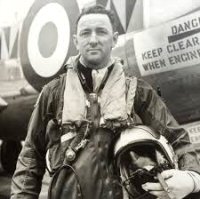  Air Vice-Marshal John Howe CB CBE AFC Our estimated value of this signature : £10 Died : 2016 | Air Vice-Marshal John Howe CB CBE AFC John Howe flew Spitfires, Mustangs and Vampires With the South African Air Force and F-5lD Mustang fighter bombers in the Korean War before joining the RAF 'to fly Hunters'. He commanded the first RAF Lightning squadron when No.74 Sqn converted from Hunters to Lightnings in 1960, and led the famous No.74 Sqn 'Tigers' nine-ship Lightning aerobatic team. He has flown all the legendary USAF 'century series' fighters, and later commanded the F-4 Phantom OCU and RAF Gutersloh. John Frederick George Howe was born in East London, South Africa, on March 26th 1930 and educated at St Andrew's College, Grahamstown. As soon as he left school, he joined the South African Air Force and trained as a pilot. In early 1951 he joined No 2 Squadron, known as the Flying Cheetahs, which was based in South Korea as part of the United Nations forces. The squadron, equipped with the piston-engine Mustang, was heavily engaged in the ground attack role in support of the Army. On June 24th, Howe took off with three others. They responded to an emergency call for air support by a surrounded ground force. In the face of intense anti-aircraft fire, the four Mustangs attacked gun emplacements a number of times. Howe did not expect to survive, but the four aircraft returned to base. All four pilots received US gallantry awards. A month later, Howe was forced to crash land and was rescued by a helicopter. In September, as a 21-year-old second lieutenant, he was the leader of four aircraft instructed to attack enemy troops that were threatening friendly forces. Fierce enemy fire damaged Howe's aircraft but he continued to lead his formation against the target. The US authorities awarded him an immediate DFC, the citation recording: He displayed a standard of leadership above and beyond that normally expected. After completing his flying tour, Howe remained in Korea as a forward air controller before returning to South Africa. At the end of 1954 he travelled to Britain to join the RAF. In April 1956 he joined No 222 (Natal) Squadron flying the Hunter. When a volunteer was required for forward air controller duties with No 3 Commando Brigade in late 1956, Howe's experience in Korea helped to land him the job. He sailed with the Brigade for the ill-fated Suez campaign and, at dawn on November 6th, landed on the beaches at Port Said with No 40 Commando, to direct aircraft on to targets in the area. In the event, the campaign was short-lived. Howe returned to his squadron before joining No 43 Squadron as a flight commander, still flying the Hunter. He was awarded a Queen's Commendation for Valuable Service in the Air, receiving a second two years later. In June 1959 he started training to take command of his Lightning squadron. Howe remained in the fighter business, including a tour of duty with the USAF which gave him an opportunity to fly the latest American fighters, including the Phantom. He has flown all the legendary USAF 'century series' fighters. In 1968 he was appointed to command the RAF's operational conversion unit that saw the introduction of the Phantom into RAF service, his unit being responsible for the conversion of the first squadron crews. After a staff tour he became the station commander of RAF Gutersloh, the home of two Lightning squadrons and a support helicopter squadron. His fighter squadrons, based a few minutes' flying time from the border with Warsaw Pact forces, mounted a continuous quick-reaction capability. He rarely missed an opportunity to maintain his fighter pilot proficiency. After attending the Royal College of Defence Studies he served at HQ 11 (Fighter) Group, and on promotion to air commodore was appointed the commandant of the Royal Observer Corps (ROC). The organisation had a fine record, but Howe justifiably believed that it was in need of modernisation and a more robust attitude. With his usual, not always popular, vigour, he set about applying the same exacting standards to the ROC that he did to his flying. By the time he left in 1980, the efficiency of the Corps had risen sharply. In May 1980 he was appointed the air officer commanding the Southern Maritime Region, a departure from his previous fighter experience and where his usual forceful approach was much in evidence. His final appointment in the RAF was the dual role of Commandant General RAF Regiment and Provost Marshal of the RAF. He retired in November 1985. He was appointed CB (1985) and CBE (1978). Air Vice-Marshal John Howe died January 27th 2016. |
Wing Commander George Walter Johnson Our estimated value of this signature : £40 Died : 2004 | Wing Commander George Walter Johnson Wing Commander George Walter 'Johnnie' Johnson flew more than 60 operations against targets in Germany before becoming one of the Royal Air Force's most experienced test pilots. After leaving the RAF, he embarked on a career in the aviation industry and played a leading role in the success of overseas sales of the Harrier and Hawk jets. Johnson joined No 158 Squadron, flying Halifax bombers, at the height of the Battle of Berlin early in 1944. On his first operation over the 'Big City', the radio communications with his two gunners failed immediately after take-off. He could justifiably have returned to base; but, conscious of the stigma of being thought 'LMF' (lacking moral fibre) on his first operation, he decided to press on to the target, using light signals to keep in contact with his crew. Flying the same aircraft the next night, the fault recurred. Reflecting that he had got away with it the night before, he stayed with the bomber stream and dropped his bombs. By the end of March, Johnson and his crew had flown 16 operations and losses had been so high - 16 crews in four operations - that they were the senior crew on the squadron. They were then transferred to the Pathfinder Force to fly Lancasters with No 635 Squadron at Downham Market. Priorities for Bomber Command had changed in the build-up to the D-Day landings, and supply dumps, marshalling yards and transportation targets in France were attacked. Returning from one target early on June 15, Johnson and his crew were crossing the Thames Estuary at low level 'when something overtook us going very quickly and apparently on fire'. They had seen one of the first V-1s launched against London. The Pathfinder force marked targets for the main bomber attack supporting the breakout from Normandy. Johnson flew as a marker against the V-1 sites in the Pas de Calais and the huge construction site at Wizernes before the bombing offensive against Germany was resumed. His aircraft was hit by flak over Kiel and then by night fighters. Despite the damage to his Lancaster, he landed safely. By the end of October, Johnson had completed 62 operations, including 46 as a Pathfinder. He was awarded a Bar to the DFC he had been given earlier in the year for his 'high standard of courage, determination and devotion to duty'. The son of a civil servant, George Walter Johnson (always known as Johnnie) was born on January 8 1923 at Camberley, Surrey. He was educated at Erith County School, Kent, and joined the RAF on his 18th birthday. Johnson trained as a pilot in the United States before returning to England where, to his great disappointment, he was sent to be a flying instructor on single-engine aircraft. After a year trying to persuade the authorities to send him to an operational squadron, he was expecting to be posted to fighters, but found himself training on four-engine bombers. After completion of his bomber tours, Johnson was sent to Transport Command before joining the RAF Mission to Australia and New Zealand to fly Dakotas. He first went to Canada to collect a new aircraft and then flew it from Montreal, via the Pacific islands, to Sydney. For the next year he flew freight and passengers between Australia and the Pacific staging posts occupied by the British and Commonwealth forces as the Japanese retreated; he flew into Hong Kong shortly after the Japanese surrender. After a spell as the personal pilot to the RAF Chief of Staff (Australia), he returned to England and joined No 6 Course at the Empire Test Pilots' School. He was just 23, and had flown 2,500 hours on more than 20 different types of aircraft. Johnson spent the next three years at the Aeroplane and Armament Experimental Establishment at Boscombe Down during which he tested some of the early jet fighters and bombers. He conducted the hot weather trials of the Vampire jet fighter at Khartoum. During a test flight to assess the efficiency of an airventilated suit being developed to keep pilots cool, the cockpit heating system stuck on hot, and Johnson just managed to land before passing out. The doctors lifted him clear of the cockpit and measured his body temperature before thinking of giving him some water. Johnson returned to England to learn that he had been posted to Namao, Alberta, to join the Winter Experimental Flight to conduct cold weather trials. During two years in Canada, Johnson flew many aircraft to assess performance in extreme cold temperatures. This often involved taking aircraft to airfields in the Yukon and to Churchill on Hudson Bay where outside temperatures reached minus 45 degrees centigrade. After spending another three years at the Empire Test Pilots' School as an instructor, Johnson was sent to the RAF Staff College, Bracknell, then became a staff officer at Fighter Command. In February 1962 he was appointed to command the Operations Wing at RAF Tengah, Singapore, the home of four RAF squadrons of Hunters, Javelins and Canberras and a RNZAF bomber squadron. In November 1963 the generally even tenor of station life overseas was interrupted by the 'confrontation' with Indonesia. With detachments of his squadrons in Malaysia, Kuching and Labuan, Johnson had a hectic time, commenting that 'confrontation' became 'a way of life, never reaching a climax but causing a good deal of frustration, proving that 'action stations' with no subsequent action is extremely debilitating'. On coming home, Johnson joined the staff of the RAF Staff College at Andover, where the student body was half British and half 'visiting officers'. The close association with many foreign air force personnel was to be important for his future. Johnson retired from the RAF in 1969, having flown more than 100 types of aircraft, in order to join the Hawker Siddeley Aviation marketing team, led by Bill Bedford, the former chief test pilot, whom he eventually succeeded. Sadly on the 28th July 2004 Wing Commander G W Johnnie Johnson died aged 81 (Telegraph obituary) |
 Wing Commander Don Kingaby DSO AFC DFM** DFC (USA) Our estimated value of this signature : £75 Died : 1990 | Wing Commander Don Kingaby DSO AFC DFM** DFC (USA) Born in London on 7th January 1920. Joined the RAFVR in April 1939 at the age of 20. He flew a Mk.I Spitfire with No.266 Squadron during the initial stages of the Battle of Britain, claiming as damaged two Ju88s and an Me110. He then joined No.92 Squadron in September 1940, claiming 4 aircraft (including 3 Me109s) in October, then 6 more Me109s in November 1940, including 4 in a single day on the 15th. He claimed a further 12 victories during 1941, before joining No.111 Sqn and No.64 Sqn in March and April 1942 correspondingly. He later joined No.122 Squadron, and was promoted to lead the Hornchurch wing in March 1943. On D-Day, he claimed the final addition to his total, sharing in the destruction of an Me109. He was the only RAF pilot to be awarded three DFMs, and scored a total of 23 victories and 8 probables. His Air Force Cross medal was awarded in 1952 for his work with Vampire jets. He retired in 1958. Sadly, he passed away on 31st December 1990. |
  Squadron Leader P G Leggett Our estimated value of this signature : £60 Died : 2013 | Squadron Leader P G Leggett Percival Graham Leggett was born on the 24th of February 1921 and joined the RAFVR In June 1939 as an Airman under training Pilot. He was called up for active duty on 1 September 1939 and he completed his training in September 1940. On the 18 September 1940 Leggett crashed at Oldbury on Severn in Gloucestershire but was unhurt. Leggett was posted to No.615 Squadron at RAF Prestick in Scotland then to 245 Squadron at RAF Aldergrove on 28 September and then to No.46 Squadron at RAF Stapleford on 18 October 1940. He claimed a Fiat BR.20 and probably destroyed and shared in the destruction of another on 11 November 1940. Leggett was then posted to No.145 Squadron in late November 1940 and then to No.96 Squadron on 18 December 1940. Flying his Hurricane off Ark Royal, Leggett joined 249 Squadron in Malta in June 1941 and was in action that same afternoon. In July he increased his Battle of Britain score by shooting down a Macchi C.200 but was shot down in December, bailing out with minor injuries. He was posted to the Desert Air Force just before El Alamein. An RAFVR pilot, Leggett had flown both Hurricanes and Defiants before his posting to Malta. He stayed on in the RAF commanding 73 Squadron on Vampires, retiring in 1958 as a Squadron Leader. He died on 26th May 2013. A Clipped Signature is Available |
 Wing Commander James Lindsay DFC Our estimated value of this signature : £25 | Wing Commander James Lindsay DFC Born in September 1922, James 'Doug' Lindsay joined the RCAF in February 1941, training on Harvards. He was posted to the UK, arriving in March 1943 and joining 403 Sqn in October that year. In his first tour, he claimed 5 Me109s as well as 2 Fw190s, plus another damaged. Of the Me109s he shot down, three of these were in a single minute, earning him a DFC. For his second tour, he rejoined 403 Sqn in April 1945, claiming a probable Fw190 during his short time with this squadron before he moved to 416 squadron until the end of the war in Europe. After the war he stayed with the air force, and in 1952 served during the Korean war with the USAF. He flew F-86 Sabres with the 39th Fighter Squadron of the 51st Fighter Wing, claiming victories over two MiG-15s and damaging 3 others. In 1953, he returned to the UK with No.1 Fighter Wing leading Sabres in formation at the Queen's Coronation. He retired in 1972, having flown more than 30 different types of aircraft (excluding different Mks). These included, Harvard, Anson, Master, Spitfire, Typhoon, Tempest, Hurricane, Mustang, Beaufort, Beaufighter, Oxford, Dakota, Tiger Moth, Vampire and Sabre. |
  David Lockspeiser Our estimated value of this signature : £50 Died : 2014 | David Lockspeiser Joining the RAF in 1949 he flew with various fighter squadrons on many aircraft including Vampires and Meteors. After leaving the RAF in 1955 he joined Hawker Aircraft Ltd as a test pilot where he was instrumental in the development and production testing of the Hunter and also the Sea Fury and Buccaneer. On leaving Hawker in 1976 he joined BAC as a communications and test pilot and in 1977 was under contract to Lockheed, running all aspects of the fighter testing department for specific weapons, navigation and reconnaissance development. Whilst still test flying he formed Lockspeiser Aircraft Ltd serving as Managing Director, to develop his own design, the Land Development Aircraft (G-AVOR). The prototype was first flown in 1971 and he oversaw development to production configuration until 1989. In all he flew 7100 hours and 90 types of aircraft. He died on 23rd March 2014. A Clipped Signature is Available |
  Flight Lieutenant Derek Lovell Our estimated value of this signature : £40 Died : 2019 | Flight Lieutenant Derek Lovell Volunteered for the RAFVR in January 1941. He trained in Canada on Tiger Moths and Oxfords. He received his wings in April 1942 and was posted to Central Flying School. Following graduation, he taught Fleet Air Arm trainees on Harvards. He returned to the UK in March 1943 and flew Masters at AFU and Hurricanes at OTU. He taught Lancaster crews fighter evasion prior to posting to 84 GSU to fly Typhoons. He joined 197 Squadron at Needs Oar Point in the New Forest in June 1944 and was involved in close support operations and tactical dive bombing and low level bombing throughout the Normandy campaign and on through to VE-Day. He completed 135 operations and in August 1945 was posted to an OTU to instruct on Typhoons and Tempest Vs. He was demobbed in June 1946 and flew weekends in the VR on Tiger Moths and later Chipmunks. He was called up on the G Reserve in July 1951 and flew Harvards, Spitfire XXIIs and then Vampire Vs. He stood down in September as the Korea situation eased. He passed away on March 1st, 2019. A Clipped Signature is Available |
Group Captain Bobby Oxspring Our estimated value of this signature : £75 Died : 1989 | Group Captain Bobby Oxspring Robert Wardlow Oxspring was born in Sheffield on 22nd May 1919, the son of a World War 1 decorated pilot of the same name. He joined the RAF in March 1938 on a short service commission and joined 66 Sqn in the December and started operational flying in July 1940, flying throughout the Battle of Britain. His Spitfire X4170 was shot down by Bf109s over Kent on 25th October, baling out with slight injuries (Caterpillar Club Badge). He was awarded the DFC on 8th November. September 1942 saw him awarded a bar to the DFC. Moving to Mediterranean combat, it is thought probable that Oxspring was the pilot who shot down renowned German ace Anton Haffner of JG51 on 2 January 1943. Oxspring led his squadron to be the highest scoring in the North African theatre, and survived his second shooting down of the war, Oxspring was awarded a second bar to his DFC in February 1943. During the war Squadron Leader Oxspring had registered 13 solo kills with 2 shared, 2 probable kills and 4 solo V-1 Flying Bombs destroys and 1 shared. In 1946 he was awarded the Dutch Vligerkruis by Royal Decree of the 31st October 1946 appearing in the London Gazette on 10th January 1947. He was awarded an AFC in January 1949 after leading a team of 54 Sqn Vampires to Canada and the USA, the first jet aircraft to cross the Atlantic. He retired from the service with the rank of Group Captain, having been Station Commander of RAF Gatow, Germany, in 1968 and settled in Lincolnshire near to RAF Cranwell. He died on 8th August 1989. |
F/Lt Ray Raby Our estimated value of this signature : £15 | F/Lt Ray Raby F/Lt Ray Raby jojned the RAFVR in 1940. His flying training began in the USA, where he was retained as an instructor with both USAF and RAF wings. He qualified on his return for an Air Navigators Certificate. He was posted to 519 Squadron, Wick, on Spitfires prior to joining 542 Squadron, Benson PRU with Jerry Fray as Flight Commander. In 1943, he was posted to Benson and survived 58 operational sorties until he was demobbed in 1946. In 1947 he joined 605 (County of Warwick) Wsquadron, Raux AF, Honiley on Vampire and Meteor jet aircraft as flight commander until disbandment in 1957. His total hours flown are 3265. |
 Alan Rawlinson Our estimated value of this signature : £35 Died : 2007 | Alan Rawlinson Alan Rawlinson was born on 31st July 1918 in Fremantle, Western Australia. Alan Rawlinson was a keen aviator and at the age of 19 in 1937 received a private pilots licence while learning to fly in DH60 Gypsy Moths. In 1938 Alan Rawlinson enlisted in the RAAF and in 1939 graduated as a Pilot Officer and was posted to 3 Squadron at Richmond, New South.Wales. When World War ll broke out 3 squadron was posted to the Western Desert and Pilot Offcier Alan Rawlinson was involved in combat flying in September 1940 to April 1941. From May 1941 to August 1941 he was stationed at Cyprus then returning to the Western Desert , Rawlinson became commanding Officer of 3 squadron soon after. It was while he served in the western desert that Rawlinson received the DFC. He returned to Australia in 1942 as Chief Flying Instructor at Mildura and was promoted to Squadron Commander and Wing Leader in 1943 and served in the Pacific campaign. In 1947 Alan Rawlinson transferred to the RAF flying the new jet aircraft Vampires and Meteors, finally retiring in 1961. Alan Rawlinson passed away 28th August 2007. |
  Duncan Simpson OBE Our estimated value of this signature : £55 Died : 2017 | Duncan Simpson OBE Educated at the De Havilland Aeronautical Technical School he joined the RAF in 1949 and completed a tour with 222 Squadron. He then served with the Central Fighter Establishment flying Vampires, Meteors, Venoms, Swifts, Sabres and Hunters. Joining Hawker Aircraft Ltd as a test pilot in 1954 he became involved in development and production test flying of the Hunter. From 1964 he was part of the P.1127 Kestrel - Harrier Squadron and became responsible for the conversion of the Kestrel Tripartite Evaluation Programme pilots. In 1969 he repeated this with the first RAF Harrier training team. Awarded the Queens Commendation in 1969 he became Hawker Chief Test Pilot in 1970 and continued on the Harrier dvelopment, making the first flight in the Hawk aircraft in 1974. Retiring from flying in 1978 he became Deputy Director of the Society of British Aerospace Companies until he finally retired in 1992. He died on 7th December 2017. A Clipped Signature is Available |
H. E. Tappin Our estimated value of this signature : £55 Died : 2007 | H. E. Tappin Started flying, as an N.C.O. pilot, with the R.A.F.V.R. at No.3 E.& R.F.T.S. run by Air Service Training, at Hamble near Southampton.in April 1937. Awarded Pilot's Flying Badge (wings) in May 1938. Moved to 26 E.& R.F.T.S. run by Marshalls Flying School at Kidlington, near Oxford in September 1938. Flying Instructor's Course, November/December 1938 Started instructing 30th December 1938. School at-Kidlington closed on outbreak of hostilities, staff moved to 22 E.F.T.S. at Carpbridge. Instructed at Cambridge until April 1941, when posted to 52 O.T.U. (Hurricane) at Debden. Commissioned December 1940. 52 O.T.U. April/May 1941. Posted to 3 Squadron (Hurricane) at Martlesham Heath 2nd June 1941, became Flight Commander in March 1942. Posted to 534 Squadron (Turbinlite) as Hurricane Flight Commander September 1942. Tutbinlite Project abandoned February 1943,,posted to 157 Squadron (Mosquito) at Castle Camps. Became Flight Commander July 1943. Posted from 157 at Predannack, March 1944 to 51 O.T.U. at Cranfield and Twinwood Farm, near Bedford, as W/Cdr Flying. January 1945 posted to Mediterranean to command 108 Squadron (Beaufighter), to learn on arrival that the Squadron was to be disbanded. I spent a short period with 334 (Special Duties) Wing at Brindisi, in Southern Italy, and in March 1945 was posted to Command 256 Squaron (Mosquito) with the Desert Air Force at Forli, iii-Northern Italy. In September 1945 the Squadron moved to Egypt,, from where I returned home in December of that year. In February 1946 1 returned to Cambridge to continue my work with Marshalls as a civilian pilot, where the work was varied and interesting, covering flying-instruction, charter work and testflying on a variety of aircraft, including the Vampire, Venom, Canberra, Valiant, Viscount and Ambassador. I left Cambridge in January 1961 to instruct at The College of Air Training at Hamble, which had been set up by B.E.A. and B.O.A.C., (taking over the Air Service Training facilities) to train new pilots ?,rom scratch, as the supply of ex-service pilots was running short. It proved to be very successful. Retired from Hamble January 1972. Service Numbers: N.C.O. 740167. Commissioned Officer 89304. D.F.C. September 1942 Bar to D.F.C. April 1944. Died 8th January 2007. |
  Squadron Leader Laurence Thorogood DFC AE Our estimated value of this signature : £65 Died : 2005 | Squadron Leader Laurence Thorogood DFC AE Joining 87 Squadron on June 14th 1940, Laurence Thorogood was thrown straight into the Battle of Britain, destroying a Ju88 on 25th August. Commissioned in 1941 he then was posted to India and remained in the Far East until the end of the war. He served with No 9 Sqn Indian Air Force (Hurricane IIc) and 67 Sqn RAF (Spitfire VIII) in the campaign down the Arakan Coast. Staying in the RAF after the war, he served in Singapore and Sumatra with 155 Sqn before converting to Vampires on 130 Sqn, after two years instructing on Oxfords at Middle Wallop, we was Adjutant with 615 Sqn, Biggin Hill before moving to Germany in 1951 to fly Vampires with 118 and 94 Sqns. He served on the Thor missile system before finishing his career as a civilian in Whitehall. Sadly Laurence Thorogood passed away in December 2005. We would like to thank Dr John Thorogood for supplying the photo of his father. A Clipped Signature is Available |
 Lt Col Douglas Duke Warren DFC CD Our estimated value of this signature : £15 Died : 2011 | Lt Col Douglas Duke Warren DFC CD Douglas Duke Warren was Born in Nanton, Alta., in 1922, along with his twin brother Bruce joined the Royal Canadian Air Force (RCAF) at the age of 18. After advanced training, the Warren twins flew two tours of operations with Royal Air Force Spitfire squadrons. After joining 403 Squadron, Duke Warren flew as part of 165 Squadron in the air battles over Dieppe. He fought over Falaise, and also served with 66 Sqn and 11 Group at Biggin Hill. In 1945, they were both awarded Distinguished Flying Crosses by King George VI at Buckingham Palace. He returned to Canada in May 1945, and along with Bruce joined the permanent RCAF in October 1946. Douglas became a Flight Commander with 421 Squadron flying DH Vampire jet aircraft at Chatham, New Brunswick. On April 5th, 1951, his brother Bruce was killed as a test pilot at AV Roe aircraft company in Toronto flying the prototype CF100 jet fighter. Duke became Commanding Officer of the F-86 Sabre-equipped 410 Squadron in 1952. The following year, he was attached to the United States Air Force and flew Sabres in Korea. Duke Warren flew 253 combat missions, including flying the F-86 Sabre in Korea. Sadly Duke Warren passed away Saturday August 27th 2011 in Comox at the age of 89. |
 John Wilson Our estimated value of this signature : £20 | John Wilson John Wilson served in the RAF from 1942 to 1948 when he left the Central Fighter Establishment to join the de Havilland Aircraft Co at Hatfield as Experimental Test Pilot. In 1949, with John Cunningham, he made the first flight of the prototype Comet 1 and the following year the first flight of the Vampire trainer prototype. After the death of John Derry at Farnborough in 1952 in the prototype DH 110, he took charge of the flight development of the Sea Vixen as a front line all weather fighter for the Royal Navy. In 1959 he transferred to the DH design department as Chief Operations Engineer where he was responsible for the development of the automatic blind landing system for the Trident airliner and Trident, DH 125, DH 146 flight decks. |
Air Marshal Sir William Wratten KBE, CB, AFC, FRAeS Our estimated value of this signature : £40 | Air Marshal Sir William Wratten KBE, CB, AFC, FRAeS Air Marshal Wratten joined the RAF as a Cranwell Cadet, graduating in December 1960. He completed the CFS course the following year and went on to instruct as a first-tour QFI on Vampire T11s at Oakington and Swinderby. The Air Marshal converted onto Lightning at Middleton-St-George in 1963 before serving on 19 Squadron from 1964 to 1968, first at Leconfield and later Gutersloh. In 1968 Air Marshal Wratten converted to Phantoms at Davis-Monthan AFB, USA, and then instructed on 288 (Phantom) OCU from 1968 to 1970. He was posted in 1971 as Flight Commander on 17 Squadron at RAF Bruggen, operating the Phantom in the Strike / Attack role. Returning to the UK in 1973, he joined the staff on HQ 38 Group before attending the RAF Staff College in 1974. He then joined the OR staff at the Minstry of Defence for a brief spell before being promoted to Wing Commander and, in 1975 taking command of 23 Squadron with the Phantom in AD role. On completing his tour as Officer Commanding 23 Squadron, Air Marshal Wratten was posted to the Air Secretarys staff at Barnwood before being promoted to Group Captain in 1980 and taking command of RAF Coningsby. In June 1982 he moved to the Falkland Islands to form and command RAF Stanley. After attending RCDS in 1983, the Air Marshal became one of the two Directors OR (Air) being concerned with future RAF aircraft (except Nimrod AEW) and offensive weapons systems. In September 1986 he was appointed SASO HQ 1 Group, a post he held until becoming AOC 11 Group on 17th March 1989. Between 14th November 1990 and 22nd March 1991, Air Marshal Wratten was detached to HQ British Forces Middle East in Riyadh, Saudi Arabia, where he held the appointments of Air Commander and Deputy British Forces Commander Middle East during the Gulf conflict. In recognition of this service he received a Knighthood in the Operation GRANBY Honours List. On 19th September 1991, Sir William was promoted to Air Marshal prior to taking up his appointment as Director General Saudi Armed Forces Project. |
 Air Commodore Eric Ricky Wright CBE DFC DFM Our estimated value of this signature : £40 Died : 2007 | Air Commodore Eric Ricky Wright CBE DFC DFM 605 Sqn Battle of Britain, Officer Commanding 54(F) Sqn Vampire 1948-1949. Eric William Wright was born on September 21st 1919 at Cherry Hinton, Cambridge, and went to the Cambridge County School and the Technical College. Wright joined the RAF Volunteer Reserve in June 1939 and was called up when he had completed his training as a pilot. As a sergeant pilot Wright flew Hurricanes over south-east England during the Battle of Britain; Wright joined No 605 (County of Warwick) Squadron in July 1940, a few days before it left its Scottish base for Croydon. He saw a great deal of action during the summer of 1940, and in the early days of September he shared in the destruction of a Messerschmitt Bf 110 fighter and a Dornier 17 bomber. On September 15, the climax of the Battle, and a day commemorated as Battle of Britain Day, Wright shot down a Dornier 17 over Maidstone and by the end of the year he had accounted for six enemy aircraft, probably destroyed three more and damaged a further six. At the end of November he was awarded an immediate DFM. Wright was made a flight commander of No.232 Squadron in 1941 and went to India. After the Japanese attacks on Malaya the squadron embarked on the aircraft carrier Indomitable, flying off to Java at the end of January 1942 en route to reinforce the beleaguered squadrons at Singapore. Within a week Wright's CO had been killed and Wright was promoted to squadron leader. He damaged a Japanese bomber off the west coast of Singapore, but 232 was soon forced to evacuate to Sumatra. Wright was made CO of a composite squadron made up of the remaining Hurricanes. They were hopelessly outnumbered, and losses mounted. With only a few aircraft left, on March 1st 1942 Wright was ordered to pass his remaining Hurricanes to a group selected to stay behind and take his remaining pilots to Tjilatjap, on the south coast, from where they were to board a boat for Australia. Two Ford V8s were commandeered, and the party drove through the jungle at night, only to find that the last boat had been sunk. In vain they searched along the coast for other craft. A few days later the island fell to the Japanese, and Wright and his pilots were captured and spent more than three years in Japanese prison camps. After the war Wright was repatriated back to the UK via Guam and the US finally returning to England onboard the liner Queen Mary. Wright resumed his career as a fighter pilot flying the early jets and was a member of the RAFs official aerobatic team, No.247 Squadron, flying Vampires. In April 1948 he flew one of the six single-engine Vampire F3s of No.54 Squadron which made the first Atlantic crossing by jet aircraft. On returning back the the UK, Wright was appointed to command No 54. After spending a year at the Central Fighter Establishment Wright was appointed wing leader at Linton-on-Ouse with command of three fighter squadrons. In late 1956 he converted to the Hunter and took the Tangmere Wing to Cyprus for the Suez operations. He was then given command of the RAFs first Bloodhound ground-to-air missile squadron. In 1960 he was promoted to group captain and spent three years at Headquarters Fighter Command, where he was heavily involved in the introduction into service of the supersonic Lightning fighter. Wright was appointed CBE in 1964. He also received a Kings Commendation for Valuable Services in the Air and the Air Efficiency Award. Air Commodore Ricky Wright CBE DFC DFM retired form the Royal Air Force in 1973. Sadly Air Commodore Ricky Wright passed away on the 5th of November 2007 aged 88. |
| Vampire Squadron details |
No.11 Sqn RAF Country : UK On 29th March 2007, XI(F) Squadron reformed at RAF Coningsby flying the Typhoon F.2 as the lead multi-role Typhoon squadron. Known Codes : , EX, OM, OY, YH, | No.11 Sqn RAF Ociores acrierosque aquilis - Swifter and keener than eagles |
No.118 Sqn RAF Country : UK Disbanded 31st August 1962 Known Codes : , NK, | No.118 Sqn RAF Occido redeoque - I kill and return |
No.130 Sqn RAF Country : UK Disbanded 23rd August 1963 Known Codes : , AP, PJ, | No.130 Sqn RAF Punjab Strong to serve |
No.14 Sqn RAF Country : UK Known Codes : , BF, CX, LY, | No.14 Sqn RAF I spread my wings and keep my promise |
No.16 Sqn RAF Country : UK Known Codes : , EE, EG, KJ, UG, | No.16 Sqn RAF Operta aperta - Hidden things are revealed |
No.20 Sqn RAF Country : UK As a result of 2010 defence cuts, 20 Squadron disbanded on 31 March 2010, with its tasks taken over by the retitled 4 (Reserve) Squadron. Known Codes : , HN, 6D, PM, TH, | No.20 Sqn RAF Facta non verba - Deeds not words |
No.247 Sqn RAF Country : UK Disbanded 31st December 1963 Known Codes : , HP, ZY, | No.247 Sqn RAF China-British Rise from the east |
No.26 Sqn RAF Country : UK Disbanded 1st April 1976 Known Codes : , XC, HL, RM, | No.26 Sqn RAF N Wagter in die Lug - A guard in the sky |
No.3 Sqn RAF Country : UK Known Codes : , QO, JF, J5, OP, | No.3 Sqn RAF Tertius primus erit - The Third shall be first |
No.329 Sqn RAF Country : UK Disbanded 17th November 1945 Known Codes : , 5A, | No.329 Sqn RAF French G.C1/2 Cigognes |
No.4 Sqn RAF Country : UK Known Codes : , FY, NC, TV, UP, | No.4 Sqn RAF In futurum videre - To see into the future |
No.421 Sqn RCAF Country : Canada Disbanded 23rd July 1945 Known Codes : , AU, JE, | No.421 Sqn RCAF Red Indian Bellicum cecinere - They have sounded the war trumpet |
No.501 Sqn RAF Country : UK Disbanded 10th March 1957 Known Codes : , SD, RAB, ZH, | No.501 Sqn RAF County of Gloucester, City of Bristol (Auxiliary) Nil time - Fear nothing |
No.54 Sqn RAF Country : UK Known Codes : , KL, DL, HF, | No.54 Sqn RAF Audax omnia perpeti - Boldness to endure anything |
No.602 Sqn RAF Country : UK Disbanded 10th March 1957 Known Codes : , LO, ZT, DU, | No.602 Sqn RAF City of Glasgow (Auxiliary) Cave leonem cruciatum - Beware the tormented lion |
No.604 Sqn RAF Country : UK Disbanded 10th March1957 Known Codes : , NG, WQ, | No.604 Sqn RAF County of Middlesex (Auxiliary) Si vis pacem, para bellum - If you want peace, prepare for war |
No.605 Sqn RAF Country : UK Disbanded 10th March 1957 Known Codes : , UP, HE, NR, | No.605 Sqn RAF County of Warwick (Auxiliary) Nunquam dormio - I never sleep |
No.607 Sqn RAF Country : UK Disbanded 10th March 1957 Known Codes : , AF, LA, LW, | No.607 Sqn RAF County of Durham (Auxiliary) |
No.608 Sqn RAF Country : UK Disbanded 10th March 1957 Known Codes : , PG, 6T, UL, | No.608 Sqn RAF North Riding (Auxiliary) Omnibus ungulis - With all talons |
No.612 Sqn RAF Country : UK Disbanded 10th March 1957 Known Codes : , DJ, WL, 8W, | No.612 Sqn RAF County of Aberdeen Vigilando custodimus - We stand guard by vigilance |
No.613 Sqn RAF Country : UK Disbanded 10th March 1957 Known Codes : , QJ, Q3, RAT, SY, ZR, | No.613 Sqn RAF City of Manchester (Auxiliary) Semper parati - Always ready |
No.73 Sqn RAF Country : UK Disbanded 17th March 1969 Known Codes : , TP, HV, | No.73 Sqn RAF Tutor et ultor - Protector and avenger |
No.94 Sqn RAF Country : UK Disbanded 30th June 1963 Known Codes : , GO, ZG, | No.94 Sqn RAF Avenge |
|
Contact Details |
Sign Up To Our Newsletter!
This website is owned by Cranston Fine Arts. Torwood House, Torwoodhill Road, Rhu, Helensburgh, Scotland, G848LE Contact: Tel: (+44) (0) 1436 820269. Email: cranstonorders -at- outlook.com
|


